


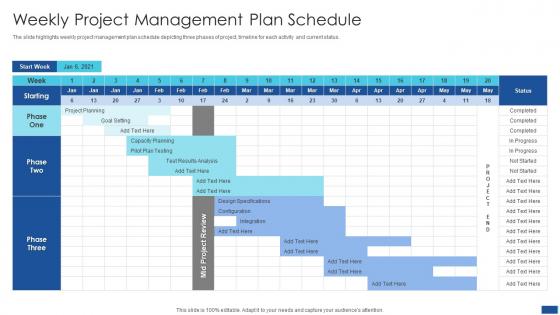
Weekly Project Management Plan Schedule




Try Before you Buy Download Free Sample Product
 Impress Your
 Audience
 100%
100% Editable
 Save Hours
 of Time


The slide highlights weekly project management plan schedule depicting three phases of project, timeline for each activity and current status.
People who downloaded this PowerPoint presentation also viewed the following :
Weekly Project Management Plan Schedule with all 6 slides:
Use our Weekly Project Management Plan Schedule to effectively help you save your valuable time. They are readymade to fit into any presentation structure.





FAQs for Weekly Project
So you'll need a solid task breakdown first - what needs doing and what each person delivers. Time estimates come next, but honestly, double whatever you think it'll take because stuff always goes sideways. Map out dependencies too - like what has to finish before other things can even start. Don't skip the milestones and buffer time! Figure out your critical path so you know which delays actually matter. Gantt charts look fancy but they're genuinely helpful for keeping everyone on the same page. Oh, and build in regular check-ins - you'll thank me later.
So the critical path is basically the longest chain of tasks that depend on each other - that's what sets your minimum project timeline. Map out all your tasks and dependencies, then add up the duration for each possible route. Whichever one takes longest? That's your critical path. Any delays there will push your whole deadline back (hence why they call it "critical"). Most PM tools like MS Project calculate this stuff automatically, thank god. I'd focus most of your attention on those critical path tasks since that's where things usually go sideways schedule-wise.
Honestly? Microsoft Project, Asana, and Monday.com are your best bets. If you're dealing with complex timelines, MS Project's Gantt charts are still unbeatable. But Asana's really stepped up their game for smaller teams lately. Monday.com has this visual thing going on that actually makes sense to people who aren't project managers - which is clutch when you need stakeholder buy-in. For simple stuff, Trello works fine too. Really depends on your team size though. Managing 50+ interconnected tasks? Go enterprise. Otherwise just pick whatever your team won't abandon after a week.
Hey! So basically, you can't get stuff done without people to actually do it, right? Limited resources mean your timeline gets stretched out or tasks get pushed back. Like when your best developer suddenly gets yanked onto some "emergency" project - boom, you're weeks behind schedule. More people can speed things up, but honestly there's a sweet spot where adding too many bodies just creates chaos. I always try to figure out the critical resources first and spot potential bottlenecks early. Then I pad the schedule because something will definitely go sideways.
Set up change control right away - seriously, scope creep will destroy you otherwise. Every time someone wants to add something, make them fill out a form showing how it impacts your timeline and budget. I learned this the hard way on my last project when "just one tiny feature" turned into three weeks of extra work. Always get written approval before you start any changes. Buffer time is crucial too - maybe 15-20% extra in your schedule. Use project management tools to track everything so you can actually show stakeholders how their "quick fixes" mess with your deadlines. Trust me, the visual proof helps when they get pushy.
Start by dumping all your tasks on paper, then figure out what has to happen before what else can start. Most of the time it's simple - finish Task A, then begin Task B. But some stuff can run at the same time, which is honestly where you save the most time. I've found Gantt charts super helpful for seeing the whole picture, though a basic spreadsheet works too if you're not feeling fancy. Here's the thing though - always pad extra time between connected tasks. Trust me on this one. Something will definitely take longer than you think it will.
Break your tasks down smaller first - way easier to estimate that way. Look at similar stuff you've done before instead of just winging it. Always pad your estimates because honestly, projects never go as smoothly as you think they will. The people actually doing the work should weigh in too, not just you guessing from your desk. Oh, and this is huge - start tracking how long things actually take vs what you estimated. That's how you get better at this over time. Seriously, begin documenting that comparison today.
Gantt charts are honestly a lifesaver - they turn your messy project into a visual timeline where you can see everything at once. No more scrolling through endless task lists trying to figure out what's due when. Dependencies become super obvious, and you'll spot bottlenecks before they wreck your deadline. When one task gets delayed, you can immediately see how it'll mess with everything else downstream. The progress bars filling up as you finish stuff is weirdly addictive too. Start with your critical path first, then build out the other tasks around it. Trust me on this one.
Dude, keeping stakeholders in the loop is literally what saves your timeline. I've seen too many projects crash because someone didn't speak up about delays early enough. Regular updates help you spot problems before they blow up everything. Also keeps people focused on what actually matters instead of adding random new stuff halfway through. Being upfront about realistic deadlines vs pipe dreams? That's huge for getting buy-in when you need to shift things around. Oh and consistent check-ins are way better than random updates when you remember to send them.
Oh man, yeah - cultural stuff can totally derail your timeline if you don't plan for it. Some teams treat deadlines like they're written in stone, others are way more flexible about it. Plus you've got different holidays, work styles, communication preferences... it adds up fast. I got burned on this German-Brazilian project last year where the approaches were completely opposite. Build in extra time upfront, that's my biggest tip. And actually talk to each team about how they work before you start. Sounds obvious but honestly most people skip that conversation. Trust me on this one!
Track Schedule Variance and SPI first - they'll tell you if you're screwed timeline-wise. Critical path stuff needs constant babysitting because one delay there kills everything downstream. I'm always checking percent complete vs what we planned, probably obsessively tbh. Milestone dates are huge for keeping stakeholders happy. Resource utilization matters too since team bottlenecks create the messiest schedule disasters. Oh, and set up some basic weekly dashboard so you catch issues early. Way easier than explaining to your boss why everything's suddenly two weeks behind.
Look for task dependencies first - those'll bite you every time. Resource bottlenecks are another red flag, plus anything with crazy tight deadlines or vague requirements. External vendors? Don't even get me started on those delays. Build buffer time into your critical path and have backup plans ready. Break big uncertain tasks down smaller - way easier to track. Weekly risk check-ins are a game changer, honestly. The trick is catching stuff before it blows up. Keep stakeholders in the loop about potential delays early, not when everything's already on fire.
So milestone tracking is like checking your project's heartbeat - you can see if you're gonna hit your big deadlines or not. I set them up as checkpoints where I pause and actually look at how things are going. Honestly, they're lifesavers for catching problems before they spiral out of control. Your stakeholders love them too since nobody wants updates on every little task you're doing. The best part? When you see a milestone coming up that you might miss, you can shift things around or cut some scope before it becomes a total mess.
Dude, agile is basically the opposite of those crazy detailed project plans that die after week one. You work in short 2-week sprints instead of mapping everything out upfront. Way more flexible since you're reassessing priorities constantly based on what actually happens. Still need deadlines obviously, but now you estimate with story points instead of hours - honestly took me forever to get used to that part. Your timeline shifts based on how fast your team moves. Try breaking your next project into 2-week chunks. You'll be amazed how much more you can pivot when stuff inevitably goes sideways.
Map your milestones straight to the company's quarterly goals - makes it super obvious to stakeholders why your project matters. Get leadership involved early when you're planning timelines. They'll spot conflicts with other big initiatives that you might miss. Honestly, I've watched so many projects crash because nobody bothered checking alignment first. Build in buffer time since organizational priorities love to shift around. Document how your deliverables actually support business outcomes (boring but necessary) and check in regularly with your sponsor. Oh, and don't forget to review this stuff often or you'll drift off course.
-
SlideTeam’s pool of 2Million+ PPTs has really benefited my team, everyone from the IT department to HR. We are lucky to have crossed ways with them.
-
Great designs, really helpful.