


Two Phase Timeline For Agile Project Management




Try Before you Buy Download Free Sample Product
 Impress Your
 Audience
 100%
100% Editable
 Save Hours
 of Time


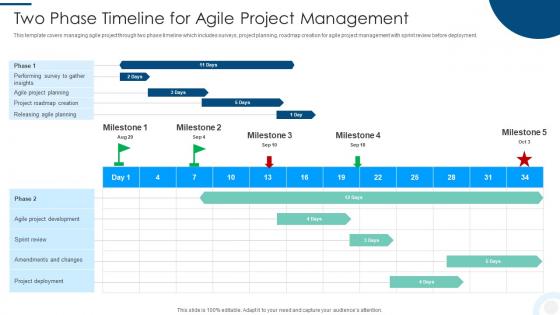
This template covers managing agile project through two phase timeline which includes surveys, project planning, roadmap creation for agile project management with sprint review before deployment.
People who downloaded this PowerPoint presentation also viewed the following :
Two Phase Timeline For Agile Project Management with all 6 slides:
Use our Two Phase Timeline For Agile Project Management to effectively help you save your valuable time. They are readymade to fit into any presentation structure.





FAQs for Two Phase Timeline For
Two Phase Agile Project Management includes discovery and delivery phases, strategic planning and iterative development cycles, stakeholder alignment sessions, risk assessment frameworks, and comprehensive documentation processes. This approach differs from traditional Agile by incorporating extensive upfront planning and analysis, enabling organizations to minimize project risks, enhance resource allocation, and deliver more predictable outcomes while maintaining Agile flexibility throughout execution phases.
Teams ensure effective communication between agile phases through regular cross-phase retrospectives, shared documentation platforms, overlapping sprint reviews, and designated phase transition ceremonies that capture lessons learned. These practices streamline knowledge transfer by maintaining consistent stakeholder involvement, establishing clear handoff protocols, and creating continuous feedback loops, with many organizations finding that structured phase bridges ultimately deliver seamless project continuity and enhanced team alignment.
Stakeholder involvement is critical throughout Two Phase Agile Project Management, with discovery phase requiring intensive collaboration for requirements gathering, vision alignment, and risk assessment, while execution phase emphasizes continuous feedback, sprint reviews, and adaptive decision-making. This strategic engagement enables organizations to minimize costly changes, accelerate delivery timelines, and ultimately deliver solutions that meet evolving business needs.
Risk management integrates into both Agile phases through continuous identification, assessment, and mitigation strategies embedded within iterative workflows, daily standups, and sprint retrospectives. During planning phases, teams establish risk registers and mitigation protocols, while execution phases utilize real-time monitoring and adaptive responses, with many software development and financial services organizations finding that this dual-phase approach significantly reduces project failures and enhances delivery predictability.
Transition success evaluation techniques include milestone assessments, stakeholder feedback sessions, deliverable quality reviews, timeline adherence analysis, and risk mitigation effectiveness measurements. These methodologies enable project managers to identify gaps, optimize workflows, and ensure seamless phase handoffs, with many organizations finding that structured evaluation frameworks ultimately deliver improved project outcomes and enhanced team performance.
The Two Phase Agile approach enhances team dynamics by creating distinct discovery and delivery phases, enabling clearer role definition, improved collaboration, and strategic planning integration. This structure allows product owners to focus on validation during discovery while development teams concentrate on implementation during delivery, ultimately streamlining workflows and reducing ambiguity, with many organizations finding that teams experience better alignment and reduced context switching.
Common challenges include managing phase transitions, aligning stakeholder expectations across different delivery cycles, maintaining team momentum between phases, coordinating dependencies, and balancing flexibility with structured planning requirements. These implementation hurdles often affect organizations in sectors like software development and product manufacturing, where teams find that establishing clear communication protocols, defining phase-specific success metrics, and maintaining cross-functional collaboration ultimately delivers smoother transitions and enhanced project outcomes.
Metrics in two-phase agile project management include velocity tracking, sprint completion rates, defect density, customer satisfaction scores, and business value delivered. These measurements enable teams to monitor development efficiency, quality standards, and stakeholder alignment across both phases, with many organizations finding that consistent metric application ultimately delivers improved project predictability and enhanced team performance optimization.
Tools for Two Phase Agile Project Management include Jira, Azure DevOps, Monday.com, Asana, and Trello, which streamline sprint planning, backlog management, and cross-phase coordination. These platforms enhance team collaboration by automating workflow transitions, providing real-time progress tracking, and enabling seamless communication between discovery and delivery phases, ultimately delivering improved project visibility and faster time-to-market for organizations.
Customer feedback directly shapes both discovery and delivery phases by validating assumptions, refining requirements, and prioritizing feature development through continuous stakeholder engagement. Organizations using this framework integrate feedback loops at sprint boundaries, conduct regular user testing sessions, and adjust backlog priorities, with many finding that early customer validation reduces development costs by 40% while significantly enhancing final product market fit.
Sprint planning best practices within Two Phase Agile include defining clear sprint goals aligned with phase objectives, conducting thorough backlog refinement, estimating user stories collaboratively, and establishing realistic capacity planning. These practices enhance team coordination by ensuring sprint deliverables support broader phase milestones, maintaining stakeholder alignment, and enabling seamless transitions between exploration and execution phases, ultimately delivering predictable outcomes and sustained project momentum.
Organizations can train teams for Two Phase Agile through structured workshops, hands-on simulation exercises, mentorship programs, and iterative practice sessions focused on phase transitions. Companies like financial services firms and healthcare organizations successfully implement cross-functional training modules, combining traditional project management principles with agile frameworks, ultimately delivering enhanced team collaboration and streamlined project delivery cycles.
Two Phase Agile Project Management offers enhanced strategic planning, clearer milestone definition, improved risk management, and better stakeholder alignment compared to traditional Agile frameworks. This approach enables organizations to balance long-term vision with iterative execution, with many enterprises in finance and healthcare finding that structured phases deliver more predictable outcomes while maintaining Agile flexibility and responsiveness.
Documentation management during two-phase agile projects involves creating living documents that evolve with each iteration, maintaining centralized repositories for real-time collaboration, and establishing clear versioning protocols. Teams streamline this process through automated documentation tools, regular sprint reviews that update requirements, and cross-functional workshops, ultimately delivering improved project transparency and faster decision-making across development cycles.
Two Phase Agile proves particularly valuable in software development, healthcare system implementations, financial services modernization, and complex manufacturing projects where requirements often evolve mid-stream. Industries like banking, telecommunications, and enterprise software companies find this approach especially effective for managing regulatory compliance alongside innovation demands, ultimately delivering faster time-to-market while maintaining quality standards.
-
I was confident and well prepared for my presentation for the first time ever. With SlideTeam’s templates, I could deliver one of my best presentations. Will be coming back for more!
-
Happy to incorporate such stunning templates in my presentation. Made my presentation look professional and engaging.