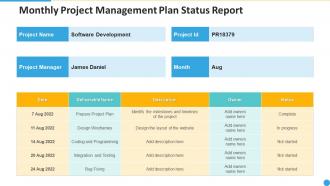
Monthly project management plan status report
Try Before you Buy Download Free Sample Product
Audience
Editable
of Time
Our monthly project management plan status report are topically designed to provide an attractive backdrop to any subject. Use them to look like a presentation pro.
People who downloaded this PowerPoint presentation also viewed the following :
Monthly project management plan status report with all 9 slides:
Use our monthly project management plan status report to effectively help you save your valuable time. They are readymade to fit into any presentation structure.
FAQs for Monthly project management
Key phases include project initiation, planning, execution, monitoring and controlling, and project closure. These phases streamline organizational efficiency by defining clear objectives, allocating resources strategically, and tracking progress systematically, with many companies finding that structured lifecycle management reduces costs, accelerates delivery timelines, and ultimately delivers competitive advantage.
Effective communication strategies enhance project outcomes by establishing clear expectations, facilitating real-time collaboration, and ensuring stakeholder alignment throughout project lifecycles. These approaches streamline decision-making processes, minimize costly misunderstandings, and accelerate problem resolution, with many organizations finding that structured communication protocols ultimately deliver improved project timelines and enhanced team productivity.
Stakeholder engagement ensures project alignment with business objectives, secures necessary resources, manages expectations, and facilitates smooth decision-making throughout project lifecycles. Through regular communication and collaborative planning, project managers build support, minimize resistance, and address concerns proactively, with many organizations finding that engaged stakeholders significantly improve project success rates and deliver sustained competitive advantage.
Project managers can effectively manage scope creep through clear initial requirements documentation, formal change request processes, regular stakeholder communication, and continuous project monitoring. By establishing robust approval workflows, maintaining detailed project baselines, and conducting frequent scope reviews, organizations streamline project delivery while controlling costs, with many finding that proactive scope management ultimately delivers improved timeline adherence and enhanced client satisfaction.
Best practices for risk assessment and management include comprehensive risk identification, probability and impact analysis, risk register maintenance, mitigation strategy development, and continuous monitoring throughout project lifecycles. These approaches streamline project delivery by enabling proactive planning, resource allocation, and stakeholder communication, with many organizations finding that structured risk frameworks ultimately reduce costs, prevent delays, and enhance project success rates.
Agile excels for dynamic projects requiring frequent iteration and stakeholder feedback, while Waterfall suits projects with well-defined requirements and sequential phases like construction or manufacturing initiatives. Many organizations adopt hybrid approaches, combining Agile's flexibility for development phases with Waterfall's structure for planning and deployment, ultimately enabling teams to optimize timelines, enhance collaboration, and deliver superior project outcomes across diverse industries.
Essential project management tools include task management platforms like Asana and Monday.com, communication software such as Slack and Microsoft Teams, scheduling tools like Gantt charts, resource allocation systems, and collaborative document platforms. These technologies streamline workflow coordination, enhance team transparency, and automate progress tracking, with many organizations finding that integrated software suites ultimately deliver faster project completion and improved resource efficiency.
Team dynamics significantly influence project performance through communication patterns, collaboration effectiveness, trust levels, decision-making processes, and conflict resolution approaches. Strong team dynamics enable faster problem-solving, improved resource allocation, and enhanced innovation, with many organizations finding that cohesive teams deliver projects 25% faster while maintaining higher quality standards and stakeholder satisfaction.
Common project execution challenges include scope creep, resource constraints, communication breakdowns, timeline delays, and stakeholder misalignment. These obstacles can be mitigated through clear change management protocols, strategic resource allocation, and regular stakeholder communication, with many organizations finding that proactive risk assessment and adaptive planning ultimately deliver improved project outcomes and enhanced operational efficiency.
Data analytics enhances project management decision-making by providing real-time performance insights, predictive risk modeling, resource optimization analysis, and stakeholder behavior patterns. Through advanced dashboard systems and AI-driven forecasting, project managers can identify bottlenecks earlier, allocate resources more strategically, and adjust timelines proactively, ultimately delivering projects faster and more cost-effectively.
Critical success factors for project delivery include clear scope definition, realistic timeline planning, effective resource allocation, stakeholder communication, and proactive risk management. These elements work together by establishing project boundaries, ensuring adequate staffing and materials, maintaining transparency across teams, and identifying potential issues early, with many organizations finding that consistent monitoring and adaptive planning ultimately deliver competitive advantage through reliable project outcomes.
Project managers can foster continuous improvement by establishing regular retrospectives, encouraging open feedback, implementing lessons learned databases, and recognizing team innovations. Through creating psychological safety and structured improvement processes, teams increasingly identify inefficiencies, propose solutions, and implement changes, with many organizations finding that this approach delivers enhanced productivity, higher quality deliverables, and stronger team engagement.
Project success measurement methods include stakeholder satisfaction surveys, budget variance analysis, quality metrics assessment, business value realization tracking, and team performance evaluations. These comprehensive approaches enable organizations to evaluate projects holistically, with many companies finding that combining financial outcomes, customer feedback, and strategic alignment delivers deeper insights into project effectiveness and long-term competitive advantage.
Project documentation is crucial for maintaining project clarity, ensuring stakeholder alignment, tracking progress, and facilitating knowledge transfer across teams. Essential components include project scope, timelines, resource allocation, risk assessments, communication plans, and deliverable specifications, with many organizations finding that comprehensive documentation streamlines decision-making, reduces costly miscommunications, and enables seamless project handoffs, ultimately delivering greater operational efficiency and successful outcomes.
Essential leadership qualities for effective project management include clear communication, strategic decision-making, adaptability, team motivation, and stakeholder management capabilities. These qualities enable project managers to navigate complex timelines, resource constraints, and team dynamics, with many organizations finding that leaders who combine technical expertise with emotional intelligence deliver projects on time, within budget, and ultimately drive competitive advantage.
-
Unique research projects to present in meeting.
-
Excellent Designs.
-
Innovative and Colorful designs.