


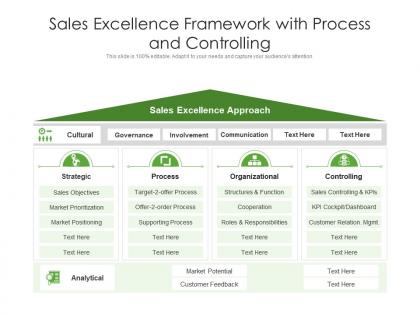
Sales excellence framework with process and controlling




Try Before you Buy Download Free Sample Product
 Impress Your
 Audience
 100%
100% Editable
 Save Hours
 of Time


Our Sales Excellence Framework With Process And Controlling are topically designed to provide an attractive backdrop to any subject. Use them to look like a presentation pro.
People who downloaded this PowerPoint presentation also viewed the following :
Sales excellence framework with process and controlling with all 2 slides:
Use our Sales Excellence Framework With Process And Controlling to effectively help you save your valuable time. They are readymade to fit into any presentation structure.
FAQs for Sales excellence framework with
Honestly, start by mapping out what you're already doing sales-wise - that'll show you the gaps. You need a solid process with clear stages, plus decent lead qualification so your team isn't chasing garbage prospects. CRM tracking is huge (I know, boring but necessary). Regular coaching makes a massive difference too. Territory management and competitive intel are also key pieces. The thing is, you can't just pick the fun parts - it's all connected. If you're missing one component or half-assing it, the whole framework kinda falls apart. Performance metrics keep everyone honest quarter to quarter.
Track your leading and lagging indicators - you need both. Revenue stuff first: sales growth, deal velocity, conversion rates. Those are obvious but crucial. Then look at pipeline quality, rep productivity, customer engagement scores. Oh and sales enablement adoption rates (seriously, most teams ignore this). Set up a dashboard that shows trends, not just monthly snapshots - way more useful. I'd do monthly reviews with your team, quarterly with leadership. Helps you actually spot patterns instead of just reacting to whatever's happening right now.
Think of sales training as what actually builds up your team's skills within the whole framework. It's way more than just those boring workshops nobody wants to sit through - we're talking continuous learning that targets the specific competencies your framework lays out. Most companies weave this into onboarding, regular coaching, and focused modules that fill performance gaps. The framework helps standardize your sales process but also lets you customize development for each rep. Honestly, I'd start by comparing your current training to the framework's competency model. That'll show you exactly what's missing.
Honestly, tech can totally transform your sales framework - just don't try to do everything at once. Start with a solid CRM to track all your customer interactions, then add AI analytics that actually show you what's working (and what isn't). Automated workflows are a game changer for keeping deals moving without you babysitting every step. Oh, and those sales enablement platforms? Way better than those mind-numbing quarterly training sessions nobody remembers anyway. The trick is making sure all your tools talk to each other - otherwise you're just creating more work for yourself. Pick one main platform first, then build around it.
Dude, the worst thing companies do is try to roll out everything at once. Start small! Also your sales team will hate it if they think it's just another management fad getting shoved down their throats. I've watched so many good frameworks crash and burn because nobody got the team on board first. Oh, and don't just copy what works for other industries - SaaS tactics won't work if you're selling heavy machinery or whatever. Pick one piece that'll give you quick wins, then build from there. Way less painful that way.
Map your sales goals straight to what the business actually needs. New markets? Focus training on prospecting and territory stuff. Here's the thing though - make sure you're tracking metrics that matter to leadership, not just numbers that make pretty charts (been guilty of that myself). Everything should connect: training, comp plans, reviews. I'd grab coffee with your exec team every quarter - literally just ask them "what do you need from sales this year?" Then design around that. Sounds obvious but you'd be surprised how many teams skip this step.
Track your activity stuff first - call volume, emails sent, pipeline you're building, conversion rates between stages. Revenue and quota hits are obvious outcomes to watch. Deal size matters too, plus how long your sales cycles run and if customers actually stick around. Customer satisfaction scores are honestly underrated - separates the decent reps from the rockstars. Same with forecast accuracy. You want leading indicators (the activities) mixed with lagging ones (actual results) so you can coach before things go sideways instead of scrambling after someone already missed their numbers.
Customer feedback is honestly what makes or breaks your sales process. Your clients know way better than you do what's actually working - so listen to them. Collect feedback after every win and loss (yeah, even the painful ones). Then use those insights to tweak your approach. Maybe your pitch needs work, or your follow-up timing is off. Sometimes you'll realize you need to completely flip how you present solutions. The key is being systematic about it rather than just hoping things improve. Think of feedback as your roadmap for getting better at sales.
Look, start with your executives actually walking the walk - if they're not showing sales excellence, nobody else will. Don't do those terrible one-off training sessions everyone hates. Instead, build coaching into regular manager check-ins, not just performance reviews. Here's what most companies screw up: they only reward hitting numbers instead of rewarding the right behaviors. Also celebrate wins publicly but actually learn from the failures too. Oh, and stop ignoring team collaboration for individual metrics - that's backwards. First step? Figure out what behaviors you're accidentally rewarding right now.
Honestly, your sales leaders have to be all-in on this or it'll flop hard. They can't just announce the new framework and disappear - they need to actually use it themselves and show up to training sessions. Weekly one-on-ones should focus specifically on how reps are applying the framework, not just pipeline reviews. Also, you'll probably need to tweak comp plans to reward adoption alongside revenue (which is kinda obvious but gets overlooked). The whole thing falls apart without consistent coaching from managers. I've seen so many "revolutionary" frameworks turn into expensive paperweights because leadership treated them like set-it-and-forget-it solutions.
Honestly, most coaching sucks because it's way too theoretical. Do weekly 1:1s with real-time feedback instead. Role-play using actual deals from your pipeline - not some made-up scenarios. I'd focus on whatever skill gaps you're seeing from call reviews and CRM data. Like if someone's struggling with price objections, practice those specific objections they're actually hearing. Always tie it back to revenue goals too. Oh and definitely use your pipeline analysis to guide these conversations - that's where you'll find the real issues. Start with weekly sessions if you're not already doing them.
So here's the deal - most companies just focus on what's screwing them up the most. Tech bros love quick demos and proving their stuff actually works. Manufacturing? They're all about relationships and super long nurturing (makes sense honestly). Healthcare is a nightmare with compliance - those sales cycles drag forever. Financial services throws in tons of trust-building since nobody wants to get burned. You gotta figure out where your customers get stuck and what weird decisions they make. Map your customer journey first, then mess with the stages until it fits. Oh and the metrics too - don't forget those.
Look, data analytics is basically your cheat sheet for crushing sales numbers. You can see which leads actually convert, track what your best salespeople do differently, and figure out where deals are falling through the cracks. Honestly, once you start digging into the patterns, it's kind of addictive. The whole thing helps you focus on the right prospects instead of chasing dead ends. Plus you'll get better at predicting which months will be strong or weak. Just pick one metric that affects your close rate first - don't try to analyze everything at once.
Honestly, just start with quarterly check-ins where you actually look at the numbers. Your sales team will be brutally honest about what's broken if you ask them - they're dealing with this stuff daily. I'd track conversion rates, how fast deals are moving, and rep performance against whatever goals you set up initially. Here's the thing though: don't wait around for some massive overhaul. Make tiny tweaks as you go. Like, pick one piece of your framework this month and create a simple way to get feedback on it. Way less overwhelming that way.
Honestly, cultural differences will mess with you more than you think. Sure, language barriers are a pain, but it's the subtle stuff that gets you - like how people build relationships or make decisions. What crushes it in New York? Total disaster in Tokyo. Your sales approach, messaging, everything needs to bend for each market. Training teams across different time zones while keeping things consistent is genuinely a nightmare. I'd figure out your core principles first - the stuff you won't budge on. Then make everything else flexible. Oh, and test small before going big. Saves you from expensive mistakes.
-
Colors used are bright and distinctive.
-
Great product with effective design. Helped a lot in our corporate presentations. Easy to edit and stunning visuals.
-
Commendable slides with attractive designs. Extremely pleased with the fact that they are easy to modify. Great work!