


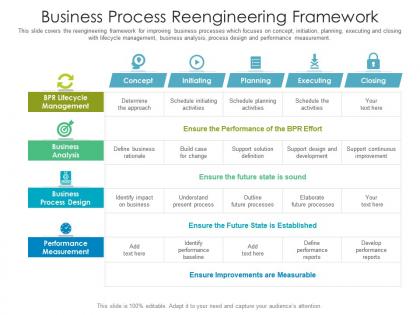
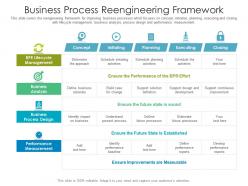
Business process reengineering framework




Try Before you Buy Download Free Sample Product
 Impress Your
 Audience
 100%
100% Editable
 Save Hours
 of Time


Our Business Process Reengineering Framework are topically designed to provide an attractive backdrop to any subject. Use them to look like a presentation pro.
People who downloaded this PowerPoint presentation also viewed the following :
Business process reengineering framework with all 2 slides:
Use our Business Process Reengineering Framework to effectively help you save your valuable time. They are readymade to fit into any presentation structure.

FAQs for Business
Start from scratch - seriously, don't just slap automation on your existing mess. Map out your whole process first and spot the biggest headaches. Put customers at the center of everything instead of obsessing over individual tasks. Honestly, most companies waste so much time on stuff that adds zero value. Cut that out ruthlessly. Give your teams power to make calls where the work actually happens, and let tech support what you're doing (not drive it). I know it sounds like a lot, but think complete processes, not random tasks.
Honestly, start with the obvious stuff - compare your current performance to what competitors are doing and what customers actually expect. Major gaps in speed, cost, or quality? Red flag. Also check for overly complicated processes with tons of handoffs (those are usually the worst offenders). Watch for bottlenecks where work just sits there, high error rates, or redundant tasks. Customer complaints tell you a lot too. The real question is whether small tweaks will fix things or if you need to blow it up and start over. Map out your current flow first - you'll spot the biggest pain points pretty quick.
Dude, tech is basically what makes reengineering actually work. Without it, you're just shuffling papers around. Automation cuts out all those tedious manual steps. New software can totally streamline your workflows. Plus data analytics will show you bottlenecks you never even noticed before - that stuff is honestly eye-opening. But here's the thing: don't just throw technology at old processes and call it a day. Map out how you want things to work first, then pick the tech that'll get you there. Otherwise you're just putting expensive band-aids on broken systems.
Honestly, getting people to actually embrace change is the brutal part of reengineering. Start by explaining WHY you're doing this - people need to see the point. Get your key players involved early so they feel heard, not steamrolled. Training before launch is huge too. Most folks freak out when their daily routine gets flipped upside down (I mean, who doesn't?). Address their worries head-on and show what they'll gain from it. Try a pilot group first - way smarter than going full-scale and discovering problems later. Oh, and create ways for feedback throughout the process so you can pivot if needed.
Honestly, the worst mistake is trying to slap automation onto processes that are already messed up. Clean slate approach works way better. Leadership has to actually care too - can't just be lip service. And for the love of god, include the people who do this stuff every day in your planning! I've seen so many projects tank because nobody talked to the frontline workers. Communication is huge here. People freak out when they don't know what's happening. Get your executives on board first, build teams with different departments, then explain the why behind everything. Skip the corporate speak - just tell them how this actually helps.
Yeah, morale's gonna take a hit at first - people immediately think layoffs and hate having their whole routine flipped upside down. Can't blame them really. But if you're upfront about the why behind everything and actually get them involved in building the new processes, they'll come around. Nobody wants to feel like they're just getting steamrolled by change. I'd start small with a pilot group first, let them see some quick wins. Once people realize they're helping create the solution instead of just dealing with whatever gets thrown at them, engagement usually bounces back even stronger than before.
Track the obvious stuff first - cycle time, cost savings, error rates, customer satisfaction. Those numbers matter for getting buy-in later. But honestly? Employee feedback is just as crucial. I've watched "perfect" processes tank because nobody wanted to actually use them. Measure how complex things were before vs after too. Start collecting baseline data before you change anything - this part's annoying but you'll thank yourself later. Then check monthly for at least six months since weird issues sometimes pop up weeks later. Oh, and if compliance was part of your goals, definitely track that improvement too.
Don't wait until the end to ask customers what they think - that's a rookie mistake I've seen way too many times. Survey them first about what's driving them crazy with the current system. Those pain points become your roadmap. During the actual redesign, run pilot programs or beta tests so you can catch problems early. Most teams completely skip this step and kick themselves later. You want both the numbers (satisfaction scores) and the stories (interviews, focus groups). Treat customers like they're helping you build this thing, not just using it. Check in regularly and actually do something with their feedback.
Okay so basically - reengineering means you're throwing out everything and starting completely over. Continuous improvement is just tweaking what you already have bit by bit. Like, imagine you're trying to fix your morning routine. Continuous improvement would be setting your alarm 10 minutes earlier or prepping clothes the night before. Reengineering? You'd totally restructure everything - maybe work from home instead of commuting, meal prep on Sundays, whatever. I'd say go with reengineering when your current system is genuinely broken beyond repair. Otherwise continuous improvement is way less risky and honestly easier to stick with long-term.
Honestly, small businesses have a huge advantage here - you can pivot way faster than big corporations. Map out your worst process first (like customer onboarding or order fulfillment) and spot where things get stuck. You don't need some massive tech budget either. Just tackle one process, cut the redundant crap, and automate whatever you can afford. While giant companies are still sitting in meetings arguing about changes, you'll already have faster service running. Your customers will definitely notice the difference before your competitors even get started. Start with whatever's causing you the biggest headache.
Dude, cross-functional teams are seriously the way to go for reengineering stuff. Different departments see things you'd totally miss - like where processes get stuck or duplicated for no reason. Marketing might catch something finance never would, you know? The whole flow becomes clearer when you're not stuck in one silo. Implementation goes so much better too since everyone's already invested in the changes. Oh, and make sure you grab someone from every single department that deals with whatever you're fixing. Trust me on this one - skipping even one group usually bites you later.
Dude, manufacturing and finance are killing it with reengineering. Ford and Toyota basically rebuilt how they make cars from scratch. Banks too - they've completely changed loan approvals and customer stuff. Healthcare's had some huge wins, but honestly they were such a mess before that anything helped lol. Retail and telecom have done pretty well also. Oh, and if you're thinking about this for your company? Start with whatever takes forever and involves like 5 different departments. That's usually where you'll see the biggest impact right away.
Honestly, data is what saves you from making dumb decisions based on hunches. Map out your current processes with real numbers first - you'll probably find bottlenecks in weird places you never expected. I've watched so many reengineering projects crash because teams just winged it without solid metrics. The analytics show you which processes are actually bleeding money vs. the ones that just *feel* broken. You can test different scenarios and see potential ROI before you commit to anything major. Start there and let the data tell you where to focus your energy.
Honestly, reengineering changes everything about how you compete. It forces you to rebuild stuff around what customers actually want instead of whatever's easiest for your team. Most companies end up way more agile afterward - like, they can make decisions faster because all those information bottlenecks disappear. Here's what's crazy though: you'll probably discover new opportunities that were totally invisible when you were stuck in those messy old workflows. Speed becomes your biggest advantage, not just cutting costs. Oh, and don't treat this as a one-and-done thing. Keep tweaking processes so you can pivot when the market shifts.
Honestly, start with the problems everyone's already complaining about - like how Sarah wastes 3 hours every week on that stupid reporting process. Don't lead with corporate speak about "optimization." People need to see exactly how reengineering fixes their actual headaches. I learned this the hard way when my first pitch totally flopped because I sounded like a consultant. Give them real examples and deadlines. Then - and this is key - let them argue with you about it. Seriously. When people can push back and ask questions, they feel heard. Follow up in a few weeks so it doesn't just die.
-
Awesomely designed templates, Easy to understand.
-
Easy to edit slides with easy to understand instructions.
-
Awesomely designed templates, Easy to understand.
-
Awesome use of colors and designs in product templates.
-
Presentation Design is very nice, good work with the content as well.
-
Presentation Design is very nice, good work with the content as well.