

Business Process Outsourcing Powerpoint Presentation Slides




Try Before you Buy Download Free Sample Product
 Impress Your
 Audience
 100%
100% Editable
 Save Hours
 of Time


Boost business productivity with the help of our professionally designed Business Process Outsourcing PowerPoint Presentation Slides. The presentation discusses the company’s current situation analysis, the need for offshoring, dealing with its difficulties. Present the details on offshoring models, company performance matrix, impact analysis, and so on with our modern-designed PPT templates. Depict four main offshoring models like own office, freelance, functional, dedicated with the help of BPO service PowerPoint layouts. Describe how the offshoring process works by mentioning the steps using content-ready PowerPoint themes. The slides allow you to present the cost incurred by the freelance offshoring model in graphical format. Discuss the impact of offshoring in the company by using content-ready PPT visuals. You can showcase the impact of offshoring on business performance by showcasing total revenue details and sales comparison. Leverage cost advantage and utilize new capabilities, skills, and strategies in the company by downloading our easy-to-use business process modeling PowerPoint slide deck.
People who downloaded this PowerPoint presentation also viewed the following :
Content of this Powerpoint Presentation
Slide 1: This slide introduces Business Process Outsourcing. Mention your Company name and begin
Slide 2: This slide shows Agenda of Offshoring
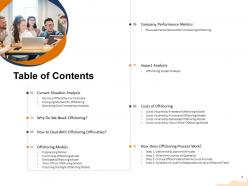
Slide 3: This slide displays Table of Contents.
Slide 4: This slide displays Table of Contents of the presentation.
Slide 5: This slide highlights Services offered by our Company
Slide 6: This slide covers the countries which will be best suitable to provide offshoring services to our company such as India, Philippines, China, Mexico, and Europe.
Slide 7: The table shows the operating cost comparison between the home country, country A and country B in million USD, wherein the home country is the most expensive.
Slide 8: The graph shows the operating cost comparison between the home country, country A and country B in million USD, wherein the home country is the most expensive.
Slide 9: This slide shows Table of Contents
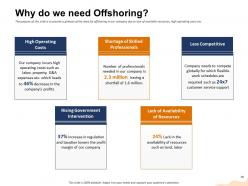
Slide 10: The purpose of this slide is to provide a glimpse of the need for offshoring in our company due to lack of available resources, high operating costs etc.
Slide 11: This slide displays Table of Contents.
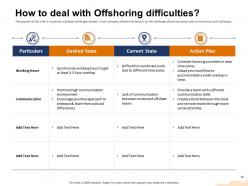
Slide 12: The purpose of this slide is to provide a glimpse of the gap analysis in our company wherein the focus is on the challenges faced and action plan to overcome such challenges.
Slide 13: This slide shows Table of Contents
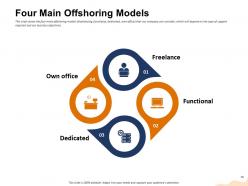
Slide 14: This slide shows the four main offshoring models (freelancing, functional, dedicated, own office) that our company can consider, which will depend on the type of support required and our business objectives.
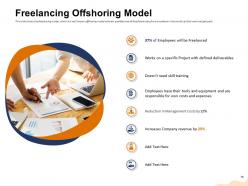
Slide 15: This slide shows the freelancing model, which is a well-known offshoring model wherein qualified and skilled freelancers from anywhere in the world can find work and get paid.
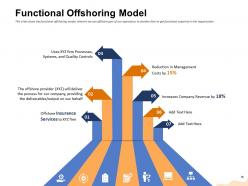
Slide 16: This slide shows the functional offshoring model, wherein we can offshore part of our operations to another firm to get functional expertise in the organization.
Slide 17: This slide shows the dedicated offshoring model which is effective, wherein we will build our team that will report directly to our head office.
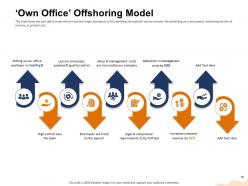
Slide 18: This slide shows the own office model which is used for larger businesses or for extending the team for various reasons like embarking on a new project, enhancing the line of services, or products etc.
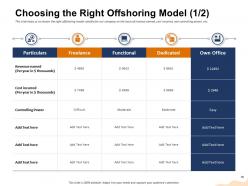
Slide 19: This slide helps us to choose the right offshoring model suitable for our company on the basis of revenue earned, cost incurred, and controlling power, etc.
Slide 20: This slide helps us to choose the right offshoring model suitable for our company to save long-term costs and maximizing our reach and value in the market.
Slide 21: This slide showcases Table of Contents
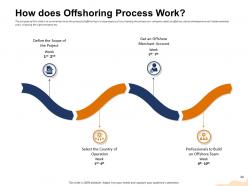
Slide 22: The purpose of this slide is to summarize the entire process of offshoring in unique steps such as choosing the process our company needs to offshore, devise development and implementation plan, choosing the right company etc.
Slide 23: This slide consists of the services and activities which our company would offshore such as customer interaction centers, insurance services, marketing services or provide internally such as data entry and conversion services, finance and accounting services etc.
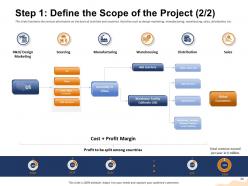
Slide 24: This slide illustrates the services distribution on the basis of activities and countries. Activities such as design marketing, manufacturing, warehousing, sales, distribution, etc.
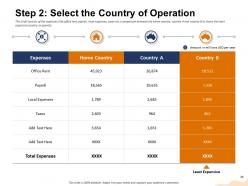
Slide 25: This slide consists of the expenses (like office rent, payroll, local expenses, taxes etc.) comparison between the home country, country A and country B to chose the least expensive country to operate.
Slide 26: This slide consists of the various offshore merchant account provider and one will be chosen who will offer best services to our company.
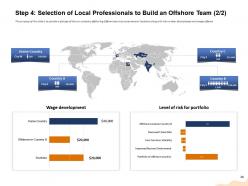
Slide 27: This slide provides the points for building an offshore team including the roles offered and the number of employees to be appointed for a team which will digitally transform and upgrade the company’s operations.
Slide 28: The purpose of this slide is to provide a glimpse of the our company offshoring different services across several locations along with the number of employees and wages offered.
Slide 29: This slide shows Table of Contents
Slide 30: This graph provides the detail of the expenses incurred by the company due to the freelancers every year.
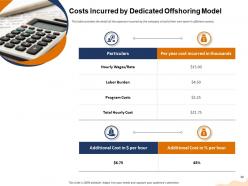
Slide 31: This table provides the detail of the expenses incurred by the company due to the different projects assigned to the outsource team.
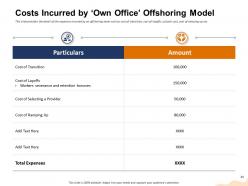
Slide 32: This table provides the detail of the expenses incurred by the company to build their own team in offshore country.
Slide 33: This slide provides the detail of the expenses incurred by an offshoring team such as cost of transition, cost of layoffs, cultural cost, cost of ramping up etc.
Slide 34: This slide shows Table of Contents.
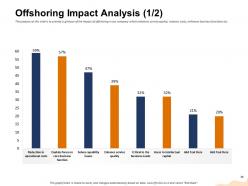
Slide 35: The purpose of this slide is to provide a glimpse of the impact of offshoring in our company which enhances service quality, reduces costs, enhances business functions etc.
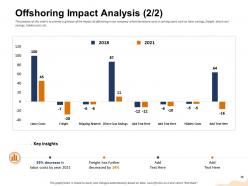
Slide 36: The purpose of this slide is to provide a glimpse of the impact of offshoring in our company which decreases costs in coming years such as labor savings, freight, direct cost savings, hidden costs etc.
Slide 37: This slide displays Table of Contents
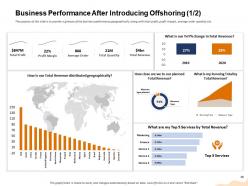
Slide 38: The purpose of this slide is to provide a glimpse of the business performance geographically along with total profit, profit margin, average order quantity etc.
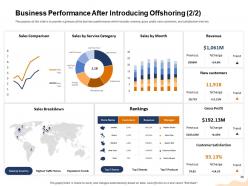
Slide 39: The purpose of this slide is to provide a glimpse of the business performance which includes revenue, gross profit, new customers, and satisfaction level etc.
Slide 40: This is Business Process Outsourcing Icons Slide
Slide 41: This slide is titled as Additional Slides for moving forward.
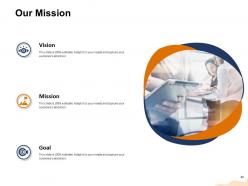
Slide 42: This slide displays Vision, Mission and Goals.
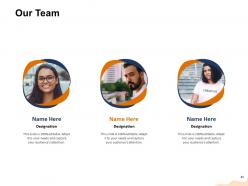
Slide 43: This is Our team slide with Names and Designations.
Slide 44: This slide is titled as Post it Notes
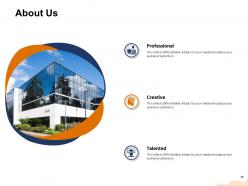
Slide 45: This is About Us slide with Company specifications.
Slide 46: This slide shows Business Offshoring Roadmap
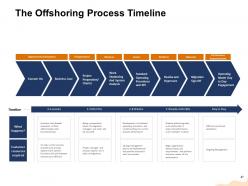
Slide 47: The slide shows Offshoring Process Timeline
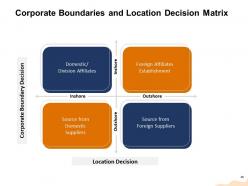
Slide 48: This slide highlights Corporate Boundaries and Location Decision Matrix
Slide 49: This is 30 60 90 Plan of Action slide.
Slide 50: This slide displays Monthly Timeline with Task Name
Slide 51: This is Thank You slide with Contact details.
Business Process Outsourcing Powerpoint Presentation Slides with all 51 slides:
Use our Business Process Outsourcing Powerpoint Presentation Slides to effectively help you save your valuable time. They are readymade to fit into any presentation structure.















FAQs for Business Process Outsourcing
Honestly, the money you'll save is huge – way cheaper than hiring full-time people for stuff like accounting or customer service. What I love about it is you get these experienced teams who actually know what they're doing, without all the HR drama and benefits costs. Frees you up to focus on the important stuff instead of drowning in paperwork. Oh, and don't go crazy at first – try outsourcing just one thing to see how it goes. You can always expand later once you're comfortable with how they work.
Honestly, BPO is pretty smart when you think about it. You hand off all the boring, repetitive stuff to companies that literally do it all day - so they're faster and way cheaper than doing it in-house. They've got the fancy tech, round-the-clock teams, all that infrastructure you'd never want to pay for yourself. Your people can actually focus on the stuff that grows your business instead of drowning in paperwork or whatever. I'd start by looking at which processes eat up the most time but aren't really what makes you money, you know?
Most people outsource customer service, IT support, accounting, HR stuff, and data entry. Honestly, call centers are probably the biggest one - way cheaper labor costs overseas. Data entry's another no-brainer since it's mind-numbing work nobody wants to do in-house. Companies also dump payroll processing because it's complicated but not really their main thing, you know? Same with IT support - you need those skills but can't afford a full team. The whole point is saving money and letting your actual employees focus on stuff that makes you money instead of getting bogged down in busywork.
Honestly, cultural stuff can totally make or break your BPO deal. Communication styles are huge - like how people give feedback or handle deadlines varies so much between cultures. Time zones already suck, but throw in language barriers and you're in for a headache. What works though is getting both teams trained on each other's work styles upfront. Be super clear about response times and meeting expectations from day one. Oh, and escalation processes too - that's where things usually go sideways. Once everyone gets the "why" behind different approaches, everything flows way better.
So basically, tech runs the whole BPO game now. Cloud systems handle all the data processing stuff, while AI takes care of boring tasks like data entry and basic customer questions. Analytics give you real-time performance updates too. Remote teams stay connected through collaboration tools - honestly can't imagine working without them anymore. Security protocols keep your sensitive info safe across different locations. Oh, and here's the thing - when you're shopping around for BPO providers, definitely grill them about their tech setup and what they've automated. That'll tell you everything you need to know about how smooth things will actually run.
Check their security certs first - SOC 2, ISO 27001, that kind of stuff. They better be encrypting everything and have proper access controls too. The companies that get burned? They always skipped doing their homework upfront. Write specific data handling rules into the contract - breach notifications, who's liable if things go south, all that. Oh and don't forget regular security audits. I know it sounds like overkill but you'd do this for your own team, right? Same standards should apply here.
You definitely need both the numbers stuff and the relationship side. Cost savings and SLAs are obvious starting points. Error rates matter too - nobody wants to deal with constant fixes. Your team's productivity boost is huge but people always forget to measure it for some reason. I'd set up scorecards for vendor performance and track how smooth communication flows between teams. Quality scores from customers tell you if it's actually working. Keep it simple though - maybe 5-6 key metrics max on a dashboard. More than that and you'll spend forever analyzing instead of fixing problems.
So BPO works because you're getting cheaper labor costs while these companies spread their overhead across tons of clients. They actually know what they're doing too - like, they eat, sleep, and breathe whatever process you're handing off. Way more expertise than your internal team probably has. Quality stays decent because they've got contracts and SLAs to hit, plus they don't want to lose you as a client. Just make sure you pick someone good and nail down your metrics from day one. Otherwise you'll get burned with that whole "we saved money but everything sucks now" thing that happens way too often.
Honestly, BPO comes with some real headaches. You'll lose control over your processes, which sucks. Data security breaches are always a risk too - vendors don't care about your info like you do. Quality can tank if they cut corners to save money. Communication gets messy, especially with different time zones. I've watched companies get burned when expectations weren't clear from day one. Plus you become dependent on them, so good luck if they jack up prices later or things go south. Hidden fees will definitely pop up. Do your homework on potential partners and nail down solid SLAs with specific metrics before signing anything.
First thing - figure out exactly what you want to outsource and what success looks like. When you're vetting companies, don't just pick the cheapest one (learned that lesson the hard way). Look at their experience in your industry and whether they actually get your business. Cultural fit matters more than people think. Check their security stuff and how they communicate - some are terrible at updates. Oh, and definitely call their references, don't just read testimonials. Start small with a pilot project before you sign anything big. That way you'll know if they're actually worth it.
Look, BPO hits morale hard if people think you're just cutting jobs or don't trust them to do the work. Some folks actually don't mind losing boring repetitive stuff though - frees them up for better projects. Communication is everything here. Tell your team what's getting outsourced and why, then show them real growth paths in their remaining roles. Skip this step and you'll watch productivity tank while good people bail. I've seen teams get way too paranoid about this. Get them involved early and focus on training them up, not just saving money.
Honestly, the timezone thing is brutal but you gotta nail down communication rules from day one. Pick regular check-in times that don't completely destroy someone's sleep schedule - though let's be real, somebody's gonna be tired. Slack or Teams for daily stuff works great, just document everything because things get lost super easily. Oh, and cultural differences mess you up way more than language barriers sometimes. Assign one main contact person per side too, otherwise it becomes total chaos with everyone messaging everyone.
So AI's basically eating up all the boring repetitive stuff now. Companies want specialists, not just cheap labor - the whole "save money at any cost" thing is kinda dead. Nearshoring is blowing up because honestly, nobody wants to deal with crazy time zones anymore. Cloud operations aren't even a trend, they're just how things work now. Oh, and everyone's shifting to paying for results instead of hours, which makes way more sense. Security rules are getting nuts though - like, everywhere you look there's new compliance requirements. When you're picking a BPO partner, focus on their automation game and security setup. That's where everything's moving.
BPO really depends on what field you're in. Healthcare stuff involves medical coding and claims processing - tons of regulations to deal with. Finance is all accounting, payroll, and compliance work (which honestly sounds like a headache). Retail BPO handles customer service and inventory management mostly. The main thing is how specialized each one gets. Like, you can't just grab any random BPO provider - they need actual experience in your specific industry, not just general business knowledge. Otherwise you'll probably end up regretting it.
Pick a vendor who actually knows your space - cheap isn't always smart here. Before you hand anything off, document your current processes like crazy. I learned this the hard way, but assumptions will absolutely wreck your timeline. Your team needs to know what's happening and when. Don't dump everything at once either - phase it out gradually. Set up KPIs and regular check-ins right from the start. Here's the thing though: keep some internal people who understand the work. You'll need them to oversee quality and handle the bigger strategic stuff down the road.
-
Excellent products for quick understanding.
-
Illustrative design with editable content. Exceptional value for money. Highly pleased with the product.
-
It saves your time and decrease your efforts in half.
-
Colors used are bright and distinctive.
-
Excellent design and quick turnaround.
-
Amazing product with appealing content and design.
-
Qualitative and comprehensive slides.
-
Presentation Design is very nice, good work with the content as well.