

Global Outsourcing Powerpoint Presentation Slides




Try Before you Buy Download Free Sample Product
 Impress Your
 Audience
 100%
100% Editable
 Save Hours
 of Time


Maximize the efficiency of operations with the help of our professionally designed Global Outsourcing PowerPoint Presentation Slides. The presentation discusses the current situation analysis of the company, the need for offshoring, dealing with offshoring difficulties, offshoring models, company performance matrix, impact analysis, and so on. Highlight four main offshoring models like own office, freelance, functional, dedicated with the help of business process outsourcing PowerPoint layouts. You can easily describe how the offshoring process works by mentioning the steps for the same using content-ready PowerPoint themes. The slides allow you to present the cost incurred by the freelance offshoring model in graphical format. Discuss the impact of offshoring in the company, It is possible to showcase the impact of offshoring on business performance by showcasing total revenue details and sales comparison. Leverage cost advantage and utilize new capabilities, skills, and strategies in the company by downloading our easy to use business process modeling PowerPoint slide deck.
People who downloaded this PowerPoint presentation also viewed the following :
Content of this Powerpoint Presentation
Slide 1: This slide introduces Global Outsourcing. State your Company name and begin.
Slide 2: This slide shows Agenda of Offshoring
Slide 3: This slide displays Table of Contents.
Slide 4: This slide displays Table of Contents of the presentation.
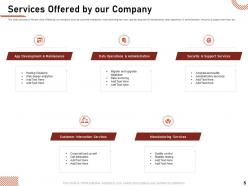
Slide 5: This slide highlights Services offered by our Company
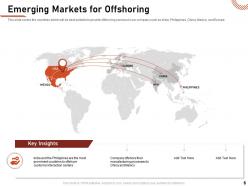
Slide 6: This slide covers the countries which will be best suitable to provide offshoring services to our company such as India, Philippines, China, Mexico, and Europe.
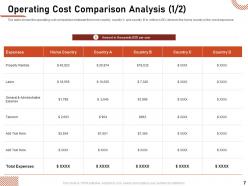
Slide 7: The table shows the operating cost comparison between the home country, country A and country B in million USD, wherein the home country is the most expensive.
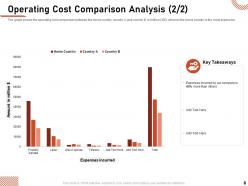
Slide 8: The graph shows the operating cost comparison between the home country, country A and country B in million USD, wherein the home country is the most expensive.
Slide 9: This slide shows Table of Contents
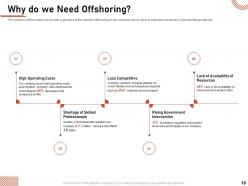
Slide 10: The purpose of this slide is to provide a glimpse of the need for offshoring in our company due to lack of available resources, high operating costs etc.
Slide 11: This slide displays Table of Contents.
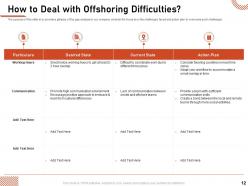
Slide 12: The purpose of this slide is to provide a glimpse of the gap analysis in our company wherein the focus is on the challenges faced and action plan to overcome such challenges.
Slide 13: This slide shows Table of Contents
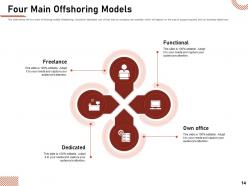
Slide 14: This slide shows the four main offshoring models (freelancing, functional, dedicated, own office) that our company can consider, which will depend on the type of support required and our business objectives.
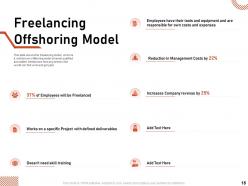
Slide 15: This slide shows the freelancing model, which is a well-known offshoring model wherein qualified and skilled freelancers from anywhere in the world can find work and get paid.
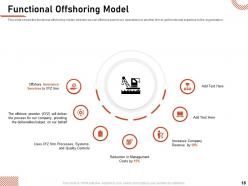
Slide 16: This slide shows the functional offshoring model, wherein we can offshore part of our operations to another firm to get functional expertise in the organization.
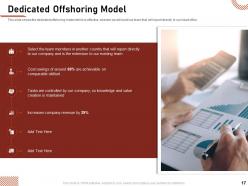
Slide 17: This slide shows the dedicated offshoring model which is effective, wherein we will build our team that will report directly to our head office.
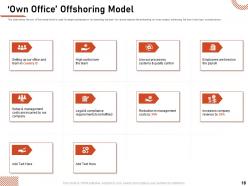
Slide 18: This slide shows the own office model which is used for larger businesses or for extending the team for various reasons like embarking on a new project, enhancing the line of services, or products etc.
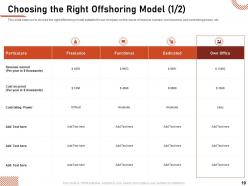
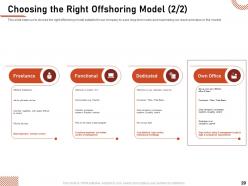
Slide 19: This slide helps us to choose the right offshoring model suitable for our company on the basis of revenue earned, cost incurred, and controlling power, etc.
Slide 20: This slide helps us to choose the right offshoring model suitable for our company to save long-term costs and maximizing our reach and value in the market.
Slide 21: This slide showcases Table of Contents
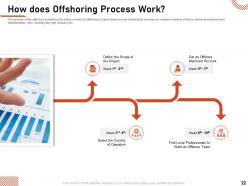
Slide 22: The purpose of this slide is to summarize the entire process of offshoring in unique steps such as choosing the process our company needs to offshore, devise development and implementation plan, choosing the right company etc.
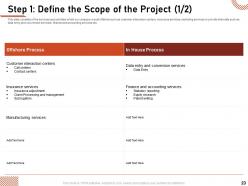
Slide 23: This slide consists of the services and activities which our company would offshore such as customer interaction centers, insurance services, marketing services or provide internally such as data entry and conversion services, finance and accounting services etc.
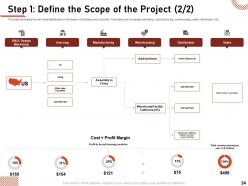
Slide 24: This slide illustrates the services distribution on the basis of activities and countries. Activities such as design marketing, manufacturing, warehousing, sales, distribution, etc.
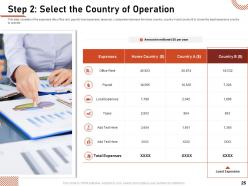
Slide 25: This slide consists of the expenses (like office rent, payroll, local expenses, taxes etc.) comparison between the home country, country A and country B to chose the least expensive country to operate.
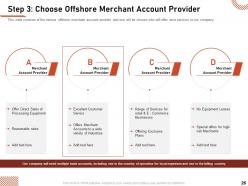
Slide 26: This slide consists of the various offshore merchant account provider and one will be chosen who will offer best services to our company.
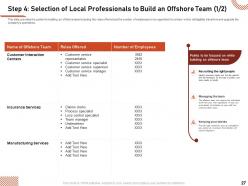
Slide 27: This slide provides the points for building an offshore team including the roles offered and the number of employees to be appointed for a team which will digitally transform and upgrade the company’s operations.
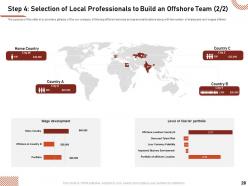
Slide 28: The purpose of this slide is to provide a glimpse of the our company offshoring different services across several locations along with the number of employees and wages offered.
Slide 29: This slide shows Table of Contents
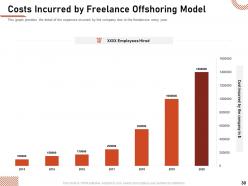
Slide 30: This graph provides the detail of the expenses incurred by the company due to the freelancers every year.
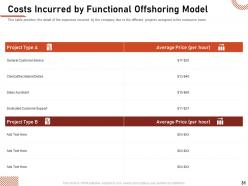
Slide 31: This table provides the detail of the expenses incurred by the company due to the different projects assigned to the outsource team.
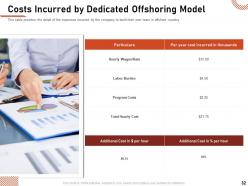
Slide 32: This table provides the detail of the expenses incurred by the company to build their own team in offshore country.
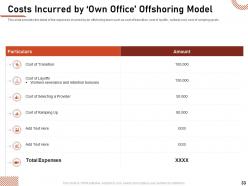
Slide 33: This slide provides the detail of the expenses incurred by an offshoring team such as cost of transition, cost of layoffs, cultural cost, cost of ramping up etc.
Slide 34: This slide shows Table of Contents.
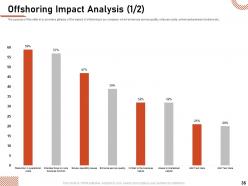
Slide 35: The purpose of this slide is to provide a glimpse of the impact of offshoring in our company which enhances service quality, reduces costs, enhances business functions etc.
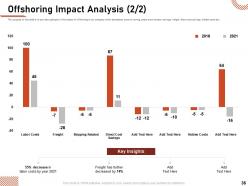
Slide 36: The purpose of this slide is to provide a glimpse of the impact of offshoring in our company which decreases costs in coming years such as labor savings, freight, direct cost savings, hidden costs etc.
Slide 37: This slide displays Table of Contents
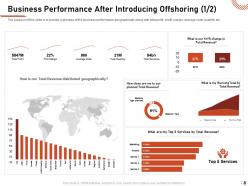
Slide 38: The purpose of this slide is to provide a glimpse of the business performance geographically along with total profit, profit margin, average order quantity etc.
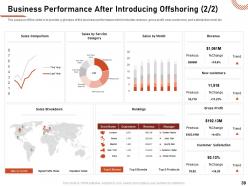
Slide 39: The purpose of this slide is to provide a glimpse of the business performance which includes revenue, gross profit, new customers, and satisfaction level etc.
Slide 40: This is Global Process Outsourcing Icons Slide.
Slide 41: This slide is titled as Additional Slides for moving forward.
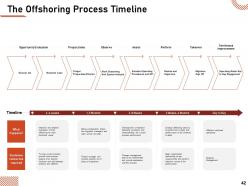
Slide 42: This slide shows The Offshoring Process Timeline
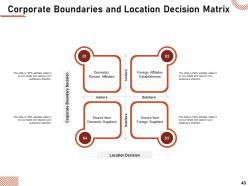
Slide 43: This slide showcases Corporate Boundaries and Location Decision Matrix
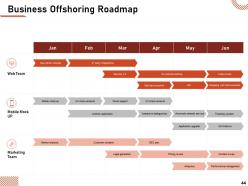
Slide 44: This slide displays Business Offshoring Roadmap.
Slide 45: This slide shows 30 60 90 Plan of Action
Slide 46: This is Monthly Timeline with Task Name slide.
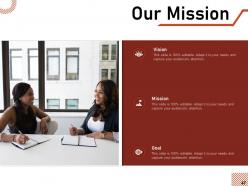
Slide 47: This slide displays Mission, Vision and Goals.
Slide 48: This is Our team slide with Names and Designations.
Slide 49: This is About us slide to showcase Company specifications.
Slide 50: This slide is titled as Post it Notes
Slide 51: This is Thank you slide with Contact details.
Global Outsourcing Powerpoint Presentation Slides with all 51 slides:
Use our Global Outsourcing Powerpoint Presentation Slides to effectively help you save your valuable time. They are readymade to fit into any presentation structure.



FAQs for Global Outsourcing
Honestly, the money you'll save is huge - we're talking 30-60% on labor costs. Philippines has amazing customer service teams, Eastern Europe's got all the AI talent you can't find here. Your offshore crew works nights so stuff gets done while you're sleeping, which is honestly genius. Frees up your team for the important stuff instead of boring tasks. Oh and don't go crazy right away - pick one thing to outsource first, see how it goes. You can always expand later once you figure out what works.
Focus on three main things: their tech skills, whether they'll mesh with your team, and if they can actually communicate well. Dig into their portfolio hard and call those references - don't just trust website testimonials. Time zones are honestly such a pain, so make sure there's decent overlap or they've got people who can work your hours. I always do a small test project first before jumping into anything big. Watch how they ask questions about your business during those early calls - that tells you a lot. Yeah, going super cheap usually backfires. You want someone who actually gets what you're trying to build.
Biggest headaches you'll run into: communication breakdowns, sketchy quality control, and data security nightmares. IP theft's another worry. Time zones are honestly the worst part - waiting half a day just to get a yes or no answer drives me crazy. Pick vendors with solid security track records and hammer out detailed contracts upfront. Set up regular check-ins so nothing falls through cracks. Start with small test projects first. Don't go all-in right away. If you can swing it, visit their actual offices - you'll learn more in two hours there than from weeks of emails back and forth.
Oh man, cultural stuff will absolutely torpedo your outsourcing if you're not careful. Communication styles are huge - what feels direct to you might come across as super rude to them. Their team probably takes forever building consensus while you're stressing about deadlines. Time zones? That's nothing compared to these misaligned expectations. I'd spend real time upfront learning how they work and set clear rules for feedback and meetings. Also conflict resolution - trust me on this one. You can't assume your good intentions land the same way across different cultures.
Honestly, tech has made global outsourcing so much easier than it used to be. Cloud platforms let everyone collaborate in real-time, which is huge. Project management stuff like Asana keeps track of everything without the chaos. Video calls actually work now too - remember when Skype was a pixelated nightmare? Communication apps and automated workflows help teams stay coordinated across time zones. AI translation tools are pretty solid for language barriers now. My advice? Pick simple tools your whole team will actually use. Don't go overboard with complicated software that'll just frustrate everyone.
Look, data security can totally make or break this decision. Check if they've got solid cybersecurity and follow rules like GDPR or HIPAA - different countries have weird privacy laws that'll give you headaches. A data breach could cost way more than you'd save (honestly, I've seen companies get burned by this). Before you sign anything, audit their security setup. Get detailed agreements about how they handle your data. Oh, and make sure there's a clear plan for if something goes wrong. Trust me, you don't want to deal with compliance violations later.
So first, nail down the obvious stuff - cost savings, quality scores, whether they're hitting deadlines and SLAs. That's your baseline data right there. But honestly? The relationship side matters just as much, maybe more. How's the communication flowing? Are your teams actually working well together, or does it feel forced? Track the risky stuff too - like how dependent you're getting on them and whether knowledge transfer is actually happening. Oh, and definitely measure things before you outsource so you can tell if it's working. Regular scorecards help, but mix the money stuff with how things actually feel day-to-day.
Ugh, the worst myth is that outsourcing = crappy work. I've literally seen outsourced teams blow internal ones out of the water. People think it's just about saving money too, but smart companies do it to tap into crazy specialized talent they can't find locally. Oh and the whole "communication nightmare because of time zones" thing? Total BS - I've worked with offshore teams that respond faster than my coworkers down the hall lol. You won't lose control either if you pick the right partner. Actually gives you better visibility into what's happening. Just figure out your real goals first beyond the obvious cost stuff.
Ugh, international labor laws are such a headache when you're setting up outsourcing deals. Every country has its own rules - minimum wage, work hours, how you can fire people, all that stuff. Your contracts have to follow whatever's local. Here's the thing that trips people up: you can't just say "not my problem" because you hired a vendor. You're still on the hook legally. I'd definitely put clauses in your contracts about following labor laws and make your partners agree to regular audits. Trust me, it's way better than dealing with violations later.
Honestly, the big thing right now is nearshoring - companies want partners closer to home for better time zones and less headaches. COVID totally changed that game. AI integration is huge too, obviously. But here's what's really different - clients don't just want cheap labor anymore, they want actual specialized skills and measurable ROI. Way more focus on cybersecurity now than even two years ago. Oh, and contracts are shifting to outcome-based instead of just paying for hours. If you're looking at partners, make sure they can show real security frameworks and actual results, not just promises.
Okay so first thing - be super clear about what you want from the start. Set up regular check-ins and use project management tools so you can actually see what they're doing. I got burned by a Ukrainian dev team once because we had zero communication structure... that was expensive lol. But here's what really matters: find partners who already have solid processes instead of trying to teach them yours later. Run a small test project first to see how they actually work. Some teams talk a good game but fall apart when it's crunch time. Always verify their work, even if you trust them.
Tech stuff is blowing up right now - everyone's scrambling for developers and IT people. Healthcare's massive too, especially medical coding and telehealth support. Customer service keeps growing steady, and manufacturing's actually coming back as companies spread out their supply chains post-COVID. Sure, cost savings matter, but honestly? Most companies just can't find the specialized skills locally anymore. If you're thinking about it, I'd look at what's sucking up your team's time that doesn't really need to be done in-house. That's usually where you'll see the biggest wins.
Honestly, you've gotta nail down how everyone talks to each other from day one. Pick some overlapping hours where people can actually chat in real time. Slack or Asana are lifesavers for keeping track of stuff. Document literally everything - trust me on this one. The cultural thing is huge too (learned that lesson the hard way when I accidentally offended half my team). Video calls beat emails every single time. Oh, and pick someone in each location to be your go-to person when communication gets weird or confusing.
Honestly, communication skills are your biggest priority here - you'll be juggling different time zones and work styles all day. Project management has to be on point because things get chaotic when you're coordinating multiple locations. Oh, and cultural awareness is actually way more important than people think. Your offshore team probably operates totally differently than you're used to. You'll also need solid contract negotiation skills since you're basically managing vendors. Technology comfort is a must for all the remote collaboration tools. Try to shadow someone experienced first if you can swing it - that's probably the best crash course you'll get.
Hey! So yeah, currency swings can totally screw with your outsourcing budget. Their currency drops? Great for you. Goes up? Ouch, your costs spike. Political drama or economic crashes over there usually mean project delays or shoddy work - honestly the worst combo. But here's the weird part: when they hit a recession, you might score better talent for less since more people are job hunting. My advice? Pad your budget for these swings and don't put all your eggs in one country's basket. Maybe split between like 2-3 regions so you're not riding their economic ups and downs.
-
Informative presentations that are easily editable.
-
Excellent design and quick turnaround.