

Business Process Reengineering Powerpoint Presentation Slides






Try Before you Buy Download Free Sample Product
 Impress Your
 Audience
 100%
100% Editable
 Save Hours
 of Time


Business Transition is a simple process, our business process reengineering PowerPoint presentation slides are graphical representation of this complete process. This change management process PPT template comprises of slides like types of change management, forces for change, gap analysis, vision statement, organizational change readiness, change management agents, roles of leadership in CM, role of team members, role of key stakeholders, Lewin’s three-stage change model, ADKAR model, bridge transition model, Szpekman’s communication framework, Roger’s technology adoption curve, risk and barriers, risk assessment etc. The organization can use this PPT graphics to pitch business transformation process with content ready templates such as risk matrix, resistance assessment survey, resistance to change, resistance management plan, implementation strategies, change transition plan, change transition curve, communication plan, CM training and timeline, sustaining momentum, change management cost, evaluation, results, performance dashboard. Download this change control process PowerPoint template to motivate your team to focus on adaptability. Boldly face challenges that emerge with our Business Process Reengineering Powerpoint Presentation Slides. They enable you to get into the fray.
People who downloaded this PowerPoint presentation also viewed the following :
Content of this Powerpoint Presentation
Slide 1: This slide introduces Business Process Reengineering with your company name. State it here to get started.
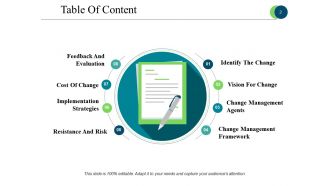
Slide 2: This slide showcases Table Of Content with the following points- Identify The Change, Vision For Change, Change Management Agents, Change Management Framework, Resistance And Risk, Implementation Strategies, Cost Of Change, Feedback And Evaluation.
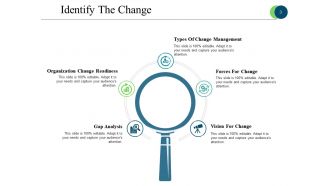
Slide 3: This is an Identify The Change slide showcasing the following with magnifying glass imagery- Types Of Change Management, Forces For Change, Vision For Change, Gap Analysis, Organization Change Readiness.
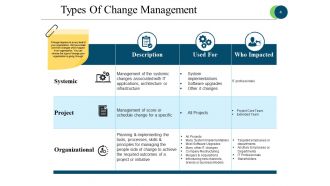
Slide 4: This slide showcases Types Of Change Management. We have listed common changes which happen in an organization. You can choose the type of change your organization is going through.
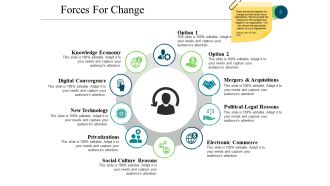
Slide 5: This slide displays Forces For Change in circular image form. These are- Mergers & Acquisitions, Political-Legal Reasons, Electronic Commerce, Social-Culture Reasons, Privatizations, New Technology, Digital Convergence, Knowledge Economy. We have listed few reasons for the changes that happen in an organization. You can choose the appropriate reason for your organization.
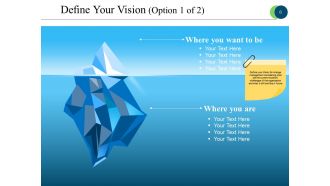
Slide 6: This is Define Your Vision slide with creative imagery. State your vision etc. here.
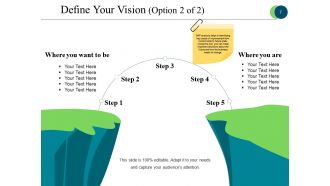
Slide 7: This is another Define Your Vision slide with GAP analysis.
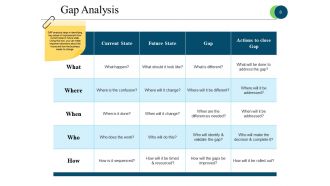
Slide 8: This slide displays Gap Analysis in tabular form.
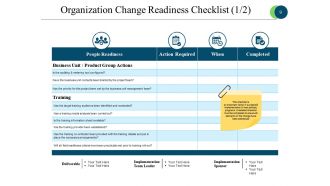
Slide 9: This slide displays Organization Change Readiness Checklist with People Readiness, Action Required, When and Completed as its measuremnt factors.
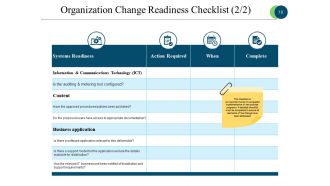
Slide 10: This is another slide displaying Organization Change Readiness Checklist.
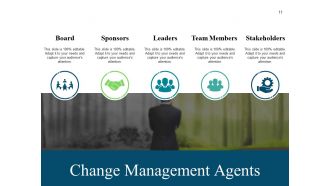
Slide 11: This slide showcases Change Management Agents with their respective icons. These are- Board, Sponsors, Leaders, Team Members, Stakeholders.
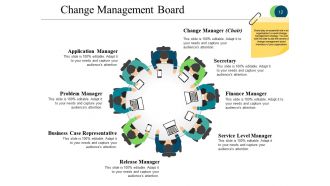
Slide 12: This slide displays Change Management Board. You can edit the slide to add the names of change management board members of your organization.
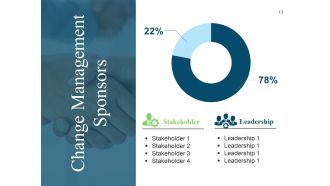
Slide 13: This slide states Change Management Sponsors majorly divided into- Stakeholder, Leadership.
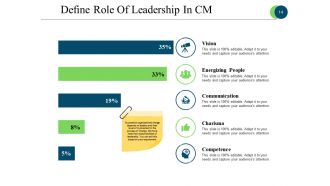
Slide 14: This is Define Role Of Leadership In CM slide. Its responsibilities are- Vision, Energizing People, Communication, Competence, Charisma. We have listed few responsibilities of leadership. You can edit this based on your requirement
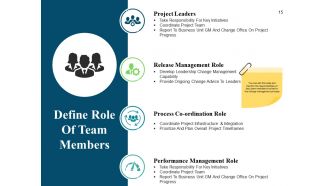
Slide 15: This is Define Role Of Team Members slide. You can edit this slide and mention the responsibilities of key team members involved in the change management process.
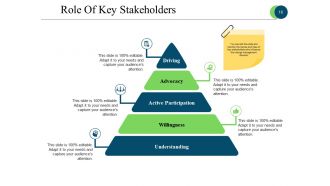
Slide 16: This slide states Role Of Key Stakeholders in triangular image form. These include- Driving, Advocacy, Active Participation, Understanding, Willingness.
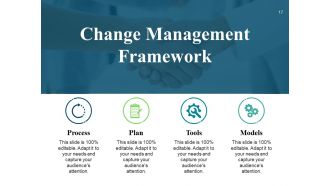
Slide 17: This slide displays Change Management Framework which includes- Process, Plan, Tools, Models.
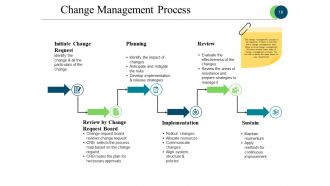
Slide 18: This slide displays Change Management Process with arrow imagery. Its steps are- Initiate Change Request, Review by Change Request Board, Planning, Implementation, Review, Sustain. You can add or delete the steps based on your requirement.
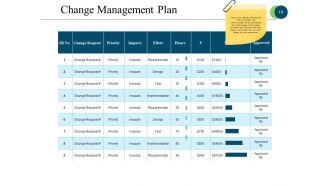
Slide 19: This slide displays Change Management Plan in a tabular form. You can edit it as per need.
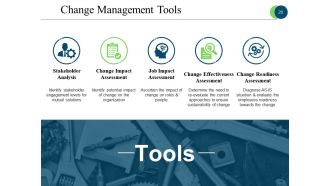
Slide 20: This slide showcases Change Management Tools which are- Stakeholder Analysis, Change Impact Assessment, Job Impact Assessment, Change Effectiveness Assessment, Change Readiness Assessment, Tools.
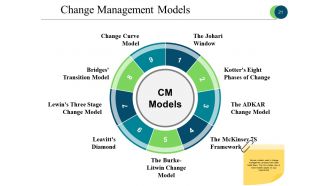
Slide 21: This slide displays Change Management Models in a circular form image.
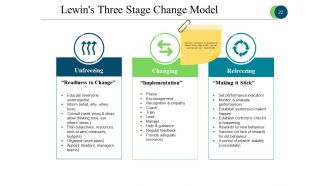
Slide 22: This slide displays Lewin's Three Stage Change Model. We have mentioned a framework of Lewin’s three stage model in this slide, you can use it as per your requirements.
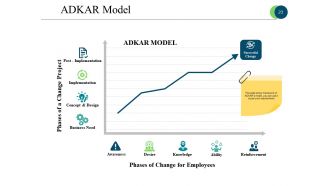
Slide 23: This is an ADKAR Model slide with a line chart/ graph. Use it as per need.
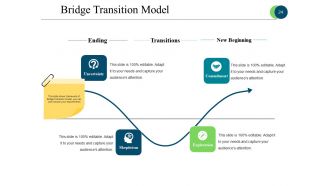
Slide 24: This slide showcases a framework of Bridge Transition model. You can use it as per your requirements
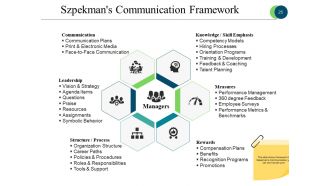
Slide 25: This slide displays Szpekman's Communication Framework which includes the following- Knowledge / Skill Emphasis, Measures, Rewards, Structure / Process, Leadership, Communication.
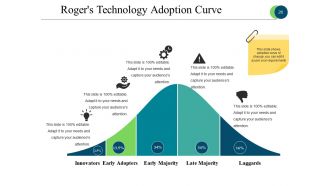
Slide 26: This is Roger's Technology Adoption Curve slide. This slide shows adoption curve of change. You can edit it as per your requirements
Slide 27: This slide displays Risk & Barriers involving- Resistance Management Plan, Resistance to Change, Risk Assessment.
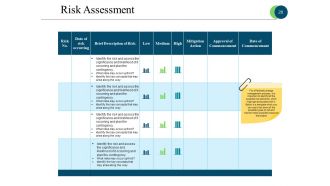
Slide 28: This is Risk Assessment slide in tabular form.
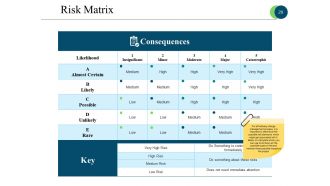
Slide 29: This slide displays Risk Matrix template. You can use it to list down all the possible types of risk and mention their possible impact on the project.
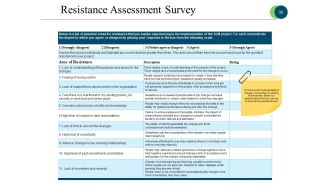
Slide 30: This slide showcases Resistance Assessment Survey with a questionnaire.You can use the questionnaire to track all the possible barriers.
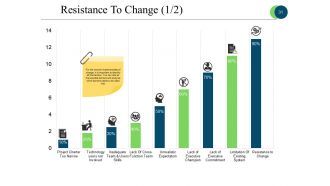
Slide 31: This is Resistance To Change slide. You can rate all the possible barriers here and analyse which barriers needs to be dealt first.
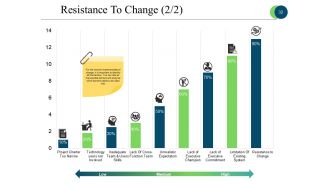
Slide 32: This is another Resistance To Change slide in a bar graph form with High, Medium and Low parameters.
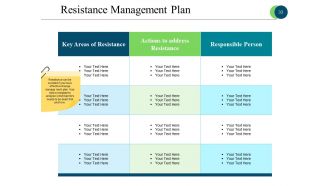
Slide 33: This slide displays Resistance Management Plan.
Slide 34: This slide showcases Implementation Strategies. These include- Change Transition Plan, Communicating the Change, Change Management Training, Timeline for Implementation, Sustaining the Momentum.
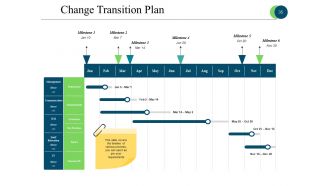
Slide 35: This is Change Transition Plan slide in a timeline. It covers the timeline of various process, you can use it as per your requirements.
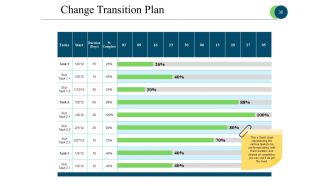
Slide 36: This is yet another Change Transition Plan slide in a Gantt chart/ graph form. You can use it as per need.
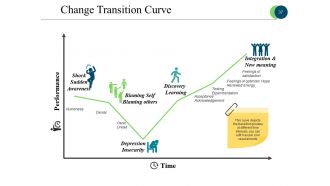
Slide 37: This slide depicts Change Transition Curve with Time and Performance parameters.
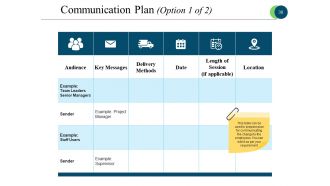
Slide 38: This slide displays Communication Plan in a tabular form. This table can be used to prepare plan for communicating the change to the employees. You can edit it as per your requirement
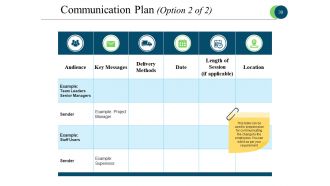
Slide 39: This is another Communication Plan slide to state.
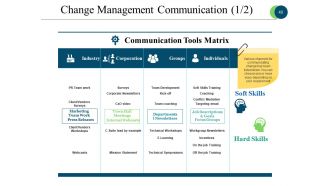
Slide 40: This is Change Management Communication slide showing Communication Tools Matrix and its various channels. You can choose one or more ways depending on your requirement.
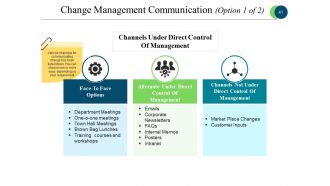
Slide 41: This is another Change Management Communication slide.
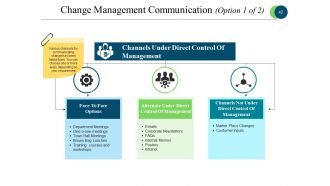
Slide 42: This too is a Change Management Communication slide.Various channels for communicating change has been listed here. You can choose one or more ways depending on your requirement.
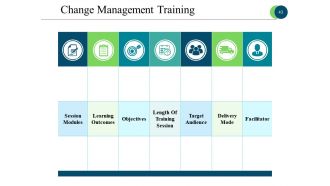
Slide 43: This slide displays Change Management Training with icons.
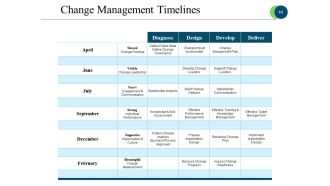
Slide 44: This is Change Management Timelines slide. It covers the timeline of change management which you can use it as per your requirements.
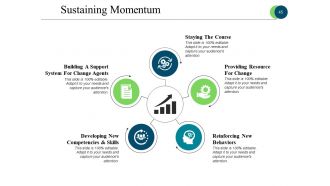
Slide 45: This is Sustaining Momentum slide in a circular image form showcasing- Staying The Course, Reinforcing New Behaviors, Developing New Competencies & Skills, Providing Resource For Change, Building A Support System For Change Agents.
Slide 46: This slide showcases Cost Of Change Management to move forward. You can change contents as per need.
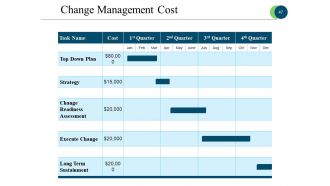
Slide 47: This slide displays Change Management Cost.
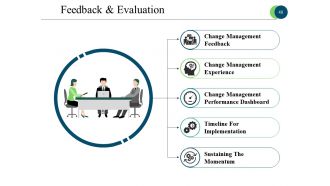
Slide 48: This slide presents Feedback & Evaluation. This includes- Change Management Feedback, `Change Management Experience, Change Management Performance Dashboard, Timeline For Implementation, Sustaining The Momentum.
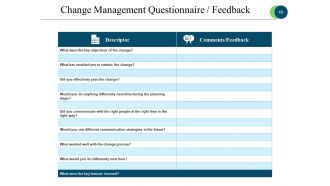
Slide 49: This slide displays Change Management Questionnaire / Feedback. You can add your own information here and edit as per need.
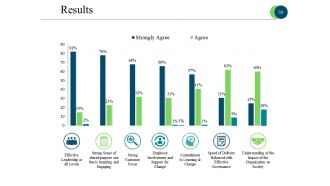
Slide 50: This slide showcases Results in a bar graph/ chart form.
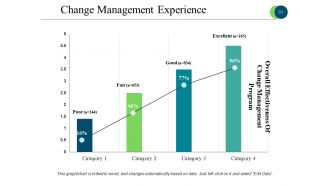
Slide 51: This slide showcases Change Management Experience in an increasing bar graph form to assess Overall Effectiveness Of Change Management Program.
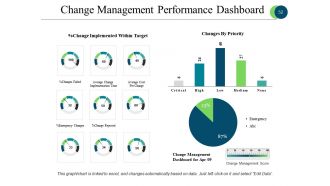
Slide 52: This slide showcases Change Management Performance Dashboard with charts and graphs.
Slide 53: This is a Coffee Break slide to halt. You may change it as per requirement.
Slide 54: This is Business Process Reengineering Icon Slide showcasing various icons. Use/ change as per need.
Slide 55: This is another Business Process Reengineering Icon Slide.
Slide 56: This slide is titled Charts & Graphs. You can alter/ change contents as per requirement.
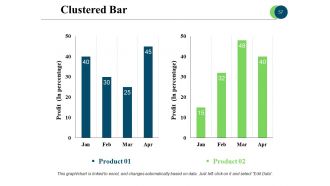
Slide 57: This is a Clustered Bar Chart slide for product/entity comparison.
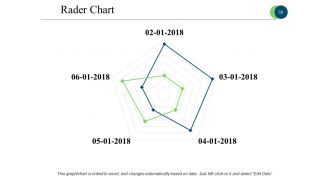
Slide 58: This slide presents a Radar Chart graph/chart for product/entity comparison, growth etc. Use as per required.
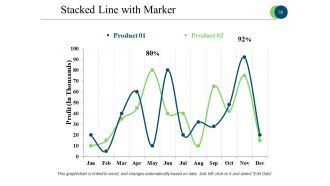
Slide 59: This slide presents Stacked Line with Marker chart. Compare Product 01, Product 02 and use as per required.
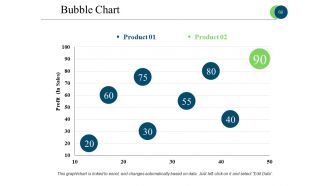
Slide 60: This slide presents a Bubble Chart for product specifications, comparison etc. to show.
Slide 61: This slide is titled Additional slides to proceed forward. You can change/ alter the contents as per need.
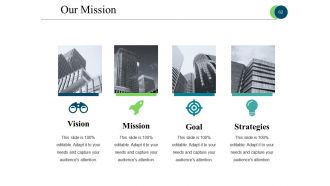
Slide 62: This is Our mission slide with imagery and text boxes to go with.
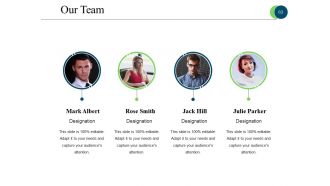
Slide 63: This is an Our Team slide with name, image, text boxes etc. to put the required information.
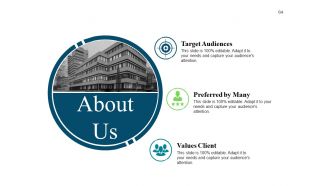
Slide 64: This is an About Us slide showing Target Audiences, Preferred by Many, Values Client as examples.
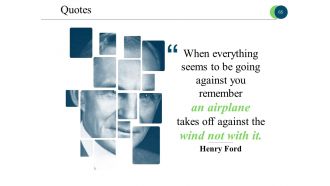
Slide 65: This slide displays Quotes by Henry Ford. Use or add your own quote as per need.
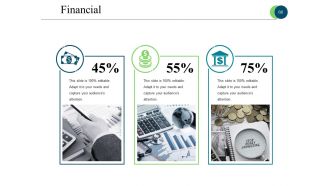
Slide 66: This slide presents Financial scores to display.
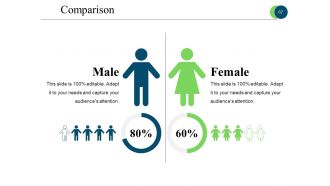
Slide 67: This slide shows Comparison of two entities in creative imagery form.
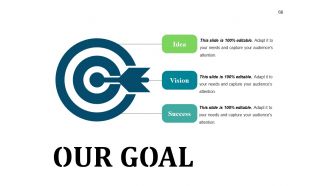
Slide 68: This slide showcases Our Goal. You can add your company goals, aspirations etc. here.
Slide 69: This is a Puzzle image slide to show information, specifications etc.
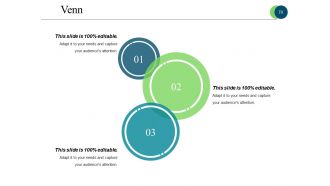
Slide 70: This is a Venn diagram image slide to show information, specifications etc.
Slide 71: This is a Target image slide. State targets, etc. here.
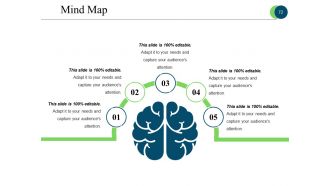
Slide 72: This is a Mind Map image slide to show segmentation, information, specifications etc.
Slide 73: This is a Bulb or Idea slide to state a new idea or highlight specifications/information etc.
Slide 74: This is a Thank You slide with Address# street number, city, state, Contact Numbers, Email Address.
Business Process Reengineering Powerpoint Presentation Slides with all 74 slides:
Evaluate the degree of acceptance with our Business Process Reengineering Powerpoint Presentation Slides. Figure out the impression you have created.



FAQs for Business Process Reengineering
So basically with BPR you're throwing out the old stuff and starting fresh - no tweaking existing processes. Focus on what you actually want to achieve, not just individual tasks. Organize everything around processes instead of departments (makes way more sense honestly). Cut out anything that doesn't add real value. Capture info once at the source rather than passing it around forever. Treat your scattered resources like they're centralized, and connect parallel activities instead of waiting to integrate later. Oh, and let people make decisions where they're actually doing the work - cuts through so much red tape it's not even funny.
Walk around and straight up ask people what pisses them off daily - seriously, best intel you'll get. Look for the obvious stuff too: crazy long cycle times, customer complaints through the roof, processes bouncing between like 8 different departments. Dig into your numbers for anything tanking or where competitors are eating your lunch. Manual processes are usually prime targets. Oh, and anything running on systems from the stone age. Basically combine what the data's screaming at you with what employees are actually living through every day.
So here's the thing - tech is what actually makes BPR possible. Without it, you're basically just moving the same inefficiencies around. Most companies that nail BPR use workflow automation and data analytics to cut out the real bottlenecks. Oh, and integrated systems are huge too. But don't get caught up picking tech first - that's backwards. Map out what your perfect process would look like, then figure out which tools can make it happen. Otherwise you'll end up forcing your workflow to fit whatever software looked shiny.
Honestly, you gotta measure both the numbers and the feelings. Start with the obvious stuff - how much faster things run now, what you're saving on costs, fewer screw-ups. But don't ignore whether people actually like working with the new process (trust me, grumpy employees will tank any project). Customer satisfaction scores tell you a lot too. I'd pick maybe 4 key things to watch monthly for at least 6 months after launch. Set up some kind of simple dashboard so you're not scrambling for data later when your boss asks if it was worth it.
Honestly, the worst part is dealing with people who freak out about losing their jobs - they'll fight you every step of the way. Communication becomes a nightmare too. Everyone and their mother will want to redesign everything at once (scope creep is real), plus you'll probably underestimate how long it actually takes. Legacy systems? Total pain when they won't integrate properly. Oh, and good luck if senior leadership isn't backing you up. Start with just one small pilot process first. Keep explaining why you're doing this - like, constantly. You really need someone dedicated to managing all the pushback from day one.
Honestly, get people involved right from the start - don't just spring changes on them. The biggest mistake I see? Leadership announces transformations without explaining WHY. People freak out when they're kept in the dark about their jobs. Build some quick wins early so everyone sees progress. Training is huge too - nobody wants to feel lost or unprepared. Look, change sucks and it's okay to admit that upfront. But here's the thing - you absolutely need feedback loops where employees can actually speak up and know their concerns matter. Otherwise you're just setting yourself up for failure.
So BPR usually makes customers way happier because you're rebuilding everything around what they actually want, not what's easier for your company. Faster service, fewer people to deal with, less chance of screwups - all that good stuff. Though honestly, most companies skip the most important part: mapping out the customer journey first. You gotta figure out what's pissing people off most, then work backwards. Nobody wants to call support three times for the same stupid problem. Start with your biggest pain points and go from there.
Look, data analytics is honestly a game-changer for BPR. It shows you exactly where things are falling apart instead of just guessing what's broken. You can baseline your current performance and spot bottlenecks you'd never notice otherwise. Plus it helps you measure cycle times and catch patterns in customer complaints or resource issues. I'd start by figuring out what data you're already collecting - most companies have way more than they realize. Then identify where you need better visibility into your processes. It's like having x-ray vision for your workflows, which sounds dramatic but it's true.
So basically, BPR is like gutting your entire kitchen while continuous improvement is more like reorganizing your spice rack every few months. When you do BPR, you're throwing out everything and starting fresh - questioning why you even do things that way. Super risky but can pay off big time. Continuous improvement? You're making tiny tweaks here and there, nothing too crazy. Way safer but takes forever to see real results. Honestly, I'd only go the BPR route if your processes are completely screwed. Otherwise, stick with the gradual approach.
Dude, culture totally makes or breaks BPR projects. People will just go back to their old habits if they hate change - I've seen it happen so many times. Your team needs to be cool with trying new things and messing up without getting fired. That "we've always done it this way" attitude? Yeah, that'll kill your project real quick. Strong leadership helps a ton here. When bosses actually model flexibility and workers feel safe speaking up, the new processes stick around. Oh, and definitely check if your culture's ready before you start - saves major headaches down the road.
Start with basic flowcharts or swimlane diagrams - doesn't need to be perfect. Write down who does what and when, plus what tools they're using. Pain points are honestly the best part because that's where you'll find all the good stuff to fix later. Here's the thing though - document what actually happens, not what the procedure manual claims. Sometimes you gotta literally follow people around to see how things really work. Keep everything visual so it makes sense to everyone. Oh, and don't overthink it! Once you've got that messy reality mapped out, you'll have something solid to work with.
So BPR saves money by cutting out redundant steps and automating the manual stuff. The big wins come from needing fewer people, faster turnaround times, and ditching those painful department handoffs. Why keep five approval steps when two work fine? You can also consolidate systems and dump unnecessary tech. Honestly, most companies have way more bloat than they realize. Map out your current processes first, then spot the biggest time-wasters before you redesign anything. That's where the real savings hide.
Look, most companies think BPR completion is the finish line - huge mistake. You've gotta do regular check-ins to catch people sliding back into old habits. Trust me, they will! Set up feedback loops so your team can flag problems early. Celebrate those small wins too, keeps everyone motivated. New hires need training on the processes, and someone needs to own maintaining these improvements. Oh, and make continuous improvement part of how you operate daily, not some one-off thing you did that one time.
Basically any industry drowning in red tape benefits from BPR. Manufacturing's the obvious one - you can actually watch money walk out the door when processes suck. Healthcare cuts patient wait times in half when they fix their workflow mess. Financial services and insurance are goldmines too since they're built on endless approval chains and ancient systems. Honestly, if your customers constantly complain about slow service or your team keeps saying "we've always done it this way," that's your answer right there. The more handoffs and bureaucracy you've got, the bigger wins you'll see.
Pick one thing to fix first - seriously, don't go crazy trying to change everything. Map out how stuff actually works right now, then talk to your team about what's driving them nuts. Your frontline people usually have the best ideas anyway since they're the ones dealing with all the broken stuff daily. Grab some sticky notes or make a simple flowchart to see the whole mess visually. Once you redesign it, test small before rolling it out everywhere. Oh, and focus on easy wins first - you'll need that momentum when you tackle the bigger headaches later.
-
Illustrative design with editable content. Exceptional value for money. Highly pleased with the product.
-
Graphics are very appealing to eyes.