


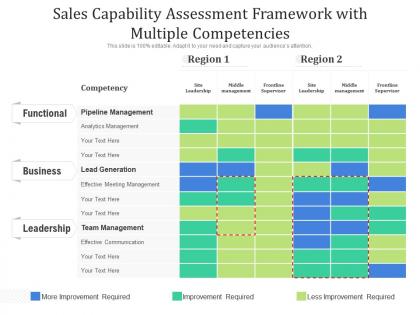
Sales capability assessment framework with multiple competencies




Try Before you Buy Download Free Sample Product
 Impress Your
 Audience
 100%
100% Editable
 Save Hours
 of Time


Our Sales Capability Assessment Framework With Multiple Competencies are topically designed to provide an attractive backdrop to any subject. Use them to look like a presentation pro.
People who downloaded this PowerPoint presentation also viewed the following :
Sales capability assessment framework with multiple competencies with all 2 slides:
Use our Sales Capability Assessment Framework With Multiple Competencies to effectively help you save your valuable time. They are readymade to fit into any presentation structure.

FAQs for Sales capability assessment framework
Honestly, you gotta hit three main areas - skills, behavior, and actual numbers. Test the basics like prospecting and objection handling, but discovery questions are where most people bomb it completely. Role-play scenarios work great for seeing how they handle pressure and whether they can actually be coached. If they're current reps, dig into their performance data too. You can't just rely on one piece though. I'd probably start by figuring out what "good" even means for your team first - sounds obvious but most people skip that step. Then combine everything to get the real picture.
Look at what your actual sales situations are first. Like, are your reps doing consultative B2B stuff or just high-volume transactions? Figure out what competencies matter for those specific scenarios. SaaS teams usually need killer discovery skills and objection handling. Pharma reps? They're all about deep product knowledge and relationships. (Every industry swears theirs is the hardest, right?) Here's what works: talk to your best performers. What behaviors make them crush it compared to average reps? Build your assessment around those real differentiators instead of boring generic sales skills that don't mean much.
Dude, behavioral interviews are honestly the way to go for sales roles. Instead of asking "how would you handle rejection," you get them to tell actual stories - like "walk me through a time you lost a big deal." Way more revealing. I always use the STAR thing (situation, task, action, result) to make sure they're not just rambling. You'll see their real skills come out - how they bounce back, build relationships, solve problems. Oh and start collecting good behavioral questions now that match what you actually need in your sales team. Trust me, hypotheticals tell you nothing.
Track your key metrics before and after - pretty straightforward stuff. Sales performance is the big one: are reps hitting quota more? Conversion rates improving? Don't overthink the analytics part (I've watched companies go way too deep here). Just see if assessment scores actually match real sales results over like 6-12 months. Survey your managers too - they'll tell you if they're seeing changes in their teams. Oh, and check if skill gaps you identified are closing through training. The real proof? Your highest scorers should become top performers within a reasonable timeframe.
Don't make your assessments too broad - tie them to your actual sales process and customer base. Self-assessments are pretty useless since everyone thinks they're amazing at their job. Beyond product knowledge, test the stuff that actually matters like handling objections and building relationships. Track development over time instead of just doing a one-off test. I'd focus on real scenarios your team deals with daily, then use those results for targeted coaching. Way better than just going through the motions to say you did it.
Dude, the data you get from tech tools is so much better than just going off what managers *think* is happening. You can actually track stuff like conversion rates and how fast deals close. There's even AI that listens to sales calls and spots where people are struggling - honestly pretty wild. Real-time dashboards show you trends across the whole team, and some tools can predict who's gonna need help before they crash and burn. Oh, and don't try to digitize everything at once. Pick like two metrics to start with or you'll go crazy.
Ok so relationship building is huge - that's gotta be your foundation. Active listening too because I swear, half the time reps are just waiting for their turn to talk instead of actually hearing the customer. You'll want consultative selling and objection handling obviously. At the senior level, territory management and strategic thinking matter more since they should be working smart by then. Oh and emotional intelligence, resilience, all that softer stuff. Honestly though, I'd start by looking at your current performance data first. See where people are actually struggling before you build out the whole training program.
First thing - check if your current interview setup accidentally favors certain communication styles. Get different people on your interview panels because honestly, we all have blind spots we don't see. Mix up your role-plays too. Don't just use scenarios your current team deals with - throw in different customer types and situations. Oh, and this might sound boring but use scoring rubrics so you're not just going with gut feelings. Focus on actual skills rather than whether someone "fits the culture" or whatever. Test everything with different people first. You'll catch weird biases before they become a problem.
So here's what works really well - when someone bombs at objection handling in an assessment, that immediately becomes their training focus. No waiting around. Some teams I know do these quick monthly check-ins that automatically create personalized learning paths for each person (honestly pretty clever). You can flip it too - make training completion part of how you score competencies. Or set up peer coaching where people tackle the exact skills their assessments flagged. The whole point is connecting everything so it doesn't feel like you're just checking random boxes.
Yeah, cultural stuff totally changes what actually works in sales. Like in Japan you need patience and formal relationship-building, but try that slow approach in NYC and you'll lose deals to someone more direct. I learned this the hard way watching a killer US rep completely bomb in Germany because he wouldn't adjust his style. You've got to figure out which skills translate everywhere - active listening, obviously - versus what needs tweaking for each region. Then build those local differences right into how you assess people. Otherwise you're just setting your team up to fail overseas.
Skip the personality stuff - stick to actual behaviors they can change. I always start with what went well first, builds them up before you dive into fixes. Don't dump everything on them at once though. Pick maybe 2-3 things to work on, otherwise they'll just shut down. That whole situation-behavior-impact thing actually works pretty well for keeping it real instead of making it feel like an attack. Oh, and definitely work together on next steps - like actual concrete stuff they can do. Nobody wants to hear "you suck at this" without getting help on how to not suck, you know?
Take your assessment results and build job profiles around what your actual top performers look like, not some generic template. Map out the specific patterns and competencies your best salespeople share - that's your gold standard right there. Way too many companies still hire on gut feeling (which honestly drives me crazy). Build those patterns into your interviews and screening process. This way you're picking people with real success indicators instead of just crossing your fingers and hoping. Oh, and definitely benchmark your current stars first - you'll probably find some surprises in what actually makes them tick.
Honestly, these frameworks work really well for keeping people around. Your team gets a clear roadmap for moving up, which beats the usual chaos of not knowing what's expected. People stick around when they can actually see their progress - makes sense, right? Plus it stops all the drama around promotions since everything's transparent. Oh, and here's the key part: get your salespeople involved in creating it from the start. Trust me, if they help build it, they'll actually use it instead of rolling their eyes at another "corporate initiative."
Honestly, you're gonna want to go heavy on digital stuff now. Video mock calls work really well - have your reps record themselves and you can catch things you might miss in person. Screen sharing exercises are solid too, and honestly? Sometimes they show more about how someone actually sells these days than old-school methods. CRM data is your friend here - track response times, follow-up patterns, all that. For hybrid teams, weight digital communication skills way more than you used to. It's like 70% of selling now anyway. Oh and set up those regular virtual check-ins to go over results. Way easier to schedule than dragging everyone to a conference room.
Honestly, you gotta measure both the quick wins and the stuff that takes time to show up. Pre/post assessment scores are your easiest proof it worked. After that, watch for behavioral shifts - more calls, better pipeline stuff, conversion rates improving at each stage. Revenue per rep is obviously what everyone's gonna ask about first. But don't skip the softer things like confidence scores or what managers are saying. Here's the thing though - some training just doesn't stick, so track how long these improvements actually last. Compare your trained reps against the ones who didn't get it yet. That'll give you the clearest ROI picture.
-
Unique design & color.
-
Qualitative and comprehensive slides.
-
Much better than the original! Thanks for the quick turnaround.