


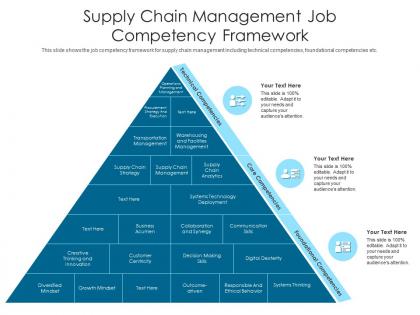
Supply chain management job competency framework




Try Before you Buy Download Free Sample Product
 Impress Your
 Audience
 100%
100% Editable
 Save Hours
 of Time


This slide shows the job competency framework for supply chain management including technical competencies, foundational competencies etc.
People who downloaded this PowerPoint presentation also viewed the following :
Supply chain management job competency framework with all 2 slides:
Use our Supply Chain Management Job Competency Framework to effectively help you save your valuable time. They are readymade to fit into any presentation structure.
FAQs for Supply chain management
So you'll need demand forecasting, supplier relationships, inventory optimization, and logistics coordination. Most companies totally bomb the forecasting though - that's honestly where everything falls apart. Map out your current supply chain first, then figure out your biggest headaches. Visibility across the whole network is clutch so you can catch problems early. Oh, and risk management became way more critical after all the crazy disruptions we've seen lately. Technology helps connect everything, but don't overthink it. Just start with your worst pain points and work from there.
Dude, start with something simple like automated reordering - that's honestly where most people see results fast. IoT sensors give you real-time tracking across everything, which is pretty sweet. The predictive stuff is where it gets interesting though - you can actually see problems coming instead of scrambling when inventory runs out. Warehouse picking speeds up like crazy with automation, plus way fewer mistakes. I know it sounds overwhelming but pick one thing first. The data insights will blow your mind once you see bottlenecks before they hit.
Honestly, sustainability isn't optional anymore - customers will literally pay extra for it and regulators are cracking down everywhere. Start by auditing your current suppliers' practices, then build those requirements into your next RFP. You'll need to track emissions, waste, and supplier compliance because it hits your reputation hard if you don't. Carbon footprint reduction, ethical sourcing - all that matters now. Companies are finally getting that this stuff directly affects profits. I mean, even my company's buyers won't work with suppliers who can't prove their sustainability metrics. It's wild how fast this shifted from nice-to-have to must-have.
Don't rely on just one supplier - that's basically setting yourself up for disaster. Map out your whole supply chain first so you know where the weak spots are. Keep extra inventory of the stuff you absolutely can't run without. Having backup suppliers already lined up saves you from panicking when things go sideways (and they will). Real-time tracking helps catch problems before they blow up. Oh, and treat your suppliers well - they'll remember who was decent when everyone's fighting over limited stock. Pick your three biggest risks and make actual plans for each.
Dude, just-in-time inventory is honestly a game changer if you can pull it off. You only buy what you actually need, so your cash flow improves big time and you're not drowning in storage costs. No more expired stuff sitting around either - I've seen warehouses that look absolutely ridiculous with old inventory everywhere. Your suppliers become actual partners since you depend on them more, which weirdly makes everything run smoother. Customer wants something different? You can pivot way faster. But here's the catch - if your supplier screws up even once, your whole production line stops. So yeah, make sure they're solid first.
Ugh, global events will absolutely wreck your supply chain if you're not ready. COVID taught me that lesson when semiconductors just vanished overnight. Natural disasters, trade wars, political drama - they mess up shipping routes and costs go crazy fast. You've got to spread suppliers across different countries instead of putting all your eggs in one basket. Keep extra inventory of the stuff you really need, and honestly? Plan for the worst-case scenarios before they happen. Having backup logistics routes saves your butt when everything goes sideways. Don't wait until you're scrambling during a crisis to figure this out.
Look, your supplier relationships can make or break your whole operation. Good partnerships mean better prices, you'll get priority when things are scarce, and they'll actually give you a heads up about problems coming down the line. I learned this the hard way - dealing with suppliers you've never talked to is like pulling teeth when stuff goes wrong. Focus on your most important suppliers first and set up regular calls with them. The goal is collaboration, not just placing orders and hoping for the best. Both sides need to benefit or it won't last.
Honestly, you need a good mix - cost, speed, quality, and how flexible you can be when things go sideways. Track your on-time delivery rates and inventory turnover for sure. Cost per unit shipped is obvious but crucial. Order fulfillment cycle time tells you if you're actually fast or just think you are. Don't sleep on supplier performance scores and customer satisfaction - people forget about those but they'll warn you before bigger problems hit. Cash-to-cash cycle time shows how quickly you're turning investments back into actual money. Start with maybe 3-4 metrics that matter most to your business, then add more once you've got the hang of it.
Dude, analytics totally changes the game for supply chains. Instead of flying blind, you'll actually see what's happening - like catching bottlenecks before they wreck everything. Demand forecasting becomes way more accurate, and you can finally ditch the guesswork on inventory levels. Tracking supplier performance is huge too (seriously saved my sanity when I had to deal with unreliable vendors). The predictive stuff is probably the coolest part - you can see disruptions coming and prep for them. My advice? Pick one metric you're already watching and start there. Once you see results, expanding gets addictive.
Ugh, honestly the data silo thing is probably the worst part. Systems don't talk to each other and suppliers all track stuff differently - total nightmare. Plus many suppliers just won't share their info because they're worried about competition or they don't have the tech setup. Cost is brutal too since good transparency tools aren't cheap. Multi-tier chains make it even messier when you're tracking through like 5+ supplier layers. I'd start with mapping your direct suppliers first though, then dig deeper from there. Way less overwhelming that way.
Blockchain basically creates this permanent record that nobody can mess with - tracks everything from raw materials to when stuff gets delivered. Luxury brands are obsessed with it right now because it stops counterfeiting. You get real-time updates on where products are, can actually verify what suppliers tell you, and if there's a recall you'll find the problem way faster. Plus customers trust you more when they can see the whole process. Honestly though, don't go crazy with it at first. Just test it out with one supplier or maybe your riskiest products.
Honestly, spreading suppliers across different regions saved my ass last year when that whole shipping mess happened. Don't rely on just one vendor - I learned that the hard way. Stock up on your most critical stuff even if your finance team gives you grief about it. Real-time tracking systems are worth every penny because you'll catch issues before they snowball. Oh, and run those "what if" scenarios regularly - like what happens if your main supplier goes dark tomorrow? Being ahead of problems beats scrambling to fix them every single time.
Dude, e-commerce flips your whole supply chain upside down. Instead of shipping pallets to stores, you're suddenly dealing with thousands of tiny individual orders. Last-mile delivery becomes this huge headache – everyone expects Amazon-level speed now, which is honestly ridiculous but whatever. Your warehouses need to be lightning fast, not just cost-efficient. Returns? Way more than regular retail. You'll want to get your distribution network sorted early and find carriers who won't flake when you start growing. Oh, and keep inventory closer to customers or you'll never hit those delivery windows people demand.
Dude, definitely nail the tech basics first - data analysis, ERP systems (SAP's everywhere), and logistics fundamentals. Excel's still king honestly, even with all the new tools out there. Communication matters way more than people think though. You're basically playing middleman between suppliers, customers, and your own team constantly. Problem-solving when everything's on fire? That's like half the job lol. Get an APICS cert if you can swing it. Oh and maybe pick up some Python - not essential but it'll make you look way more valuable. The combo of tech + people skills is what actually gets you promoted.
Honestly, supply chain collaboration just breaks down those annoying departmental walls so everyone's actually working together instead of just worrying about their own stuff. Real-time data sharing with your suppliers helps you catch problems early - way better than scrambling when everything's already on fire. Plus you'll cut down on extra inventory sitting around. My old boss used to say it's like getting everyone to row together, which sounds dumb but it's actually pretty accurate. Better forecasts, fewer last-minute panics. I'd start small though - pick one solid partner and do regular check-ins to build some trust first.
-
Excellent work done on template design and graphics.
-
Very unique, user-friendly presentation interface.
-
Excellent design and quick turnaround.
-
Unique research projects to present in meeting.