


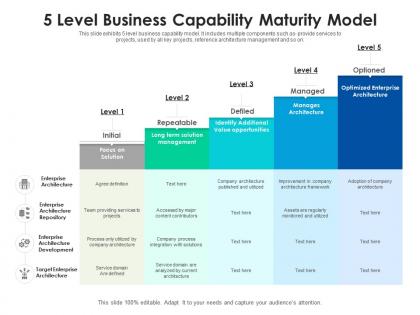
5 level business capability maturity model




Try Before you Buy Download Free Sample Product
 Impress Your
 Audience
 100%
100% Editable
 Save Hours
 of Time


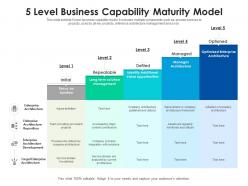
This slide exhibits 5 level business capability model. It includes multiple components such as- provide services to projects, used by all key projects, reference architecture management and so on.
People who downloaded this PowerPoint presentation also viewed the following :
5 level business capability maturity model with all 2 slides:
Use our 5 Level Business Capability Maturity Model to effectively help you save your valuable time. They are readymade to fit into any presentation structure.
FAQs for 5 level business
So BCMM breaks down into five main pieces: capability definition, maturity levels, assessment criteria, governance framework, and improvement roadmaps. You'll map each capability across different maturity stages - think initial/ad-hoc all the way up to optimized. Assessment criteria show you where you actually stand (spoiler: it's usually worse than you think). Governance keeps everyone accountable, which honestly can be a nightmare without proper buy-in. The roadmaps are gold though - they give you real steps to improve. Don't try to assess everything at once. Pick 2-3 critical capabilities first.
Honestly, just start by being brutally honest about where you actually stand right now - not where you wish you were. Map everything against those five BCMM levels: processes, tech, people, governance. Get some outside eyes on it too because we're all terrible at seeing our own blind spots. Document it all with real numbers and evidence. The magic happens when you spot those gaps between current reality and where you want to be. Then you can build an actual roadmap instead of just hoping things improve. Oh, and those standardized questionnaires? They're annoying but super helpful for staying objective about the whole thing.
Honestly, the biggest win is finally having a clear picture of where your processes actually suck vs where you think they do. No more guessing games about what to fix first. You'll catch problems way before they blow up in your face, which is huge. Teams stop bickering about standards too since everyone's working from the same playbook. The investment decisions become so much easier when you can see exactly what's broken. Oh, and definitely don't try to map everything at once - pick one area first or you'll go crazy. Test it out small before going all in.
BCMM doesn't compete with ITIL and COBIT - they actually work great together. COBIT handles your governance stuff, ITIL covers service delivery processes. But BCMM? It's looking at how mature your business capabilities are organization-wide. Different angles, same problems basically. Here's how I think about it: COBIT says what controls you need, ITIL shows you how to run services properly, and BCMM tells you if your business functions are actually any good at what they do. Honestly, using all three makes sense since they don't really step on each other's toes. I'd probably start by figuring out where your existing frameworks already touch BCMM's capability areas.
So BCMM shows you exactly where your capabilities are now vs where they need to be. Pretty straightforward actually. You rate each one on those maturity levels - starts at ad hoc, goes up to optimizing. Gaps become super obvious when current and target don't match up. Pick maybe 3-4 of your most critical capabilities first (don't try to boil the ocean). Run them through the model looking at governance, metrics, tech, people skills - all that stuff. You'll see the biggest process holes right away. It's honestly like having a heat map but for business processes instead of website clicks or whatever.
Honestly, just focus on where you're at right now - don't try jumping ahead. I used to make this mistake all the time. Figure out what's actually missing between your current level and the next one, then make a real plan with deadlines you can actually hit. Here's the thing though - don't try fixing everything at once. Pick maybe 2 or 3 things that really matter and get good at those first. Have someone own each area so nothing falls through the cracks. Check in regularly to see how it's going and switch things up if needed. Baby steps beat trying to do it all.
Honestly, the toughest part is people lying to themselves about where they actually are right now. Everyone thinks they're more mature than they really are, which screws up your whole plan from day one. Then you've got executives who want to skip ahead to the fancy stuff without building the foundation first - I've seen this tank so many projects it's not even funny. Data's always a mess too, especially when different departments can't agree on basic definitions. Oh, and good luck keeping leadership interested when things get boring or expensive. Start with just one area though, grab some easy wins, then use those to convince people the rest is worth doing.
Leadership is make-or-break for BCMM stuff. Without executives who actually get what capability maturity is about, you're basically dead in the water. I've seen too many initiatives tank because leaders treated it like just another box to check. They need to champion the cultural changes and communicate why you're doing this whole thing in the first place. Plus they have to stick around when implementation gets ugly (and trust me, it will). Get your senior people educated and bought in early, or you'll hit the first roadblock and everything falls apart. Can't stress this enough - leadership buy-in isn't optional here.
So basically companies just weight the different parts based on what matters most to them. Finance companies obsess over risk management and compliance stuff. Tech focuses on innovation and how fast they can pivot - which honestly makes total sense. Healthcare puts patient safety first, obviously. Manufacturing cares about keeping operations smooth and supply chains running. The trick is figuring out what's actually critical for your specific industry, then scoring those areas heavier instead of treating everything the same. Don't just use some generic framework - tailor it to what'll make or break your business.
Track stuff that actually matters - cycle times, error rates, how much you've automated, plus customer satisfaction and revenue impact. Honestly, half the metrics people obsess over are just dashboard eye candy. What you really need is consistency across your whole org, not just those one-off wins that look good in meetings. Start with maybe 3-5 key things per area and check quarterly. That's enough to see patterns without getting buried in spreadsheets. Focus on process stuff AND outcomes - both matter. Don't go overboard though, you'll just end up paralyzed by all the data.
So BCMM shows you exactly where your capabilities actually are vs where they need to be - makes planning way more realistic. You can see which areas are lagging and throw resources there instead of just guessing. Honestly, it's so much better than wandering around hoping stuff works out. Plus you'll spot mature capabilities that can handle new projects right away. No more starting from zero every time. The maturity scores are gold for budget meetings too - execs eat up that data-driven stuff when you're asking for money.
Oh nice question! Microsoft's whole BCMM thing is probably your best bet - they completely flipped their structure from products to capabilities and the results were pretty crazy good. Kaiser Permanente did something similar for patient care, which is cool but maybe less relevant? JPMorgan Chase used it after acquisitions to cut out duplicate stuff. The manufacturing examples are honestly kind of boring but they work well in practice. I'd definitely start with Microsoft since they documented everything really well and you'll get actual numbers to back up whatever you're pitching.
Look, training is basically what moves you up the BCMM ladder - you need people who actually know how to do this stuff right. Without it, you're stuck at basic level forever. The real game-changer though? Getting everyone to speak the same language about what good business continuity looks like. I swear, so many companies skip this part and wonder why nothing clicks. Training also catches skill gaps early, which saves you tons of headaches later. Just map what training you've got now against each BCMM level. You'll spot the gaps pretty quick.
Honestly, tech integration is a game-changer for BCMM - it automates those tedious capability assessments and gives you real-time dashboards showing exactly where your maturity gaps are. The analytics piece is probably my favorite part because it catches patterns you'd totally miss doing things manually. Plus you get automated workflows that actually walk your teams through improvements instead of just hoping they figure it out. Oh, and it standardizes how different business units measure stuff, which sounds boring but trust me, it's huge for consistency. Start by connecting whatever tools you're already using - create one place where all your capability data lives.
Grab Visio or Lucidchart first - you need to actually see what capabilities you have now. TOGAF works great if you're doing enterprise architecture stuff. For tracking improvements, Jira or Monday.com are solid choices. BCMM plus balanced scorecard is honestly the sweet spot for measuring progress - I've seen that combo work really well. Oh, and don't forget about your existing ITIL or Agile setups since people already know those frameworks. Start by mapping current state with whatever visualization tool clicks for you, then add the measurement piece. It's way less overwhelming that way.
-
Unique and attractive product design.
-
Good research work and creative work done on every template.