

5 Levels Of Agile Development Maturity Model




Try Before you Buy Download Free Sample Product
 Impress Your
 Audience
 100%
100% Editable
 Save Hours
 of Time


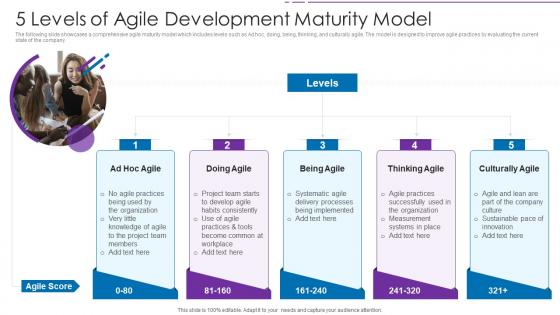
The following slide showcases a comprehensive agile maturity model which includes levels such as Ad hoc, doing, being, thinking, and culturally agile. The model is designed to improve agile practices by evaluating the current state of the company.
People who downloaded this PowerPoint presentation also viewed the following :
Content of this Powerpoint Presentation
The term “Agile” means the capability of adapting and responding to change. It is an approach to project management that handles projects in an uncertain environment. Is it confusing for you? Do you want to identify the uncertainty and find a way of adapting to it? The Agile maturity model is here to help.
The journey towards Agile maturity is not straightforward and fast, but you will reach the destination with a roadmap navigating your pathway. The Agile maturity development model acts as a roadmap. Companies use the Agile framework to guide structures of project management and make operations more productive. Implementation of the Agile framework requires a model to get an idea about the position of the company, the camaraderie of members with the framework, etc.
The Agile maturity model evaluates a company’s integration with the Agile framework into project management. Performing a maturity evaluation helps you discover a team's familiarity with the agile concepts and the company's efficacy in using the framework to increase productivity. The maturity levels in the model help identify the team's category and approach to improving processes.
User stories are a significant element of Agile development. To create a user-centered framework, click here to access the best-quality PPT templates on Agile development, which show user stories with sprint and launch.
5 Levels of Agile Development Maturity Model PPT Templates
We are introducing our PPT Template with features like easy-to-edit and 100% customization. This innovatively designed slide is curated with high-definition graphics, text, colors, and font. Interpret the relevant topics by using our slides and impress your audience in minutes. Download it and tailor it to your information.
Click here to download and get a brief idea about the issues an organization faces with the Waterfall model and implementation of Agile Methodology in software development projects.
Now, take a tour of an informative PowerPoint Templates, each 100% editable and customizable, showcasing how five levels of the Agile Development Maturity Model are perfect for your presentation.
Let’s explore.
Template 1: 5 Levels of Agile Development Maturity Model
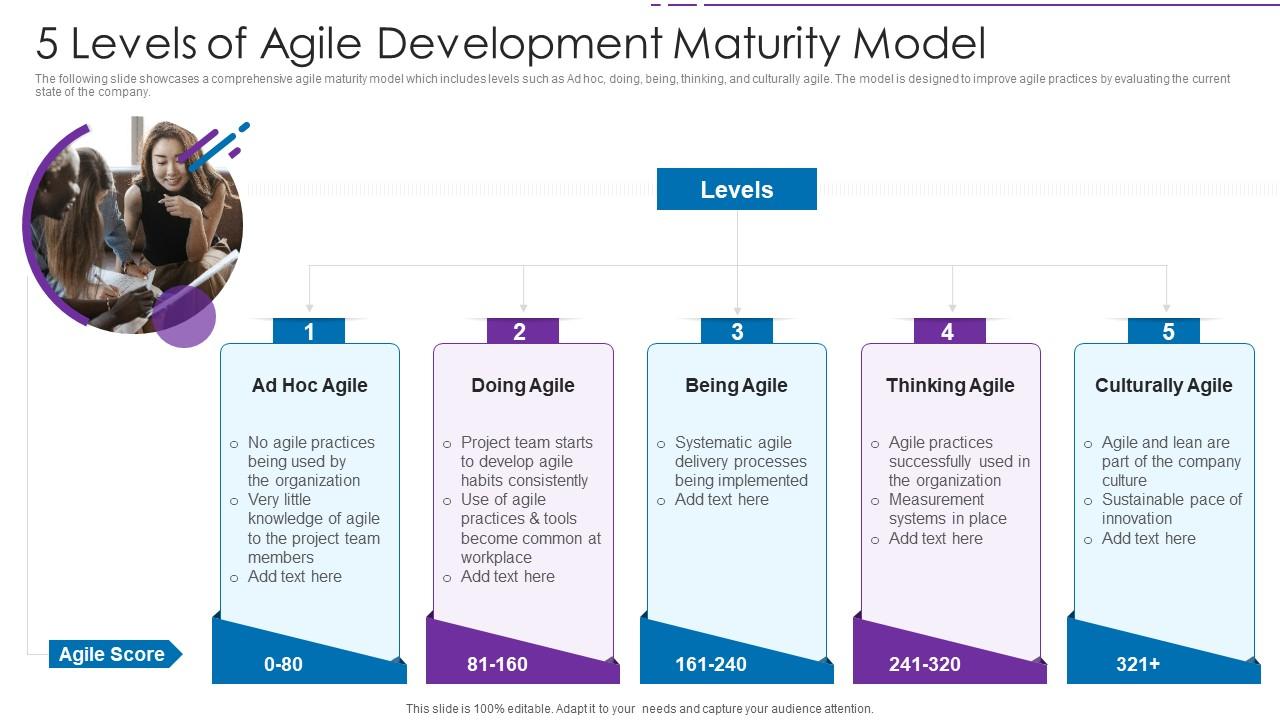
Want to plan a positive transformation in your company's project structure? Then, understanding the Agile maturity development model along with its five key phases is essential. This Agile PowerPoint Template offers a platform to represent five significant levels of the "Agile Development Maturity Model." It showcases five levels, including Ad hoc, doing, being, thinking, and culturally agile, in a comprehensive manner. The layout is designed to improve Agile practices by assessing the status of the company. It exhibits stages in separate boxes with colors, along with a brief depiction. Download it now and highlight information on development, measurement, and more to captivate your audience's attention.
******
AGILITY IS EMPOWERING
To conclude, Agile frameworks are flexible enough to empower teams to provide products and react to changing project needs in dynamic environments. SlideTeam’s Agile Development Maturity Model PPT templates provide adaptability to projects alongside versatility in communication. This template is ideal for team collaborations and project discussions, saving time, elevating professionalism, and captivating audiences.
PS Click here to take charge of your Agile presentations and drive your project toward successful completion.
5 Levels Of Agile Development Maturity Model with all 6 slides:
Use our 5 Levels Of Agile Development Maturity Model to effectively help you save your valuable time. They are readymade to fit into any presentation structure.






FAQs for 5 Levels Of Agile
Oh man, you'll know when teams actually start running themselves without managers breathing down their necks. Retrospectives become productive instead of just whining sessions - that's huge. Delivery gets predictable too. Here's the real test though: does leadership actually let people fail and learn from it? Most places just fake it. When your org stops panicking over changing requirements and cross-functional stuff happens naturally, you're getting there. Also customer feedback gets folded in fast instead of creating drama. It's less about following some methodology and more about actually living those values day-to-day.
So honestly, most teams totally overestimate how agile they actually are - it's wild how disconnected perception can be from reality. Start with something structured like Spotify's framework or SAFe indicators to get a real baseline. Check the basics first: retrospectives, sprint planning, how well different roles actually work together. Don't just measure if you're doing the ceremonies though - focus on whether stuff's actually working. Getting an outside perspective helps too, whether that's a coach or even another team doing peer reviews. Self-assessment surveys are fine but they'll lie to you every time.
Oh man, leadership can totally make or break your Agile transformation. The good ones actually model the behaviors instead of just talking about them - they remove roadblocks and let teams experiment without freaking out about failure. But here's the thing that drives me crazy: so many executives claim they're "all in" on Agile, then turn around demanding detailed project plans and breathing down everyone's necks about timelines. Look for leaders who coach instead of micromanage. Those are your allies. Start there and work outward - honestly, it's way easier than trying to convert the skeptics first.
Look, Scrum gives you structure with all those ceremonies and roles - great for building habits early on. But I've watched tons of teams get trapped thinking the framework IS being agile (spoiler: it's not). Kanban's different - focuses on flow and actually seeing your work patterns. Way more sustainable long-term, honestly. Scrum can make you rigid once you've got the basics down. My take? Pick one to start, get those foundational habits locked in. Then just... adapt as you go. Mix approaches when your team's ready for it.
Honestly, the biggest pain is when leadership says they want Agile but still demands those rigid timelines and upfront plans. Mixed signals everywhere. Teams end up cherry-picking the fun stuff while avoiding retrospectives or actually working cross-functionally - which, let's be real, is where the magic happens. Most companies also try scaling these fancy frameworks before anyone's actually good at the basics. That's backwards. Pick one or two teams first. Get them crushing it with real Agile practices, then let other teams see what's possible. Way more effective than some top-down rollout.
Okay so basically instead of those awful quarterly check-ins, you want feedback happening all the time. Your Agile assessment becomes this living thing that actually shows what's broken vs what management thinks is fine. Set up different ways to hear from people - retros, quick surveys, looking at actual delivery numbers, casual conversations. Real-time visibility beats those snapshot moments every time. Oh and don't try to do everything at once, that's a recipe for burnout. Pick one feedback method you can start this sprint. Build from there and you'll see gaps you never noticed before.
Honestly, I'd focus on velocity consistency and cycle time first - they're your bread and butter for spotting real improvements. Team happiness is massive too (unhappy devs = nothing else matters, trust me). Sprint commitment accuracy shows if you're actually getting better at planning or just winging it. Defect escape rates and deployment frequency are solid additions once you get the hang of tracking. Oh, and customer satisfaction scores if you can swing it. Start small though - pick like 2-3 metrics max. You can always layer more on later as you figure out what actually moves the needle for your team.
Look, if your team isn't collaborating well, you're basically just doing waterfall with fancy sprint names. Good collaboration speeds up feedback loops and gets people actually sharing knowledge instead of hoarding it. Retrospectives become way more useful too. The real shift happens when teams stop waiting for permission and start making decisions together - that's where self-organization kicks in. Honestly, I'd focus on breaking down silos first. Get your developers talking to your designers regularly, that kind of thing. Once people start communicating across disciplines, everything else tends to follow.
Look, three things matter most here. Get your leaders actually bought into Agile - not just nodding along in meetings. Don't cheap out on training either (I see this mistake constantly). People need real coaching, not a one-day workshop. Build psychological safety so teams can mess up without getting crucified. Short retrospectives help catch problems early. Oh, and start with the "why" conversation first - leadership needs to understand what they're signing up for. Then weave learning into daily work instead of treating it like an afterthought.
Honestly, you gotta meet teams where they're at, not where you want them to be. Beginners need the basics - Scrum fundamentals, how to write decent user stories. Advanced teams? They're ready for continuous delivery and better cross-team collaboration. Don't make it one-size-fits-all because that never works. Product owners need totally different training than developers or scrum masters do. Skip the lecture-heavy stuff and do hands-on workshops with real project scenarios instead. Oh, and build learning paths so people can go at their own speed - teams change and they'll need to circle back to concepts later anyway.
Oh absolutely - mature Agile teams see like 20-30% better success rates compared to newer ones. The magic happens around 18-24 months when teams finally stop overthinking every ceremony and just... flow with it. Your retrospectives actually start fixing real problems instead of just being complaint sessions. Planning becomes muscle memory. Honestly, the predictability boost is huge - way fewer "oh shit" moments that derail everything. Stakeholders trust you more because you're not constantly missing targets. Track your velocity and cycle time if you haven't already - those numbers tell the real story about where you're headed.
Honestly, you can't really do Agile properly without decent tools - it's like trying to track everything in your head. Jira or Azure DevOps will show you sprint progress, team velocity, all that good stuff. Without it you're basically flying blind. The automation handles the boring tracking work so you don't have to mess around with spreadsheets (thank god). Once you get some data flowing, you'll start seeing patterns in how your team works. That's where it gets interesting - you can actually improve your process based on real info instead of just guessing. Pick whatever fixes your biggest headache first.
Honestly, just start with one of those assessment frameworks - the Agile Fluency Model works pretty well. But here's the thing: don't only ask your Scrum Master what they think. Get everyone involved - developers, product owners, even stakeholders if you can. I've watched teams completely miss obvious problems because they only got one perspective. Look at what you're actually doing, not what you think you should be doing. That's where most people mess up. Focus on real behaviors and results happening right now. Then use whatever you find to build a roadmap that actually makes sense for your situation.
Honestly, retros are what separate teams that actually improve from ones just checking boxes. Look for patterns instead of surface complaints - if you're hitting the same blockers every sprint, that's your team screaming something at you! The magic happens when you turn insights into real experiments, then check how they worked next time. I'd track your improvement themes over time too. Short ones work fine. Just don't let it become another meeting where people complain and nothing changes. That's the worst. Make it sacred time where stuff actually shifts in how you work together.
You'll just keep banging your head against the same problems - blown deadlines, burnt out teams, stakeholders wondering why nothing's getting done. When your Agile maturity is low, you end up doing all the ceremonies but none of the actual mindset change. It's honestly the worst of both worlds. Your teams aren't empowered to decide anything, retrospectives are just complaint sessions that change nothing, and you're basically doing waterfall with daily standups thrown in. Meanwhile competitors are shipping faster and better. My advice? Pick one thing to fix first instead of trying to overhaul everything at once.
-
“Detailed and great to save your time.”
-
Visually stunning presentation, love the content.