

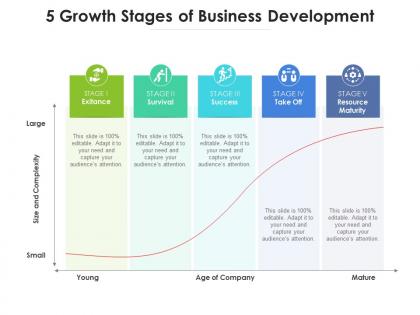
5 growth stages of business development




Try Before you Buy Download Free Sample Product
 Impress Your
 Audience
 100%
100% Editable
 Save Hours
 of Time


Our 5 Growth Stages Of Business Development are topically designed to provide an attractive backdrop to any subject. Use them to look like a presentation pro.
People who downloaded this PowerPoint presentation also viewed the following :
5 growth stages of business development with all 2 slides:
Use our 5 Growth Stages Of Business Development to effectively help you save your valuable time. They are readymade to fit into any presentation structure.
FAQs for 5 growth stages
Dude, startup life is pure chaos - you're basically throwing your idea at the wall to see if it sticks. Cash disappears way too fast (seriously, where does it all go?). Most of your time gets spent figuring out if people actually want what you're building. Your team's tiny so everyone does everything. Revenue? What revenue lol. You're probably living off your savings or whatever funding you scraped together. The whole thing is about staying flexible and cheap. When customers tell you something sucks, you better be ready to change direction fast. It's survival mode 24/7.
Honestly, you'll know when your revenue stops feeling like a rollercoaster every month. Growth stage hits when you're hiring people faster than you can train them (been there, it's chaos but good chaos). Your sales process actually works consistently instead of crossing your fingers each time. The shift is pretty obvious - you stop asking "will this even work?" and start thinking about scaling up. Monthly recurring revenue and customer lifetime value both climb steadily. Oh, and you're reinvesting profits into expansion rather than just scraping by. Customer acquisition becomes predictable too, which feels weird after the startup scramble phase.
So during growth stage, market research is basically your GPS - keeps you from expanding into the wrong places or moving too fast. I've watched way too many companies mess this up honestly. You want to find new customer segments while keeping your original base happy. Also helps you catch trends early before your competitors notice. The tricky part? Don't get stuck overthinking all the data when there's obvious opportunities sitting right there. Speed matters, but so does direction - you don't want to scale quickly just to realize you went the wrong way.
So basically you need to get all your processes down on paper first - like everything that's been living in your head this whole time. Then hire people who can actually run things without you breathing down their necks. Honestly, getting the right team is like 80% of this whole scaling thing. Don't chase shiny new revenue ideas yet though. Fix your current operations first because growing a messy business just gets really expensive really fast. Oh and focus way more on keeping existing customers happy vs finding new ones - it's so much cheaper. Start by making a list of what only you can do vs what you could train someone else to handle.
Honestly, price wars are a nightmare - nobody wins those. What you really need to do is figure out what makes you different and lean into that hard. Talk to your best customers this week, like your top 20%, and ask what would make them never want to leave. Focus on solving their problems better than everyone else, not just cheaper. Small improvements matter too, btw - doesn't have to be some huge innovation. Make your service so good that switching feels like a downgrade. Build those relationships because that's what actually keeps people around when competitors start circling.
Honestly, the metrics you track should change as you grow. When you're just starting out, focus on customer acquisition cost and monthly recurring revenue - basically proving people want your stuff. Growth stage? That's when retention rates and lifetime value matter most. I always think mature companies get obsessed with profit margins and competitive positioning, which makes sense I guess. But here's the thing - don't track everything! Pick maybe 3-5 core metrics per stage or you'll go crazy with all the data. Even if your numbers feel tiny right now, start tracking consistently. You'll thank yourself later when you can actually see patterns.
Customer feedback is like your startup's GPS - shows you if you're going the right way or about to crash. Early on, it validates product-market fit and tells you when to pivot. Later it drives feature decisions and shows what customers actually want vs what you assume they want. Too many founders fall in love with their original idea and totally ignore user signals (guilty of this myself once). Set up regular ways to collect feedback - surveys, interviews, digging through support tickets. I review customer input every week now. Short bursts work better than those marathon feedback sessions.
Oh man, cash flow will absolutely wreck you if you're not watching it closely. Revenue takes forever to catch up when you're expanding fast. Plus you'll probably lose that personal vibe that made your business work in the first place - I've seen it happen so many times. New locations, bigger team, but your systems are still built for when you were tiny. Quality starts slipping, communication gets messy. Honestly? Be super conservative with your cash projections and get your systems sorted before you actually outgrow them, not after.
Honestly, there's no one-size-fits-all approach here. Early on, you're probably looking at bootstrapping or hitting up friends and family. Once you've got some actual traction (not just an idea), angels and seed funds become realistic options. VCs are for when you're already growing like crazy. Oh, and don't sleep on crowdfunding - I know it sounds cheesy but I've watched companies absolutely crush it that route if their product connects with people. The trick is timing your ask right and having your numbers dialed in. Start building those investor relationships way before you need cash though. Seriously, fundraising drags on forever and you don't want to be scrambling when you're running low.
Tech can totally change how fast you hit each business stage. Early on, the right tools help you test ideas without burning cash. Scaling up? Automation saves you from drowning in all the operational mess - trust me on that one. When growth starts plateauing later, analytics and AI stuff keeps you from getting steamrolled by competitors. Timing's everything though. Jump on tech too soon and you're wasting money, wait too long and you're already behind. I always tell people to match their tech spending to where they actually are, not where they think they should be.
Honestly, marketing has to change as you grow - can't use the same playbook forever. Early days? Just focus on nailing product-market fit with direct feedback and whatever scrappy stuff works. Once you hit growth mode, double down hard on your best channels and scale them fast. I swear, founders always wait too long to stop doing everything themselves and actually build proper systems. When you reach maturity, it's about efficiency optimization and maybe testing new markets. The trick is catching when your current approach stops working and not being stubborn about switching things up.
Sounds like you're hitting that mature phase, honestly. Revenue's still growing but way slower than those wild early days. Your market share has basically flatlined, competition's fierce, and everything feels more predictable now. Customer acquisition costs are probably climbing too - all the low-hanging fruit is gone. Time to pivot your strategy, really. Focus less on rapid expansion and more on squeezing better margins from what you've got. Maybe look into new products or markets if you want that growth spark back. It's not a bad thing though, just means you've gotta be smarter about where you spend energy.
Honestly, you gotta stop trying to do everything yourself as you grow. When it's just you or maybe 2-3 people, sure - be that control freak who handles it all. But once you hit like 10+ people? Time to let go and actually trust your team to make decisions. I made this mistake big time with a 15-person team - total disaster lol. The mature stage is weird though, you become more of the "big picture" person while your managers deal with daily chaos. Real talk: most founders wait way too long to change their style and it kills momentum.
Honestly, you need a scalable business model or you'll hit a wall fast. It's like building a machine that pumps out 10x more without needing 10x the resources - that's where you actually make money. Without it, you'll burn out trying to handle everything manually (trust me, I've seen it happen). The trick is figuring out what you can automate or delegate before you're drowning. Map out your current processes and ask yourself "how would this work with 5x more customers?" Don't wait until you're already overwhelmed to think about it.
Dude, partnerships are seriously underrated. They let you tap into new markets and customers without dropping crazy money upfront. Find companies that hit your same audience but aren't competing - like a software company teaming up with consultants. Joint ventures and referral programs work great too. I swear, the fastest companies I've seen grew through smart partnerships, not grinding solo. Oh, and co-marketing campaigns are clutch if you do them right. Start by figuring out what you're missing, then see which companies could fill those gaps. It's basically borrowing each other's strengths.
-
Excellent template with unique design.
-
Unique design & color.
-
Presentation Design is very nice, good work with the content as well.
-
Excellent Designs.