

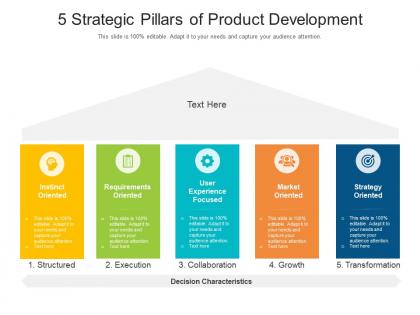
5 strategic pillars of product development




Try Before you Buy Download Free Sample Product
 Impress Your
 Audience
 100%
100% Editable
 Save Hours
 of Time


Our 5 Strategic Pillars Of Product Development are topically designed to provide an attractive backdrop to any subject. Use them to look like a presentation pro.
People who downloaded this PowerPoint presentation also viewed the following :
5 strategic pillars of product development with all 2 slides:
Use our 5 Strategic Pillars Of Product Development to effectively help you save your valuable time. They are readymade to fit into any presentation structure.
FAQs for 5 strategic pillars
So there's like 6 main stages: ideation, validation, design, development, testing, and launch. But honestly? They're way more messy and connected than any textbook tells you. Start with finding real market problems and coming up with solutions. Then validate with actual users before you waste months building something nobody wants. Design and development come next, obviously. Testing is huge - don't skip it. Launch involves all your go-to-market stuff. Here's the thing though - don't do these in order like some robot. Build feedback loops everywhere so you can pivot fast when things inevitably go sideways.
Dude, you really can't skip market research if you want to build something people will actually buy. Survey your potential customers first, run some focus groups, check out what similar products are doing. Otherwise you're just guessing and hoping for the best - which honestly never works out well. Small research chunks before each big development phase will save you so much headache later. Focus on validating demand early and figuring out which features users actually care about. Your gut instincts are probably wrong (sorry, but they usually are). Look for gaps your competitors missed too. Way better than building something nobody wants.
Dude, customer feedback is literally everything when you're deciding what features to build. I mean, it shows you what people actually want instead of what you're just guessing they want. Collect it early, collect it often - surveys, interviews, watching how people use your stuff. Too many teams (mine included, oops) just build random features and then act shocked when nobody cares. Balance what users ask for with where you want the product to go. But here's the thing - don't just hoard all that feedback. Actually do something with it or you're wasting everyone's time.
Honestly, just focus on three things: what users actually need, how much money it'll make, and how hard it is to build. Figure out your users' biggest headaches first - that's usually where you want to start. Then do the math on revenue vs development time. Don't get too fancy with this stuff though. RICE scoring works great if you want something simple (Reach, Impact, Confidence, Effort). The hardest part? Saying no to all those shiny features that seem cool but won't actually move the needle. Trust me, you'll thank yourself later for being picky about what makes the cut.
Track both leading and lagging stuff to get the whole story. User adoption is key - DAU/MAU, retention rates, time to value. Business metrics matter too: revenue growth, customer acquisition cost, lifetime value. Honestly, the soft metrics are where most people mess up. Net Promoter Score and customer satisfaction tell you if people actually *like* your product. Feature usage shows what's working. But seriously, stick to 3-5 core metrics max. More than that and you'll just confuse yourself. Set up a simple dashboard you can glance at weekly and call it good.
Honestly, start with making people feel safe to share weird ideas without getting shut down. Give teams actual time to mess around - hackathons, 20% projects, whatever works. The key thing I've noticed? Companies freak out when experiments don't immediately make money, which totally defeats the point. Get different departments talking to each other more often. Your frontline people usually know what customers actually want better than executives do. Oh, and this is huge - celebrate when people try stuff, even if it flops. That's how you get real innovation instead of just... safer versions of what you're already doing.
So Agile basically flips everything on its head - you work in these short 2-week chunks instead of planning forever upfront. Build something small, get feedback, then adjust. Way better than guessing what people want for months (been there, it sucks). You catch issues super early and can actually pivot when stuff isn't working. The cool part? Your product grows based on real user needs, not whatever assumptions you had initially. Honestly once your team clicks with it, you'll wonder how you ever worked differently. Just start with short sprints and see what happens.
Dude, these tools are game-changers for keeping everyone on the same page. No more digging through a million emails to find that one decision from last week. Everything lives in one spot - your convos, docs, project updates, the whole mess. Slack and Figma honestly changed my life (okay maybe that's dramatic but seriously). Your designers can see what engineering's up to, PMs know about roadblocks instantly. Cuts meeting time in half since people actually know what's happening. Don't go crazy though - just pick one tool that plays nice with whatever you're already using.
Honestly, the worst mistake is building something nobody actually wants - validate demand first! Feature creep will kill your MVP too, trust me on that one. Don't ignore real users just because some exec has opinions. We're all terrible at estimating timelines, so pad them. Competitive research matters more than you think. Technical debt from rushing? Yeah, that'll bite you later. Resource allocation gets messy fast when teams try doing everything simultaneously. My take: start stupid small, talk to users constantly, and expect weird stuff to go wrong.
Honestly, the biggest thing is making sure whatever you're building actually helps the business hit its goals - revenue, new markets, keeping customers happy, whatever. Map out your roadmap against those objectives so you're not just building random cool features that go nowhere (trust me, I've been there). Track metrics that actually matter to leadership, like how your new stuff affects customer lifetime value or what it costs to bring people in. Oh and definitely do regular check-ins with stakeholders. It's annoying but keeps everyone on the same page so you don't waste months going in circles.
So instead of doing everything step by step, run stuff at the same time - like have marketing figure out messaging while engineering's still coding. Cross-functional teams help tons because you're not constantly waiting for someone else to finish their piece. MVP is your friend here too. Launch with the basics and add features later based on what users actually want (not what you think they want, which is usually wrong anyway). The trick is being ruthless about what you truly need for launch vs what would just be nice to have. Start by making that list first.
So competitive analysis is clutch for avoiding building features that already exist everywhere. You'll catch what's actually innovative vs just basic requirements - saves you money and time honestly. I love finding stuff competitors totally botched lol. The bigger win though? Understanding market direction so you're not always behind. Quick tip - do a competitive check every few months. Google alerts work great for tracking your main rivals. Just dump everything in a basic spreadsheet. Nothing fancy needed but you'd be surprised how much intel you gather over time.
Honestly, start thinking about this stuff from day one - user privacy, data security, all that. Who could your product accidentally screw over? Build in protections against bias and addiction early. Environmental impact is huge too (wish more teams cared about this tbh). Don't forget accessibility - are you locking out entire groups of people? The trick is making ethics part of your regular sprint planning, not some box you check later. Someone on your team needs to actually own this and call out problems when they see them.
Honestly, tech can totally speed up your whole dev process if you use it right. Data analytics tools are where I'd start - they'll show you customer patterns and market gaps you probably never noticed. Automation saves you weeks on testing and prototyping (seriously, why do that manually?). AI's pretty good for predictive modeling too, so you can see if your product might flop before dumping money into it. Cloud stuff makes team collaboration way smoother. Just don't go crazy trying to implement everything - pick 2 or 3 tools that actually fix your biggest problems first.
Dude, prototyping is literally your sanity saver. Test stuff early before you waste months building the wrong thing. I always tell people - match your prototype to what you're actually trying to figure out. Paper sketches work great at first, then you can get fancier later. Don't overthink it though, I've watched teams spend forever perfecting prototypes when they should've been getting user feedback. The messier early versions are honestly where you learn the most. Just start somewhere and keep iterating - your future self will thank you when you're not scrambling to fix massive problems right before launch.
-
Perfect template with attractive color combination.
-
Very unique, user-friendly presentation interface.
-
Amazing product with appealing content and design.