


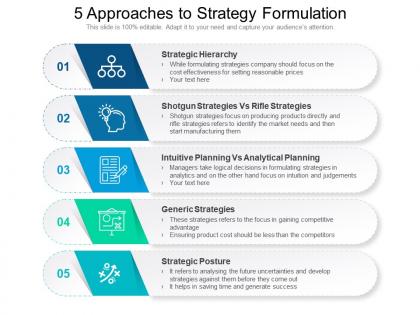
5 approaches to strategy formulation




Try Before you Buy Download Free Sample Product
 Impress Your
 Audience
 100%
100% Editable
 Save Hours
 of Time


Our 5 Approaches To Strategy Formulation are topically designed to provide an attractive backdrop to any subject. Use them to look like a presentation pro.
People who downloaded this PowerPoint presentation also viewed the following :
5 approaches to strategy formulation with all 2 slides:
Use our 5 Approaches To Strategy Formulation to effectively help you save your valuable time. They are readymade to fit into any presentation structure.
FAQs for 5 approaches
Four things you'll need to nail down: first, really dig into your competitive landscape and internal strengths - most teams totally rush this part, which is a mistake. Second, set a vision that's specific enough to actually guide decisions, not just sound pretty. Generate multiple strategic options too (don't get married to your first brilliant idea). Last bit is mapping out realistic implementation with clear owners. Oh, and block out real time for analysis before you start brainstorming solutions - I know it's tempting to jump straight into the fun stuff, but the groundwork matters.
Get your SWOT done early in the planning process - don't save it for last. Be brutally honest about weaknesses (seriously, lying to yourself helps nobody). The real win comes from matching your strengths to opportunities you spot in the market. Also build plans to fix weak spots and handle threats. Once it's mapped out, pick the biggest issues and create actual initiatives around them. Oh, and update it regularly since things change fast. I learned this the hard way when we kept using outdated analysis for months.
Honestly, competitive analysis is just figuring out what your rivals are up to so you can make better moves. Map out your top 3-5 competitors first - I'd check on them quarterly or so. Look at their strengths, weaknesses, and where they're positioning themselves. It's kind of like chess where you can't just focus on your own pieces, you know? The whole point is spotting gaps you can jump into, threats coming your way, and ways to actually stand out. Without doing this homework, you're basically flying blind and hoping for the best.
Think of your company culture like invisible boundaries around strategy - it literally controls what ideas you'll even entertain. Risk-taking cultures go for the big, disruptive moves. Meanwhile, conservative "we've always done it this way" places (ugh, we've all worked at those) stick with baby steps and playing it safe. Implementation gets shaped by this too - collaborative teams execute way differently than top-down hierarchies. Honestly, the biggest mistake is picking a strategy that fights against your actual culture. You'll just end up with everyone dragging their feet and wondering why nothing's working.
Here's what I'd do for forecasting in strategy work: scenario planning is gold because you get to map out different "what if" situations. Historical trend analysis helps too - basically looking at past patterns to predict future ones. The Delphi method pulls in expert opinions, though honestly getting a bunch of experts to agree on anything is pretty much impossible. Environmental scanning catches those early warning signals before they become big problems. Cross-impact analysis shows how trends affect each other. Don't put all your eggs in one basket though - mix 2-3 methods for better results.
Dude, you'll catch so many blind spots by getting stakeholder input early. Customers and employees see stuff you totally miss. But here's the thing - people actually want to support ideas they helped build, which honestly saves you from pushback later. I learned this the hard way on a project last year. The real constraints become obvious too, not just what looks good on paper. Short version: those conversations aren't just nice-to-haves. Schedule them first, not as some checkbox at the end. Way better ideas come out of it.
Ugh, the worst thing you can do is get stuck researching forever instead of just making a call. Analysis paralysis is real! Don't try pleasing everyone either - you'll end up with some watered-down strategy that means nothing. I see people copying competitors all the time, but their situation is totally different from yours. Get input from actual workers, not just executives who haven't touched the ground level in years. Also be realistic about timelines and what you can actually pull off. Focus on maybe 2-3 things max, get different perspectives when planning, and check in regularly to adjust course.
Your leadership style basically determines how you build strategy from day one. Collaborative leaders bring in tons of different voices and get people on board, though it drags out the process. Meanwhile, autocratic types make quick calls but often miss crucial details or deal with pushback later. I've honestly watched both methods completely fall apart. Transformational leaders usually come up with more creative strategies since they're all about the big vision. Transactional ones? They stick to small, steady improvements. Really comes down to reading the room and adapting instead of just doing what feels comfortable.
Dude, it's massive. Misaligned strategy and execution = guaranteed disaster. Picture training for a marathon when you can't even finish a 5K (guilty as charged). Your team gets confused, deadlines get blown, and everyone's frustrated as hell. But when everything clicks? People know exactly what to do and actually have the tools to pull it off. I'd say check your capabilities against your goals pretty regularly - like every quarter or so. Then you can either dial back the ambitious stuff or invest in building up what you're missing. Way better than crossing your fingers and hoping.
So basically you build out 3-4 different "what if" scenarios – best case, worst case, maybe a couple realistic ones in between. Then test how your strategy holds up in each situation. It's actually pretty interesting once you dive in, though I'll warn you it can get addictive lol. The whole point is seeing which strategies work no matter what happens vs. which ones completely fall apart if your assumptions are wrong. Most people just plan for one future and pray. But if you map out early warning signs for each scenario, you'll know when to change course before you're totally screwed.
Honestly, I'd go with strategy maps first - they show how your goals connect which is pretty clutch. Decision trees work great when you've got a bunch of sequential choices to make. Scenario planning matrices help with those "what if this totally bombs" situations. Oh, and those simple 2x2 grids? Like impact vs effort or whatever fits your situation. They look basic but they actually work really well. I always end up coming back to them. Pick whatever matches what you're trying to figure out and don't overthink it - that's where people usually mess up.
Honestly, digital stuff makes planning feel impossible sometimes. Your old 5-year strategies? Forget about it. Technology moves way too fast now. I'd start doing quarterly check-ins instead of those massive annual planning sessions. Real-time data beats those dusty reports every time. Plus you've got to think about how customers actually behave online now – they're totally different than they used to be. The whole mindset shift is wild though. Instead of making one big plan and sticking to it, you're basically planning to keep changing. Sounds exhausting but that's where we're at.
Honestly, metrics are like a gut check for your strategy - they'll tell you what's actually happening vs what you're hoping is happening. Start with baseline data to find gaps, then watch leading indicators so you can pivot before things go sideways. I've watched so many good strategies crash because people ignored the early red flags. Pick metrics that actually connect to your goals though, not just stuff that makes pretty slides. Oh and definitely review them regularly - like actually schedule it or it won't happen. When the data contradicts your plan, listen to it.
You'll get way better strategy when different departments actually talk to each other. Finance catches budget issues you'd never think of. Sales knows what customers are actually complaining about. Operations can tell you if something's even doable - saved me from a few disasters honestly. Marketing spots competitive stuff leadership misses. When people help build the plan, they don't just roll their eyes at it later. They actually execute because it was partly their idea. Try pulling in 2-3 department heads next time you're planning. The conversation gets so much richer. You'll wonder why you didn't do it sooner.
Honestly, feedback and iteration are everything. Your first strategy? It's basically an educated guess. You've got to test assumptions constantly, pull data from customers and your team, then tweak things. I learned this the hard way - strategy definitely isn't something you can just set and walk away from. The winning strategies go through tons of refinement cycles based on what's actually happening in the real world. Build regular check-ins into your process to see what's bombing and what's crushing it, then don't be stubborn about pivoting when the numbers are screaming at you.
-
Easily Editable.