

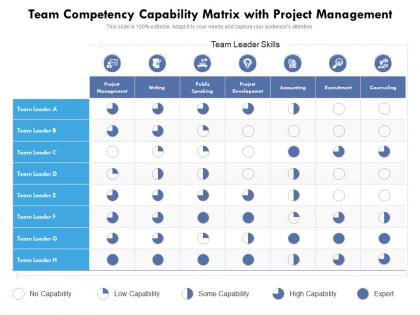
Team competency capability matrix with project management




Try Before you Buy Download Free Sample Product
 Impress Your
 Audience
 100%
100% Editable
 Save Hours
 of Time


Our Team Competency Capability Matrix With Project Management are topically designed to provide an attractive backdrop to any subject. Use them to look like a presentation pro.
People who downloaded this PowerPoint presentation also viewed the following :
Team competency capability matrix with project management with all 2 slides:
Use our Team Competency Capability Matrix With Project Management to effectively help you save your valuable time. They are readymade to fit into any presentation structure.
FAQs for Team competency capability matrix
So a Team Competency Matrix is basically a visual map showing everyone's skill levels across different areas you need covered. Picture a skills heat map - you'll instantly spot who's strong where and what gaps exist. Super helpful for project assignments and figuring out training needs. Plus you can see those scary single points of failure (like when Sarah's the only one who knows that ancient system). I honestly think the quarterly planning sessions are where these really shine - helps you avoid putting everything on one person's shoulders. Quick tangent but we learned this the hard way when our lead dev left mid-project last year.
So a Team Competency Matrix is basically a skills cheat sheet for your whole team. No more awkward "hey does anyone know how to..." conversations in Slack. You just check the matrix and boom - there's who you need to talk to. Sarah might be sitting right there but you had no clue she's a Python wizard, you know? The matrix fixes that weirdness. People can find mentors easier too when they see skill gaps laid out. Honestly, it saves so much time. Just start simple - pick like 5-6 skills your team actually uses and rate everyone's levels. Don't overcomplicate it at first.
So you'll need the actual skills list first - both technical stuff and soft skills that matter for your team. Then map out who's on your team and create some kind of rating system. I like beginner/intermediate/advanced but whatever works for you. The magic happens when you add a section for gaps and development goals though - that's honestly the most useful part. Oh, and definitely get your team involved in picking the competencies or they'll think it's just another corporate thing. Start basic and tweak it as you go. Way easier than trying to perfect it upfront.
Don't just pick one method - you need a mix. Have people rate themselves first, then get feedback from their teammates and see how they actually perform day-to-day. Honestly, most people are pretty realistic about what they can and can't do if you ask the right way. Look at their past projects, any certs they have, stuff like that. Oh and don't make it a one-and-done thing. Skills change constantly. I'd do quarterly check-ins to keep the matrix current, but frame it as growth conversations, not performance reviews.
So basically, map out everyone's current skills first - that's your starting point. A competency matrix shows you exactly where the gaps are, which means no more boring generic training sessions that waste everyone's time. Honestly, those are the worst. You can build actual personalized development plans for each person instead. Track their progress as they go, and boom - you've got solid data to show leadership why the training budget was worth it. It becomes this clear roadmap for who needs what training and when. Way more targeted than just throwing everyone into the same workshops.
Just adapt the categories and skill levels to fit your team. Tech folks might focus on coding languages and frameworks. Marketing teams? Campaign management and analytics stuff. Don't overthink making it perfect right away - I've watched teams waste weeks on that. Start simple with 5-7 core competencies your team actually needs. You can always tweak the rating scale later (maybe 1-3 instead of 1-5 for smaller groups). The whole point is helping you make smarter decisions about people, so begin with what matters most and adjust as you go.
Honestly? People get weird about rating themselves - they either way undersell or totally oversell their abilities because they're scared of being judged. Plus there's always that eye-roll factor where everyone thinks it's just another HR thing that'll vanish by next quarter. I'd say be super transparent that this isn't for performance reviews, it's actually about development and figuring out what resources you have. Maybe start with just one skill area first? Get some quick wins under your belt. The collaborative approach works way better than just dropping it on people from above - trust me on that one.
Honestly, a competency matrix is super helpful for succession planning because you can actually see who has what skills instead of just winging it. Like, you'll spot exactly which people are almost ready for bigger roles versus who needs way more development time. The best part? No more panic when someone quits and they're literally the only person who knows how to do something critical. I'd start by figuring out your most important positions first, then map out what skills those roles need. From there you can see who's closest to being ready. It sounds boring but it's actually pretty eye-opening once you do it.
Honestly, I'd just start with Google Sheets - it's free and you probably already know how to use it. Test out your whole approach there first. Once you figure out what actually works for your team, then maybe look into the fancier stuff like Skills Base or AG5. Those are built specifically for competency tracking so they've got way more bells and whistles. Notion's pretty solid too if you want something in between a basic spreadsheet and full software. But seriously, don't overthink it at first. Most people get caught up picking the perfect tool when a simple sheet would've gotten them started weeks ago.
Quarterly reviews work well for most teams, but don't get too hung up on that schedule. Update it whenever big stuff happens - new hires, training completions, project shifts. Monthly check-ins during regular meetings help catch gaps before they bite you. Some agile teams I've worked with do updates after sprint retros, which honestly makes a lot of sense. The real trick is keeping it current so it's actually useful - not another doc gathering digital dust. Quick pulse checks beat formal reviews anyway.
Honestly, competency matrices are game-changers for performance reviews. Instead of going off vibes, you've got actual criteria to point to. Makes the whole thing less weird since you're both looking at the same standards. I love how you can track someone's progress over months - way easier to see patterns that way. Short sentences work well here. Also helps you figure out what skills your whole team is missing during review season. Oh, and definitely use it during one-on-ones to keep things on track. Trust me, it'll make those conversations so much more focused and less awkward.
Honestly, just map what skills your team has now vs what you'll need for upcoming projects. The gaps jump out at you pretty quick. Like if your whole team sucks at data analysis but you've got three analytics-heavy projects coming up - boom, there's your answer. Makes those budget meetings way less painful when you can actually show what you need. Sometimes you'll realize someone internal is ready to step up instead of hiring from scratch. Oh and definitely update this thing every few months. Share it with your team too - they love seeing where they can grow.
Keep it visual - nobody wants to stare at some messy spreadsheet. Color coding works great for showing skill levels quickly. Here's the thing though: don't try to cover every single competency. I've watched so many presentations drag on forever when you really just need 3-4 critical gaps that matter for your upcoming projects. Heat maps are your friend here. Always have development plans ready because that's literally the first question they'll ask. Oh, and connect it back to business results - like how fixing these gaps reduces project risks or improves outcomes. That's what actually gets their attention.
Honestly, these matrices are game-changers because they make skill gaps impossible to ignore. Your team can actually see where everyone stands, so people start asking "how do I level up my Python skills?" instead of just wandering around confused. The transparency creates this natural mentoring thing too - you'll spot who can help whom pretty quickly. I've seen teams where knowledge sharing just starts happening on its own once they implement this. Just don't be one of those people who creates it then never touches it again (we've all been there). Update it regularly and bring it up in your one-on-ones.
So Netflix does this "keeper test" thing to spot their best people and find skill gaps. Google's Project Oxygen actually boosted team performance by 75% just by mapping what good managers do. We did something similar with our engineering team last year - honestly saved us from some major knowledge bottlenecks. Spotify uses theirs for squad planning too. The real trick though? Don't just build it and leave it sitting there. These companies actually use the data for hiring and figuring out who goes on what project. Oh, and update it every quarter or it'll get stale fast.
-
Very unique and reliable designs.