


Team skill capability assessment corporate program improving work team productivity




Try Before you Buy Download Free Sample Product
 Impress Your
 Audience
 100%
100% Editable
 Save Hours
 of Time


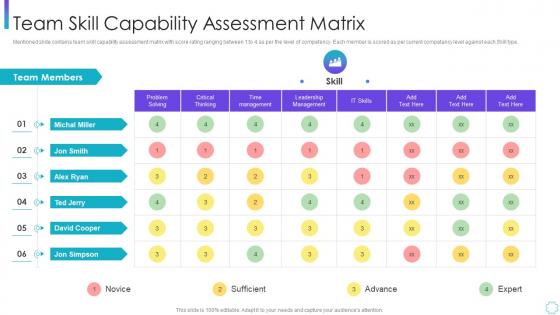
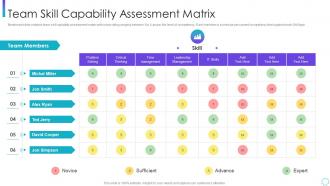
Mentioned slide contains team skill capability assessment matrix with score rating ranging between 1 to 4 as per the level of competency. Each member is scored as per current competancy level against each Skill type.
People who downloaded this PowerPoint presentation also viewed the following :
Team skill capability assessment corporate program improving work team productivity with all 6 slides:
Use our Team Skill Capability Assessment Corporate Program Improving Work Team Productivity to effectively help you save your valuable time. They are readymade to fit into any presentation structure.





FAQs for Team skill capability assessment corporate program improving
Key performance indicators for team capability evaluation include productivity metrics, quality scores, collaboration effectiveness, skill proficiency ratings, and goal achievement rates. These KPIs enable organizations to identify strengths and development areas through measurable data, with many companies finding that regular capability assessments ultimately enhance resource allocation, optimize training investments, and deliver sustained competitive advantage.
Qualitative assessments enhance quantitative metrics by capturing communication skills, collaboration dynamics, adaptability, leadership potential, and cultural alignment that numbers alone cannot measure. Through structured interviews, peer feedback, and behavioral observations, organizations gain deeper insights into team strengths and development needs, ultimately delivering more comprehensive talent strategies and improved team performance.
Team diversity enhances capability assessment by bringing varied perspectives, experiences, skills, and problem-solving approaches that reveal comprehensive organizational strengths and gaps. This multifaceted evaluation enables more accurate identification of collective capabilities, with diverse teams in sectors like consulting, healthcare, and technology finding that varied backgrounds ultimately deliver deeper insights, reduced blind spots, and more robust strategic planning.
Technology tools streamline team capability assessment by automating data collection, providing real-time analytics, and enabling standardized evaluation frameworks across departments. Through AI-powered platforms and integrated assessment software, organizations enhance accuracy in skill mapping, reduce administrative overhead, and accelerate decision-making processes, ultimately delivering more strategic workforce planning and competitive talent optimization.
Best practices for conducting team capability assessment workshops include structured skill mapping, peer evaluation sessions, competency gap analysis, individual development planning, and actionable feedback mechanisms. These workshops enhance team performance by identifying strengths, addressing skill gaps, and creating targeted development paths, with many organizations finding that regular assessments improve collaboration, productivity, and strategic alignment across departments.
Teams should undergo capability assessments quarterly for rapid skill evolution industries and annually for more stable sectors, with continuous micro-assessments integrated into regular workflows. Many organizations combine formal biannual reviews with ongoing performance analytics, enabling proactive skill development, strategic resource allocation, and competitive positioning while maintaining workforce agility in increasingly dynamic business environments.
Common pitfalls include relying solely on self-assessments without objective validation, focusing only on technical skills while neglecting soft skills, and conducting assessments without clear performance metrics or benchmarks. These oversights can lead to inaccurate capability mapping, with many organizations finding that comprehensive assessments incorporating peer feedback, real project outcomes, and structured competency frameworks deliver more actionable insights for strategic workforce planning.
Feedback loops improve team capability evaluations by incorporating continuous input from multiple stakeholders, real-time performance data, and iterative assessment cycles that capture evolving skills and competencies. These mechanisms enable organizations to move beyond static annual reviews, with many companies finding that regular feedback from peers, clients, and project outcomes delivers more accurate capability mapping and strategic workforce planning.
**INPUT**: What methods can be used to assess both hard and soft skills within a team? **OUTPUT**: Team skill assessment methods include technical evaluations, behavioral interviews, 360-degree feedback, peer reviews, and project-based assessments. These approaches streamline talent evaluation by combining performance metrics, collaborative observations, and competency frameworks, with many organizations finding that strategic skill mapping enhances resource allocation, identifies development opportunities, and ultimately delivers stronger team performance and competitive advantage. [Word count: 58 words]
Team capability assessments drive strategic planning by identifying skill gaps, performance strengths, workforce readiness, and development priorities across departments. Through comprehensive evaluation frameworks, organizations can align talent with strategic objectives, optimize resource allocation, and accelerate project timelines, with many companies finding that targeted capability mapping ultimately delivers enhanced operational efficiency and competitive advantage.
Leadership style significantly influences team capability assessments by affecting communication patterns, performance visibility, and development opportunities within teams. Transformational leaders often reveal higher team capabilities through enhanced collaboration and innovation, while micromanaging styles may suppress individual contributions, with many organizations finding that adaptive leadership approaches deliver more accurate assessments and stronger competitive advantage.
Team capability assessment results should directly shape development programs by identifying specific skill gaps, highlighting individual strengths for leveraging, and revealing collaboration patterns that need improvement. Organizations use these insights to create targeted training initiatives, strategic role realignments, and mentorship programs, with many teams finding that data-driven development approaches enhance overall performance and accelerate professional growth outcomes.
Ethical considerations include maintaining confidentiality, ensuring fair and unbiased evaluation criteria, obtaining informed consent, providing transparent feedback processes, and protecting employee data privacy. These principles enhance trust and accuracy by creating psychological safety, reducing assessment anxiety, and encouraging honest self-reflection, ultimately delivering more reliable capability insights and stronger team engagement.
Organizations ensure alignment by linking assessment criteria directly to strategic objectives, key performance indicators, and required competencies for business success. Through regular stakeholder consultations, competency mapping, and goal-setting frameworks, companies can evaluate team strengths against actual business needs, ultimately identifying skill gaps and development priorities that drive organizational growth and competitive advantage.
**INPUT**: What frameworks exist to standardize team capability assessment across departments? **OUTPUT**: Standardized team capability assessment frameworks include competency mapping models, skills matrices, 360-degree feedback systems, performance benchmarking tools, and cross-functional evaluation protocols. These frameworks streamline talent management by establishing consistent evaluation criteria, enabling strategic resource allocation, and facilitating targeted development programs, with many organizations finding that standardized assessments ultimately enhance operational efficiency and competitive advantage. [Word count: 58 words]
-
Unique research projects to present in meeting.
-
Commendable slides with attractive designs. Extremely pleased with the fact that they are easy to modify. Great work!