


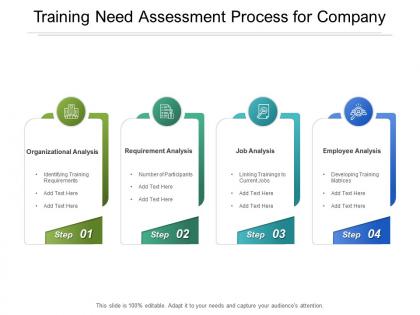
Training need assessment process for company




Try Before you Buy Download Free Sample Product
 Impress Your
 Audience
 100%
100% Editable
 Save Hours
 of Time


Our Training Need Assessment Process For Company are topically designed to provide an attractive backdrop to any subject. Use them to look like a presentation pro.
People who downloaded this PowerPoint presentation also viewed the following :
Training need assessment process for company with all 2 slides:
Use our Training Need Assessment Process For Company to effectively help you save your valuable time. They are readymade to fit into any presentation structure.
FAQs for Training need assessment
Key components of an effective training needs assessment include organizational analysis, task analysis, individual performance analysis, gap identification, and priority setting. These components work together by examining strategic goals, job requirements, and current skill levels, ultimately delivering targeted training programs that enhance performance, reduce skill gaps, and improve organizational effectiveness across departments.
Organizations identify skill gaps through comprehensive performance evaluations, employee self-assessments, manager observations, competency mapping, and regular feedback sessions with team members. These assessment methods enable companies to pinpoint specific training requirements across departments, ultimately enhancing productivity and employee development while ensuring workforce capabilities align with evolving business objectives.
Data gathering methods for training needs assessment include surveys and questionnaires, focus groups, one-on-one interviews, performance reviews, and observational techniques. These approaches enable organizations to identify skill gaps, training priorities, and development opportunities across departments, with many companies finding that combining multiple methods delivers more comprehensive insights and ultimately enhances employee performance and operational efficiency.
Employee input directly influences training needs assessment outcomes by identifying skill gaps, revealing performance barriers, and highlighting learning preferences that management might overlook. Through surveys, interviews, and focus groups, organizations capture frontline insights that shape more targeted training programs, with many companies finding that employee-driven assessments result in higher engagement rates and better skill retention outcomes.
Performance management data serves as a critical foundation for training needs assessment by identifying skill gaps, performance trends, competency deficiencies, and areas where employee capabilities fall short of organizational standards. This data enables HR teams and managers to design targeted training programs that address specific performance challenges, ultimately improving individual productivity, team effectiveness, and organizational outcomes while ensuring training investments deliver measurable returns.
A training needs assessment aligns with organizational goals by identifying skill gaps that directly impact strategic objectives, analyzing performance metrics against desired outcomes, and mapping employee competencies to business priorities. Through systematic evaluation, organizations streamline workforce development initiatives, enhance operational efficiency, and accelerate goal achievement, with many companies finding that strategic alignment ultimately delivers measurable ROI and competitive advantage.
Common challenges during training needs assessment include resistance from employees, difficulty measuring skill gaps accurately, limited budget for comprehensive analysis, conflicting stakeholder priorities, and inadequate data collection methods. Organizations often find that overcoming these obstacles requires strategic communication, multiple assessment approaches, and clear alignment between training objectives and business goals, ultimately delivering more targeted development programs.
Technology enhances training needs assessment through automated data collection, AI-powered skill gap analysis, predictive analytics, and real-time performance tracking systems. These digital tools streamline evaluation processes by identifying competency deficits faster, personalizing learning pathways, and integrating seamlessly with existing HR platforms, ultimately delivering more targeted training programs and measurable ROI for organizations.
A training needs assessment identifies skill gaps and learning requirements before training occurs, while training evaluation measures the effectiveness and impact of training programs after completion. Assessment focuses on determining what employees need to learn through surveys, performance reviews, and competency analyses, whereas evaluation examines whether training objectives were met, ultimately ensuring organizations invest resources strategically and achieve measurable improvements in performance.
Training needs assessments vary significantly across industries due to distinct regulatory requirements, skill demands, and operational contexts. Healthcare organizations focus on compliance training and patient safety protocols, while technology companies prioritize technical certifications and innovation skills, and manufacturing emphasizes safety procedures and equipment proficiency, ultimately enabling each sector to address specific workforce challenges and maintain competitive advantage.
**INPUT**: What strategies can be implemented to ensure stakeholder buy-in during the assessment process? **OUTPUT**: Effective stakeholder buy-in strategies include transparent communication about assessment objectives, involving key stakeholders in planning phases, demonstrating clear ROI potential, and providing regular progress updates throughout the process. These approaches streamline engagement by building trust, addressing concerns proactively, and showcasing tangible benefits, with many organizations finding that early stakeholder involvement ultimately delivers stronger program support and faster implementation across departments. [Word count: 60]
Demographic diversity significantly impacts training needs through varying learning preferences, cultural backgrounds, generational expectations, and skill levels across different employee groups. Organizations must customize their training approaches by incorporating multiple delivery methods, culturally relevant examples, and flexible scheduling options, with many companies finding that diverse training strategies ultimately enhance engagement and knowledge retention.
Key metrics include learning objective achievement rates, skill gap closure percentages, employee performance improvements, training ROI calculations, and post-training competency assessments. These measurements enable organizations to track behavioral changes, productivity gains, and knowledge retention across departments, with many companies finding that systematic evaluation ultimately delivers enhanced workforce capabilities and measurable business outcomes.
Organizations maintain training needs assessment relevance through regular performance reviews, employee feedback surveys, industry trend monitoring, and continuous skills gap analysis. These strategic approaches enable companies to adapt training programs proactively, with many finding that quarterly assessments and ongoing stakeholder input deliver enhanced workforce capabilities and sustained competitive advantage.
Best practices for documenting training needs assessment findings include creating executive summaries, detailed gap analyses, prioritized recommendations, visual data presentations, and stakeholder-specific reports. These comprehensive documentation approaches streamline decision-making by presenting clear evidence, actionable insights, and implementation timelines, with many organizations finding that structured reporting enhances training program approval and resource allocation processes.
-
Amazing product with appealing content and design.
-
Very well designed and informative templates.
-
Wonderful templates design to use in business meetings.
-
Awesome presentation, really professional and easy to edit.
-
Best way of representation of the topic.
-
Enough space for editing and adding your own content.