


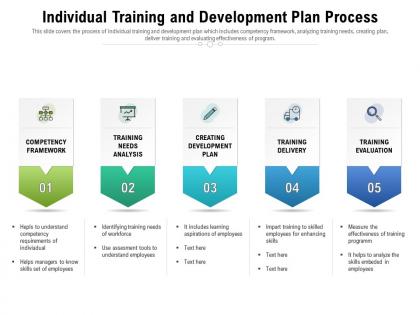
Individual training and development plan process




Try Before you Buy Download Free Sample Product
 Impress Your
 Audience
 100%
100% Editable
 Save Hours
 of Time


Our Individual Training And Development Plan Process are topically designed to provide an attractive backdrop to any subject. Use them to look like a presentation pro.
People who downloaded this PowerPoint presentation also viewed the following :
Individual training and development plan process with all 2 slides:
Use our Individual Training And Development Plan Process to effectively help you save your valuable time. They are readymade to fit into any presentation structure.

FAQs for Individual training and
Match your training to how people actually learn. Visual people need infographics and videos - they've gotta see it mapped out. Auditory learners love podcasts and group discussions where they can talk things through. Hands-on folks? Workshops and role-playing all the way. Then you've got your manual readers who want case studies they can dive into. Most people are honestly a mix though, so I'd combine 2-3 approaches in each session. Survey your team first about what works for them - seriously, the engagement boost is wild when you hit their preferred style. Worth the extra prep time.
Performance reviews are your starting point - managers usually know where people are struggling. But honestly, just asking employees directly works better than you'd think. Most people know what they suck at. Look at your company's direction too. Expanding somewhere new? Obviously that means training. I'd also watch for repeated mistakes in workflows - those scream "knowledge gap." Focus groups with different teams give you the real story about daily challenges. Mix what leadership thinks you need with what employees actually want to learn. That combo approach hasn't failed me yet.
Dude, tech has totally flipped training on its head. Mobile apps let people learn whenever they want - no more sitting through boring conference room presentations. You can build simulations, use VR for practice, and AI actually personalizes everything based on how fast someone's picking things up. The data aspect is huge too since you'll finally know what's actually sticking. LMS platforms make delivery super smooth. My advice? Figure out what's currently driving you crazy about training first. Then find specific tools that fix those exact problems. Way better than just throwing random tech at it and hoping something works.
Honestly, measuring training ROI is easier than people make it sound. Start with basics like productivity bumps, fewer mistakes, and whether people actually stick around longer. The Kirkpatrick model breaks it down into four levels - reactions all the way to real business results. Don't sleep on the softer metrics either, like engagement scores and internal promotions. Those matter way more than most companies realize. Set your baseline before training kicks off, then check back in 3-6 months to see what changed. Pick just one or two things that actually align with what your business cares about most.
Okay so first thing - send them all the boring paperwork stuff before they even start, plus like a welcome packet or whatever. Day one should be workspace ready, introduce them to key people, don't just throw them at their desk alone. That buddy system thing? Actually super helpful, I was skeptical but it works. Don't dump everything on them the first week though - that's where most people mess up. Spread the training out over 90 days with regular check-ins. Cover the technical parts of their job but also explain how your team actually works day-to-day. The cultural stuff matters more than you'd think.
Honestly, the biggest thing is protecting learning time from all those random meetings that pop up. People need to feel like it's actually part of their job, not homework they do at 7pm. Set up lunch-and-learns or skill swaps between teams - those work way better than formal training sessions in my experience. Also, celebrate the wins when someone tries something new, even if they totally bomb it the first time. Leaders have to model this too and admit when they're learning stuff. Oh, and just ask your team what they actually want to learn instead of assuming you know.
Honestly, the worst part is how distracted everyone gets at home. Kids screaming, dogs barking, phone notifications going off constantly - it's chaos. Tech problems always happen right when you're hitting your stride too. Reading the room is basically impossible when half the faces are tiny squares. Make your sessions way more interactive than normal - polls, breakouts, whatever keeps people awake. Always have a backup plan for when (not if) something crashes. Oh, and definitely send materials early so people aren't panicking during tech meltdowns. I learned that one the hard way.
Honestly, your employees are gonna be way more helpful than you think for fixing training issues. Just ask them! Do quick surveys after sessions or grab a few people for coffee chats. They'll straight up tell you when something's boring, too fast, or completely useless for their actual job. Sometimes they come up with delivery ideas that are honestly better than what the "experts" suggest. Don't just ask generic stuff like "how was it?" though - get specific about what skills they're missing or what felt outdated. Their feedback shows you exactly what's broken and what's actually working.
Dude, mandatory training is such BS - people see right through that. What actually works? Make it feel worth their time by tying it to promotions or skills they'll use tomorrow. Give them options on when/how they do it, and get their managers hyping it up too. Oh, and definitely celebrate completions with certificates or whatever. I'd start by just asking your team what they want to learn. The whole "this is important because we say so" thing never lands. Show them real benefits or they'll just phone it in. People respond way better when there's actual upside, not just corporate speak about development.
Dude, soft skills training is totally worth it. Communication and teamwork get so much better, which honestly just makes work less of a headache for everyone. People actually start collaborating instead of butting heads constantly. Your customers notice the difference too - better service, fewer complaints. Employee turnover drops because the workplace isn't toxic anymore. I'd start with communication training first, maybe some emotional intelligence stuff. Most companies see real results within like 6 months, sometimes faster. The productivity boost alone usually pays for itself. Trust me on this one - I've seen it work magic at places that were total disasters before.
Dude, mentorship is a game changer for developing your people. Pairing experienced folks with newer employees gives them guidance you just can't get from standard training. I'm talking real one-on-one support - technical stuff, office dynamics, career moves, the whole deal. Honestly? I made so many dumb mistakes early on that a good mentor could've helped me avoid. It builds confidence too when people have someone to bounce ideas off. You don't need some fancy program either - start with informal coffee meetings between senior and junior staff. Even that makes a huge difference.
Honestly, just survey your people first - find out who loves videos vs hands-on stuff vs reading. The age thing is real too. Gen Z will crush mobile learning while others need that traditional classroom vibe. Don't forget about language barriers and accessibility needs either. Flexible scheduling is huge since parents and night shift folks can't always do 9am training (learned that one the hard way). Career stages matter too - newbies need different approaches than veterans. Bottom line: same content, multiple ways to deliver it. That way everyone actually has a shot at succeeding instead of struggling through one-size-fits-all garbage.
Dude, schedule follow-ups at 1 week, 1 month, and 3 months or people forget literally everything - we're talking 70% gone in days. Let them practice immediately with real projects, not boring role-playing (though sometimes you gotta do what you gotta do). Make simple reference guides they'll actually use instead of those fancy PDFs nobody opens. Pair newbies with mentors who can walk them through stuff. Oh, and book that first follow-up before you even finish the training session - trust me on this one.
Honestly, most managers are garbage at this because they're always putting out fires. But here's what actually works: give people projects that stretch their skills beyond their comfort zone. Do regular one-on-ones about growth, not just task updates. Pair them with mentors if you can. Budget for conferences or courses - and I mean actually budget, don't just say you will. Ask each person what skills they want to develop this quarter, then make it happen consistently. The annual performance review thing is basically useless for real development.
Microlearning is probably the biggest thing right now - bite-sized stuff people can actually squeeze into their day. AI personalization is everywhere too, adapting to how you learn best. Companies are finally obsessing over ROI (about time, honestly). Skills-based training matters way more than job titles now. VR training's getting popular for hands-on work, though I still think it's kinda gimmicky. Start with microlearning modules - they're quick wins that won't stress anyone out. Oh, and everything's focused on specific capabilities rather than generic training anymore.
-
Top Quality presentations that are easily editable.
-
Commendable slides with attractive designs. Extremely pleased with the fact that they are easy to modify. Great work!