

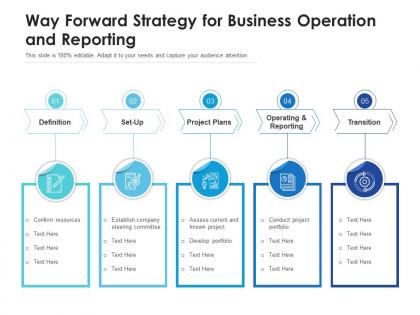
Way forward strategy for business operation and reporting




Try Before you Buy Download Free Sample Product
 Impress Your
 Audience
 100%
100% Editable
 Save Hours
 of Time


Our Way Forward Strategy For Business Operation And Reporting are topically designed to provide an attractive backdrop to any subject. Use them to look like a presentation pro.
People who downloaded this PowerPoint presentation also viewed the following :
Way forward strategy for business operation and reporting with all 2 slides:
Use our Way Forward Strategy For Business Operation And Reporting to effectively help you save your valuable time. They are readymade to fit into any presentation structure.
FAQs for Way forward strategy for business
Honestly, start with just one area - don't try fixing everything at once or you'll go crazy. Look at your data to find the actual bottlenecks, not what you think they are. Map out your customer journey and ask employees what's broken - they know where the real problems hide. Most "optimization" software is overpriced junk anyway, so be picky about tech. Streamline processes so they actually make sense (shocking concept, right?). Set up KPIs you can measure so you'll know if changes work. Then put your money and people where they'll make the biggest difference.
Look, data analytics is basically your business gut check but with actual proof. You know how you're always wondering if that marketing campaign actually worked? Numbers don't lie. Start with one thing that bugs you - maybe why sales dip in March or which customers keep bouncing. The patterns will jump out once you dig in. I used to hate spreadsheets but honestly, seeing the data click into place is pretty satisfying. You'll catch stuff you missed, like products that look fine but are quietly bleeding money. Pick something small first though - don't go crazy trying to analyze everything at once.
Honestly, training your team is one of the smartest moves you can make. Fewer mistakes, faster work, better results - it all adds up. Most companies blow their budget on fancy software but totally neglect their people (which drives me crazy tbh). Well-trained employees figure things out quicker and don't need you hovering over them constantly. Plus they actually stick around, so you're not always hiring. My advice? Look at where things get stuck most often and focus your training there first. Way better return than you'd expect.
First thing I'd do is map out everything step by step and time each part. The slowdowns will jump out at you pretty fast. Your team's gonna have the best ideas though - they're the ones actually dealing with all the annoying stuff every day. Honestly, half the problems are things we just accept as "how it's always been done." Hunt for duplicate work, those approval chains that make no sense, or anything you could automate. Focus on whatever's eating the most time first. Those quick wins feel amazing and free up energy for the trickier fixes.
Honestly, just pick the metrics that actually affect your bottom line - revenue per customer, conversion rates, and customer acquisition cost are probably your best bets. Don't sleep on the operational stuff though, like how efficient your processes are and whether your team's being productive. Customer satisfaction scores matter way more than people think. If you're launching products regularly, track how long that takes too. Oh, and seriously - stick to like 5-7 metrics max or you'll drown in spreadsheets. Measure everything for a month to get your baseline, then check quarterly to see what's working.
Honestly, automation is a game-changer if you do it right. Start with one process that's currently sucking up hours of manual work - maybe customer service or inventory tracking. Chatbots can handle basic questions while you focus on actually growing the business. Real-time data helps you make way better decisions too. Your team stops doing boring repetitive stuff and can work on things that actually matter. Yeah, it cuts down on mistakes and scales pretty easily as you get bigger. Don't try to automate everything at once though - that's how people mess it up.
Honestly, the biggest mistake is trying to fix everything at once. You'll just burn out and see zero progress anywhere. Pick one or two things max and nail those first. Oh, and definitely measure your baseline before changing anything - otherwise you're just guessing if stuff actually worked. I've seen so many teams optimize their processes but totally forget about how it impacts their actual employees or customers. Pretty counterproductive if you ask me. Start small, track the right metrics (not just the flashy ones), and don't lose sight of what you're actually trying to accomplish.
So feedback is like your cheat sheet for what's actually broken vs. what's working. Collect it through surveys, reviews, talking to people directly - then hunt for patterns. Complaints? Those show you where you're bleeding customers or money. Quick wins right there. Most companies suck at this part though, they just collect feedback and do nothing with it. Praise tells you what to keep doing more of. I'd set up some basic system to sort through everything monthly. Hit the stuff that keeps coming up first - if ten people mention the same problem, that's your answer right there.
Honestly? Start with automating the boring stuff - invoicing, social posts, basic customer replies. Cash flow's huge too - try negotiating better terms with suppliers and throw customers a small discount for paying early. Most people totally ignore retention though, which is crazy since keeping customers costs way less than finding new ones. I'd check your numbers weekly instead of monthly so you can actually catch problems fast. Oh, and don't be like me trying to fix everything at once. Pick one thing, nail it, then move on. Way less overwhelming that way.
Look, supply chain stuff might sound boring but it's literally what makes or breaks most businesses. Better supply chains = lower costs, happier customers, faster delivery times. You'll cut inventory waste and improve cash flow too. Honestly, I've seen companies transform just by fixing their supply chain bottlenecks first. Start by mapping what you're doing now - sounds tedious but trust me on this. Find your biggest pain points and tackle those. That's where you'll see results fastest. Oh, and it makes sustainability way easier if that's something you care about.
Honestly, treating optimization like a one-time thing is where most people mess up. You've gotta keep testing and tweaking stuff constantly - it becomes weirdly addictive once you get the hang of it. Market conditions change so fast now that what worked last month might be garbage today. The cool thing is your team starts naturally looking for ways to improve things instead of just going through the motions. Problems get caught early, opportunities don't slip by. Start simple though - just pick one process and ask yourself "how do we make this 10% better?" That shift in thinking changes everything.
Honestly, these tools are game-changers for cutting through all that scattered communication mess. No more digging through endless email threads to find who said what. You get real-time updates on projects, teams can share data instantly, and - this is huge - you avoid that annoying situation where two people accidentally work on the same thing. Pick something that actually fits with what you're already doing though, don't just add another platform to juggle. I'd start with whatever's driving you most crazy right now, probably communication or keeping track of tasks, then build from there.
Look, if you're not tying your optimization work to what the company actually cares about, you're gonna waste a ton of time. I've watched entire teams spend months perfecting stuff that literally didn't move the needle on revenue or customers - such a disaster. You want every improvement to connect back to real business goals like growth or retention. That way you can actually measure if it matters. Honestly, just take whatever optimization projects you're working on right now and check them against your company's top three priorities. I bet you'll find some weird gaps.
Honestly, just go after whatever's bleeding the most money or eating up your time right now. Check your data for the real bottlenecks - stuff that's actually stopping sales or pissing off customers. Don't get distracted by the easy fixes (we all do this lol). Those feel productive but won't move the needle. Score everything on impact vs effort, then knock out the quick wins first. Build some momentum before you tackle the massive projects. That way you're not burning through resources on things that sound important but don't actually matter to your bottom line.
Honestly, agility is like having a cheat code for your business. Markets flip overnight now - I swear it's getting crazier every year - so you need systems that let you pivot fast when the data shows you're heading in the wrong direction. While your competitors are still stuck following some strategy they wrote six months ago, you can test new approaches and actually adjust based on what's happening right now. Quick decisions beat perfect plans every time. Focus on building processes where you can tweak things weekly instead of waiting for monthly reviews. That responsiveness? It'll save your ass when everything inevitably changes again.
-
Informative presentations that are easily editable.
-
Great product with highly impressive and engaging designs.
-
Unique and attractive product design.
-
Attractive design and informative presentation.
-
Great quality slides in rapid time.