


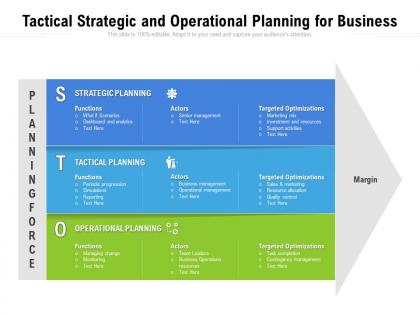
Tactical strategic and operational planning for business




Try Before you Buy Download Free Sample Product
 Impress Your
 Audience
 100%
100% Editable
 Save Hours
 of Time


Our Tactical Strategic And Operational Planning For Business are topically designed to provide an attractive backdrop to any subject. Use them to look like a presentation pro.
People who downloaded this PowerPoint presentation also viewed the following :
Tactical strategic and operational planning for business with all 2 slides:
Use our Tactical Strategic And Operational Planning For Business to effectively help you save your valuable time. They are readymade to fit into any presentation structure.
FAQs for Tactical strategic and operational
Essential components of a successful business plan include executive summary, market analysis, competitive landscape assessment, financial projections, and operational strategy. These elements work together by providing comprehensive roadmap clarity, demonstrating market viability, and securing stakeholder confidence, with many investors and lenders finding that well-structured plans significantly enhance funding opportunities and strategic decision-making capabilities.
Market research informs business planning by identifying target demographics, analyzing competitor strategies, assessing market demand, and revealing industry trends and customer preferences. Through comprehensive data analysis, businesses can make strategic decisions about product development, pricing strategies, and market positioning, while minimizing risks and maximizing resource allocation, ultimately delivering competitive advantage and sustainable growth.
Financial forecasting serves as the strategic backbone of business planning by projecting revenues, expenses, cash flows, and capital requirements across multiple time horizons. These projections enable entrepreneurs and organizations to validate business models, secure funding from investors or lenders, and make informed operational decisions, with many successful ventures finding that accurate forecasting ultimately delivers competitive advantage and sustainable growth.
Setting realistic goals involves conducting thorough market research, analyzing your resources and capabilities, establishing specific timelines, and creating measurable metrics for success. Start by examining industry benchmarks, assessing your team's capacity, and setting both short-term milestones and long-term targets, with many successful businesses finding that incremental objectives ultimately deliver sustained growth and competitive advantage.
Common business plan challenges include market research complexity, financial projection accuracy, competitive analysis depth, executive summary clarity, and revenue model validation. These obstacles can be overcome by leveraging industry databases for research, consulting financial experts for projections, and using structured templates for organization, with many entrepreneurs finding that breaking the process into phases ultimately delivers more comprehensive plans and stronger investor confidence.
SWOT analysis enhances business planning by systematically identifying internal strengths and weaknesses alongside external opportunities and threats, enabling strategic decision-making based on comprehensive organizational assessment. This structured approach helps businesses leverage competitive advantages, address vulnerabilities, and capitalize on market opportunities while mitigating risks, ultimately delivering more informed resource allocation and strategic positioning for sustainable growth.
Business plans should evolve through regular financial forecasting updates, expanded market analysis, refined operational processes, updated competitive positioning, and enhanced risk management strategies. As organizations scale, their plans must incorporate new revenue streams, strategic partnerships, and resource allocation models, with many successful companies finding that quarterly plan revisions enable sustained growth and competitive advantage.
Effectively communicating your business plan requires clear value proposition presentation, compelling financial projections, market opportunity demonstration, and competitive advantage articulation through concise executive summaries and engaging pitch presentations. Successful entrepreneurs combine data-driven insights with storytelling techniques, addressing investor concerns about scalability, risk mitigation, and return potential, ultimately delivering confidence in both the business model and leadership team's execution capabilities.
Defining your target audience during planning ensures focused resource allocation, strategic messaging alignment, and product-market fit optimization. This foundation enables businesses to streamline marketing efforts, enhance customer experiences, and minimize development costs, with many organizations finding that clear audience definition ultimately delivers higher conversion rates and sustainable competitive advantage.
Technology and data analytics enhance business planning by providing real-time insights, predictive modeling capabilities, automated forecasting tools, and comprehensive performance tracking systems. Through advanced analytics platforms, organizations streamline resource allocation, minimize planning cycles, and deliver more accurate projections, with many companies finding that data-driven planning ultimately reduces costs while improving strategic decision-making accuracy.
Startup business plans emphasize market validation, funding requirements, scalability potential, and rapid growth strategies, while corporate business plans focus on resource allocation, performance optimization, stakeholder alignment, and strategic expansion within established frameworks. Startups typically prioritize investor attraction and pivot flexibility, whereas corporations concentrate on operational efficiency and market position strengthening, with established companies finding their planning cycles more structured and comprehensive.
A business plan serves as a benchmark for measuring success by establishing specific goals, timelines, financial targets, and key performance indicators that organizations can track regularly. Through quarterly reviews and milestone assessments, companies can evaluate actual performance against projected outcomes, identify areas requiring strategic adjustments, and demonstrate progress to stakeholders, ultimately enabling data-driven decision-making and sustainable growth acceleration.
A contingency plan ensures business continuity by preparing for unexpected disruptions, market shifts, financial challenges, and operational risks that could derail strategic objectives. This proactive approach enables organizations to respond quickly to crises, maintain stakeholder confidence, and protect revenue streams, with many companies finding that comprehensive contingency planning ultimately delivers competitive advantage and operational resilience.
Visual aids like templates and charts enhance business plan presentations by organizing complex financial data, clarifying strategic relationships, improving stakeholder comprehension, and creating professional credibility. Through structured templates and data visualizations, organizations streamline investor communications, accelerate decision-making processes, and ultimately deliver more compelling proposals, with many financial institutions and venture capital firms finding that well-designed visual presentations significantly increase funding approval rates.
Compelling business plans employ clear value propositions, robust market research, realistic financial projections, detailed competitive analysis, and strong execution timelines. These strategies work by demonstrating market opportunity, validating demand through customer insights, and showcasing management expertise, with many investors finding that businesses combining comprehensive data with compelling storytelling ultimately secure funding more effectively.
-
Easily Understandable slides.
-
Visually stunning presentation, love the content.
-
The content is very helpful from business point of view.
-
Helpful product design for delivering presentation.
-
Easily Understandable slides.
-
Unique design & color.
-
Helpful product design for delivering presentation.
-
Perfect template with attractive color combination.