

Business Strategic Planning Template For Organizations Powerpoint Presentation Slides





Try Before you Buy Download Free Sample Product
 Impress Your
 Audience
 100%
100% Editable
 Save Hours
 of Time


Business Strategic Planning Template: Looking for a strategic plan that can help you attain the future goals of your organization? We bring you a content-business strategic planning template for organizations PowerPoint presentation slides to achieve the desired goal. The corporate strategic plan PPT illustrations are designed by PowerPoint professionals to track growth and establish a budget for your company. These professionally designed business strategic planning template for organizations PPT visuals will help you define your company goals clearly and will also let you conduct an extensive research to understand the latest industry trends. A variety of topics that have been thoroughly researched by our experts include executive summary, organizational chart, mission statement, SWOT analysis, company sales and performance, key success indicators, operational management, recruitment plan, brand promotion strategy, actual vs target performance, market expansion & growth. Some related topics that this strategic management presentation covers are vision & mission, business action plan, business strategy mapping, enterprise planning system and integrated business strategy. Download readymade business strategic planning presentation to provide a better and targeted services to your clients.
People who downloaded this PowerPoint presentation also viewed the following :
Content of this Powerpoint Presentation
Whether it is the management of your organization or the clients, they may ask you how your business plan and strategy will proceed for any product or service. Hence, you need to draft a thorough and specific set of documents that can help you showcase details related to the extensive planning and its execution.
However, drafting such a document from start to finish can be a bit complicated, and as every business works on a time crunch, drafting can also cost you man-hours, which can be expensive. So, what’s the solution?
The perfect way to handle such a situation is to use a pre-drafted and ready-to-use business strategy and planning template. Hopefully, SlideTeam’s 100% editable and predefined business strategic planning template can be of great use to you. This template houses everything important to strategic planning, including mission statements, key success indicators, extensive SWOT analysis, and so much more.
To learn more about the 100% editable and customizable template and its offerings, feel free to refer to some of the inclusions provided and described below for your ease.
Here’s an extensive template for strategic planning and control that you may need to showcase what you have planned for your business’s growth and development.
Template 1: Business Strategic Plan Template

This slide of the strategic planning template allows you to offer a framework for your business plan. Here, you can showcase the purpose of your plan and what you want to achieve in the given time frame. Additionally, you can also add the main objectives related to the plan. To complete such objectives, you may need to take up some initiatives to help you reach the cause sooner. You can list and explain such initiatives for a better understanding of the audience.
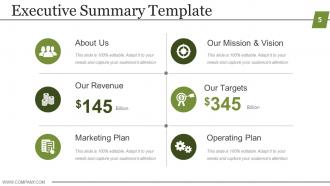
Template 2: Executive Summary Template
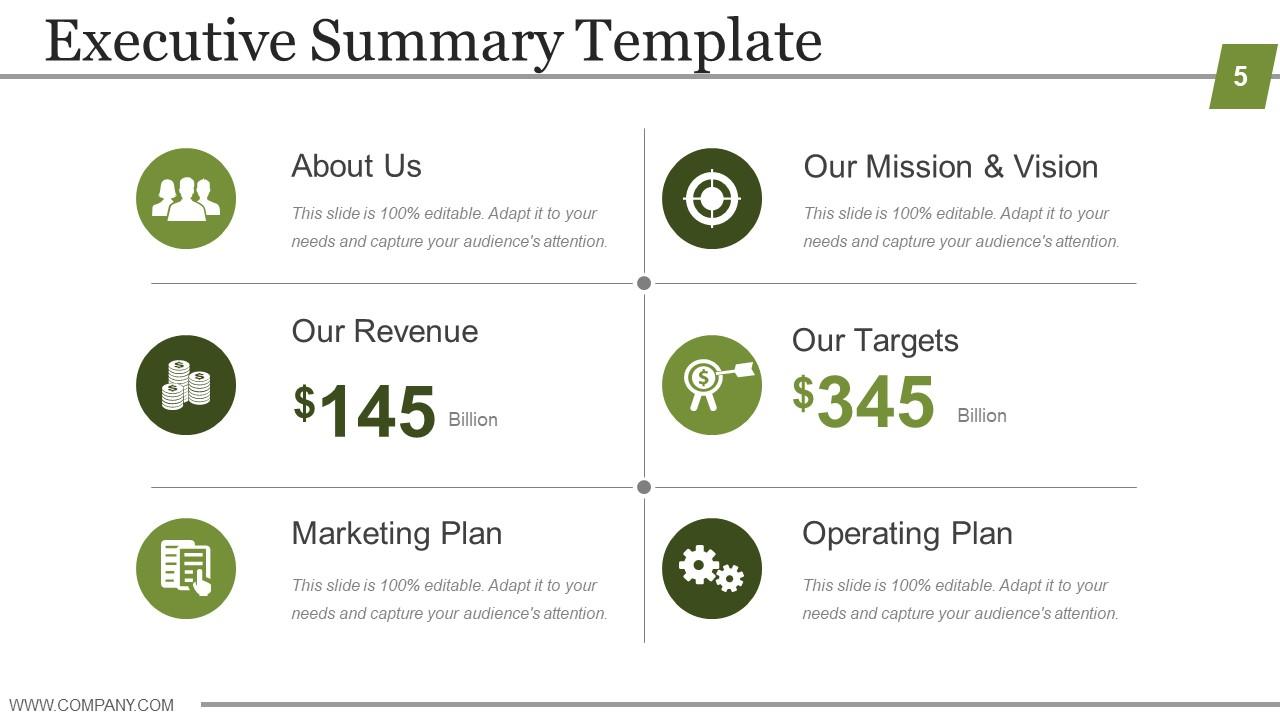
Here’s the next template offers more insights into your strategic plan in brief. Within the executive summary, you can add facts and statements related to the business like your Mission, Vision, and About Us statements, the overall revenue in the previous years (in $ US billion), and the target you have set for the plan (in $ USbillion). Thereon, you can also state the marketing and operating plan to achieve the set goals with ease.
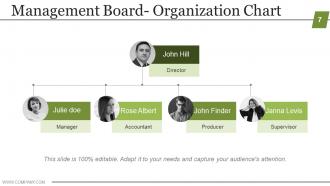
Template 3: Management Board Organization Chart

The people involved in the management board of your company matter a lot. Hence, you can take the help of this slide to showcase who represents your business and its strategic plans. Within this slide, you can use a tree chart to showcase the top and lower-level management executives. You can add the names and designations of the management personnel as well. Also, state the number of experience in each domain for every executive to strengthen your point-of-view.
Template 4: SWOT Analysis

SWOT or Strengths, Weaknesses, Opportunities, and Threats method of analysis is used by most businesses to rule out the problems and solutions in executing any plan. This slide allows you to showcase the same to your audience. Under each category of the SWOT analysis, you can add supportive text to offer deeper insights into the same. This will allow the audience to engage with business problems personally and use thinking to reach the best possible solutions.
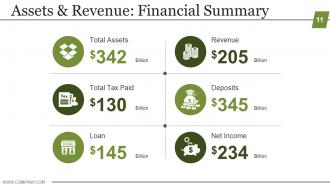
Template 5: Assets and Revenue: Financial Summary
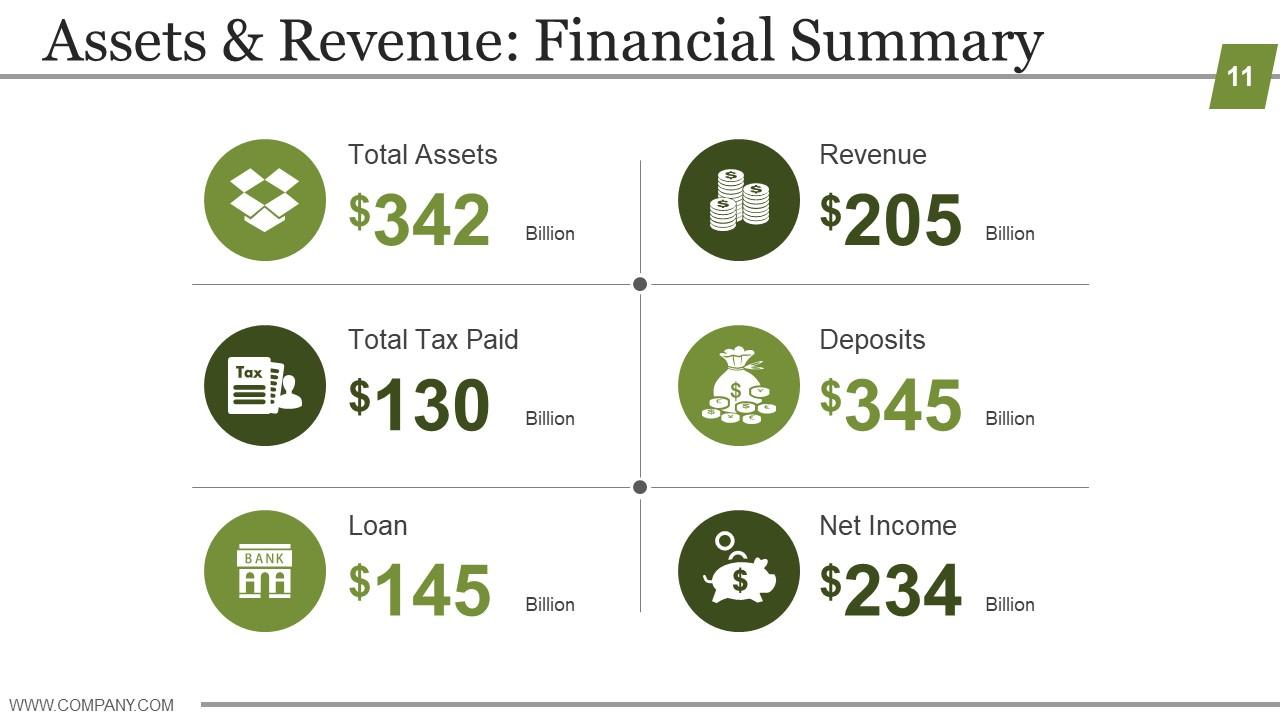
You cannot proceed with a strategic plan without stating facts and projections. You can use this guide to showcase your total present revenue, total value of assets, total tax paid in the previous year, deposits made to the organization, loans raised/offered by the business, and its total net income. All these figures should be offered in $US billion for the audience to grasp the information quickly.
Template 6: Company Sales and Performance Dashboard
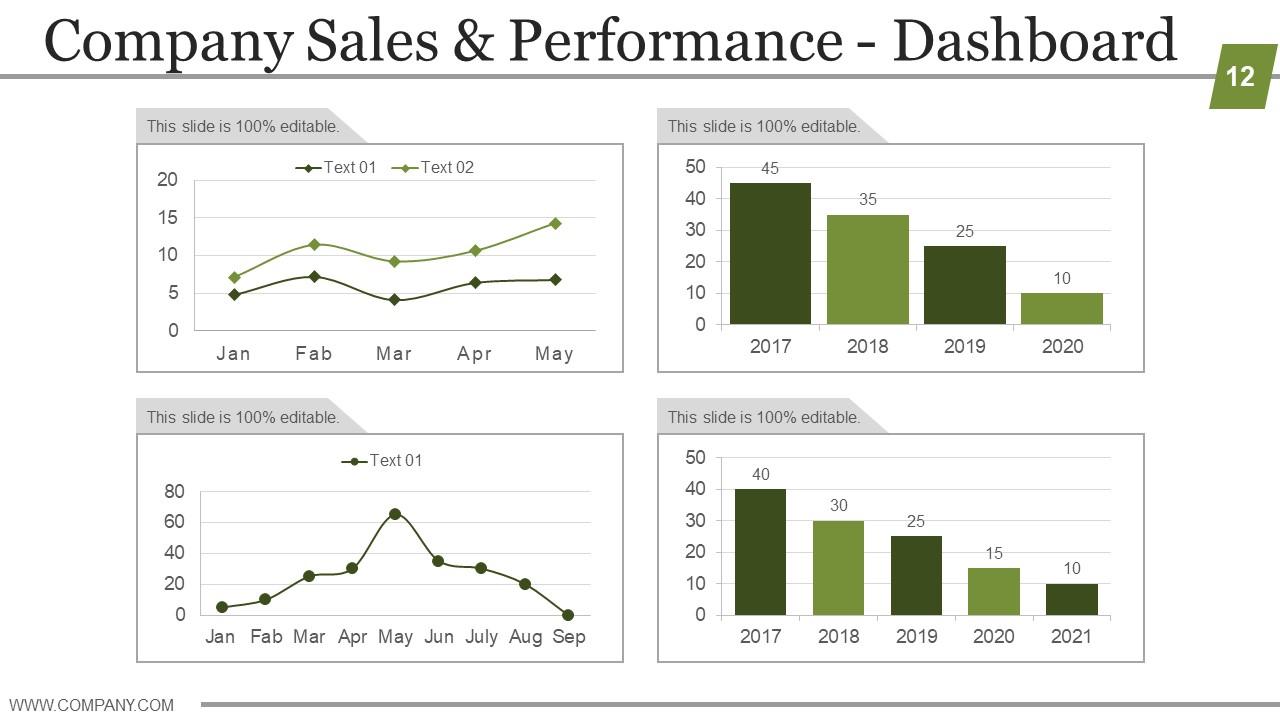
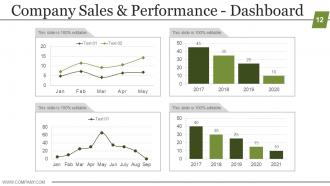
To provide an accurate reference for your audience, you can take the help of the charts and graphs available in this slide to showcase the overall company sales and its performance in the previous year. A set of line and bar graphs are offered here for your ease. You can present the data and information related to the changes in sales, improvement in performance, and other facts in this slide.
Template 7: Market Expansion and Growth Editable World Map
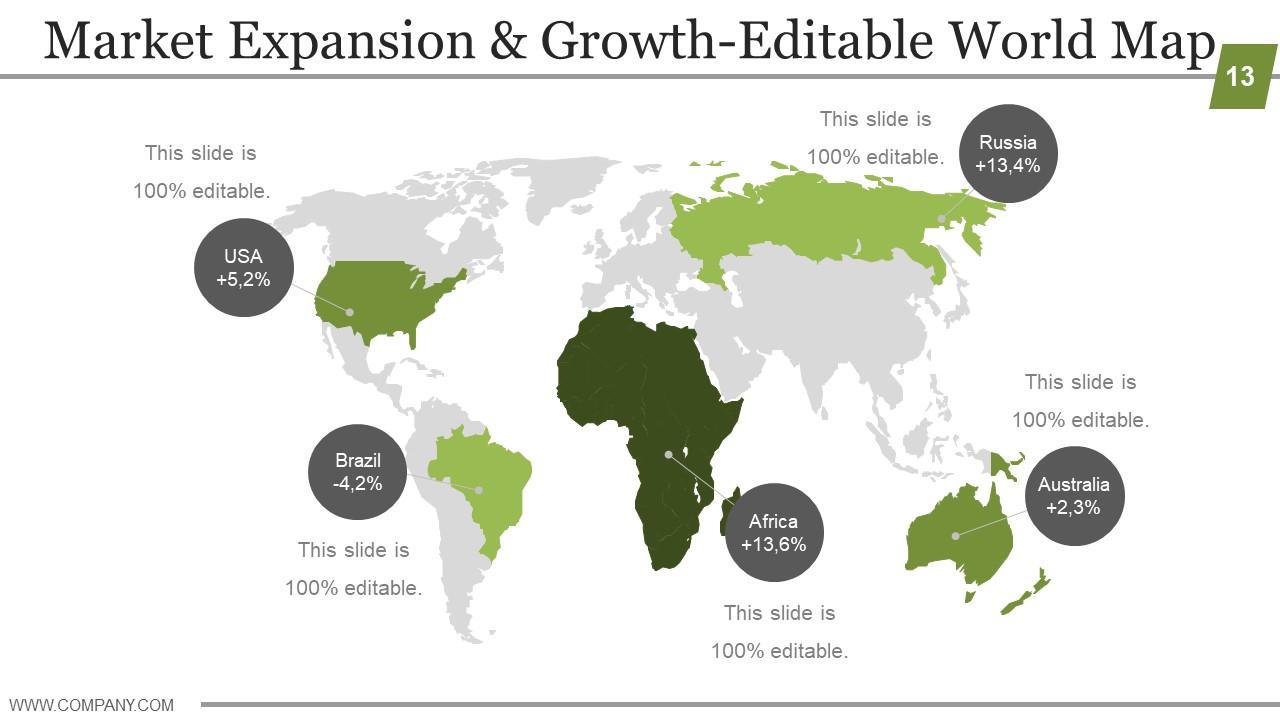
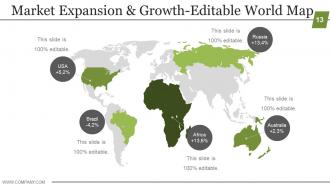
Your presence in one or more countries or cities helps your audience understand the global reach of the business and its operations. Hence, you can take the help of this map to showcase countries and/or cities in which your business is operational. You can show the percentage increase or decrease in the sales or revenue for the business in each country. If you want, you can also add the addresses of the branch offices, warehouses, production plants, retail outlets, and other business premises as required.
Template 8: Brand Promotion Strategies for Engagement
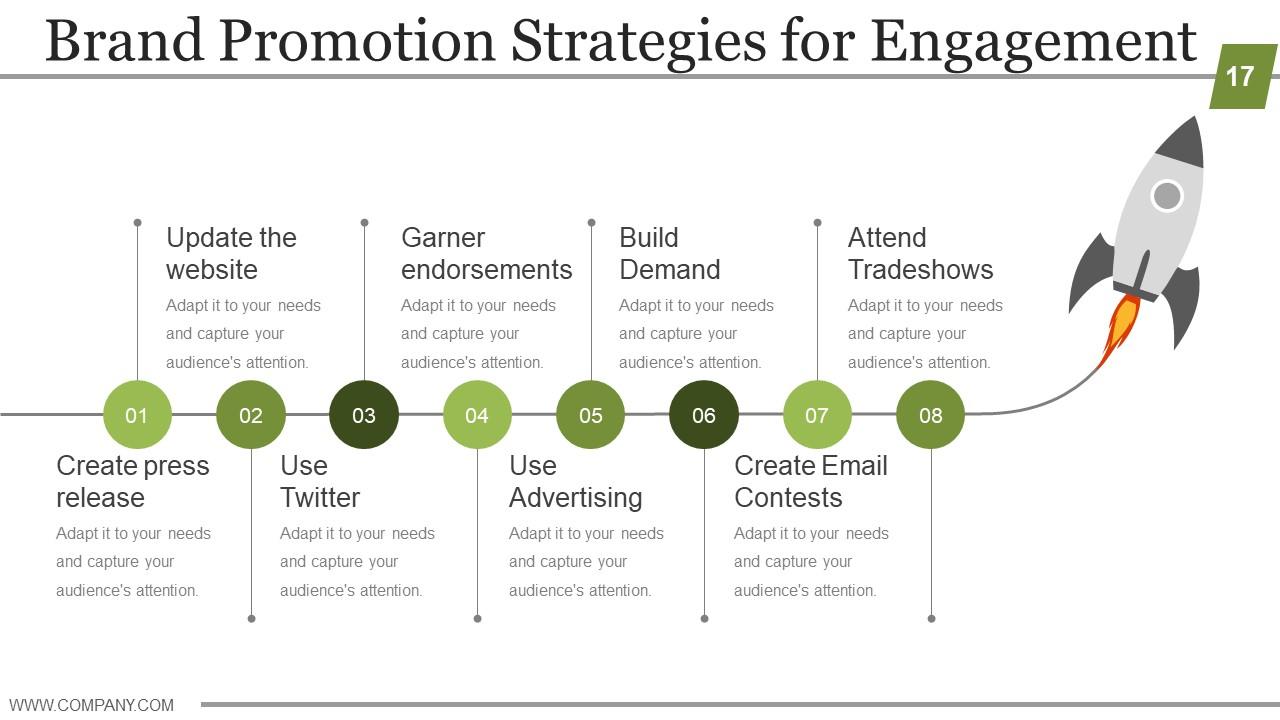
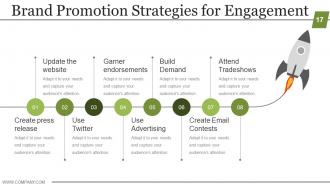
Now that you have showcased the present facts and information related to the business, it's time to move on to the potential strategy. Here, you can state and explain your business strategies related to brand promotion and engagement. These strategies can be creating regular press releases, drafting and updating the business website, using Twitter and other social media platforms for increased visibility, using paid advertising for promotion, taking the help of Garner endorsements, building and converting potential demands, and more.
Template 9: Marketing Team Deliverables for Brand Promotion
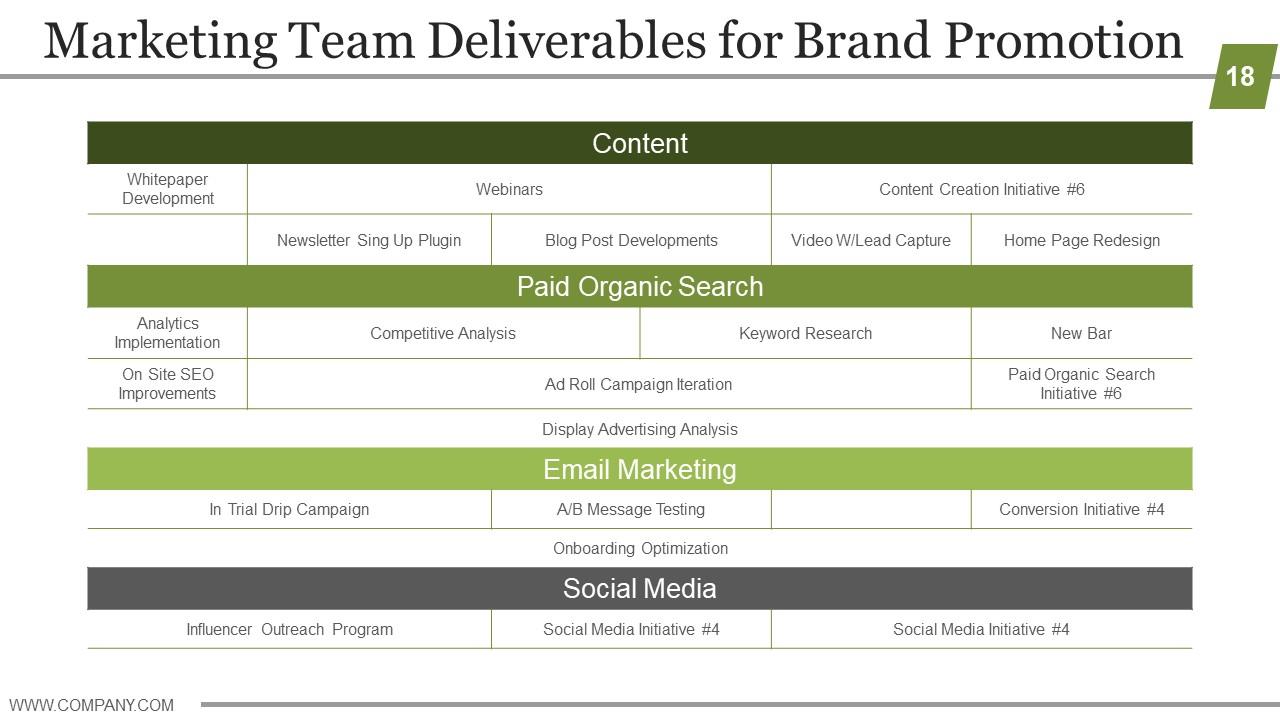
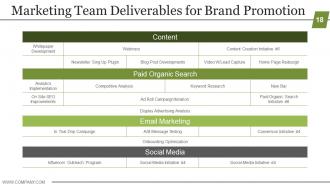
This slide allows you to enlighten the audience about the services offered by the marketing team for the promotion of the business, its brand, and its products/services. The deliverables of the marketing can be in the form of content (whitepapers, blogs, webinars, video generation, etc.), paid organic search (achieved using competitive analysis, on-site SEO optimizations, keyword research, etc.), email marketing (marketing campaigns, onboarding optimizations, etc.) and social media marketing (influencer shout-outs and more.)
Template 10: Project Timeline for Strategic Planning- Gantt Chart
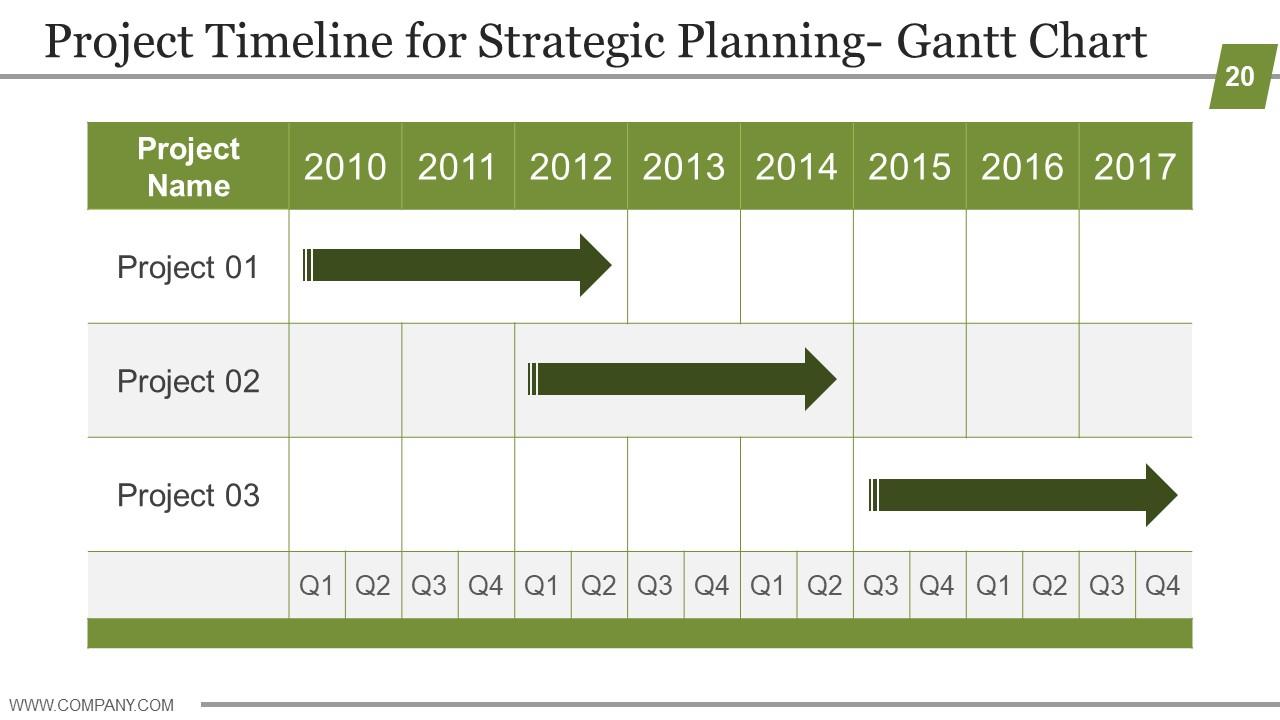
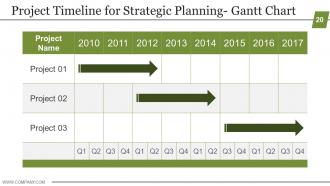
A smart Gantt Chart will help you showcase the proceedings of your strategic plan one after the other. Hence, you can use this slide to showcase the proceedings of your plan in different timelines. This slide is sufficient for your audience to get the required details of the projects. You can showcase the process of three different projects in this template. For better feasibility, you have the option to showcase project progress across years and quarters.
Take the help of this play-to-win strategy template provided for you to showcase your strategic decision-making process in detail to your curious audience.
Feasible Planning and Execution Done Right!
The above template works like the complete arsenal that you may need to tackle questions and doubts of your audience related to a strategic plan. The template alone is sufficient enough to offer deeper yet brief insights related to the present conditions and future outcomes of any project, plan, or otherwise.
Want to focus on the implementation part of your business strategy plan? Here’s a simple yet thorough template that you can use to offer the required implementation insights to the audience.
Business Strategic Planning Template For Organizations Powerpoint Presentation Slides with all 23 slides:
Display dynamism as an executive with our Business Strategic Planning Template For Organizations Powerpoint Presentation Slides. Demonstrate that you are completely in control.
-
Business Strategic Planning Template for Organisations
-
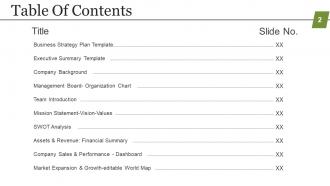
Table Of Contents
-
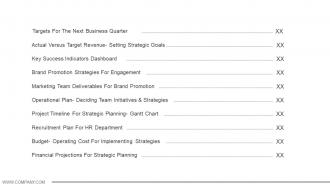
Business Strategic Planning for Organizations Powerpoin
-
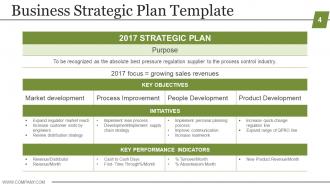
Business Strategic Plan Template
-
Executive Summary Template
-

Company Background
-
Management Board Organization Chart
-
Team Introduction
-

Mission Statement Vision Values
-

SWOT Analysis
-
Assets Revenue Financial Summary
-
Company Sales Performance Dashboard
-
Market Expansion Growth Editable World Map
-
Targets for the Next Business Quarter
-
Actual versus Target Revenue Setting Strategic Goals
-

Key Success Indicators Dashboard
-
Brand Promotion Strategies for Engagement
-
Marketing Team Deliverables for Brand Promotion
-
Operational Plan Deciding Team Initiatives Strategies
-
Project Timeline for Strategic Planning Gantt Chart
-
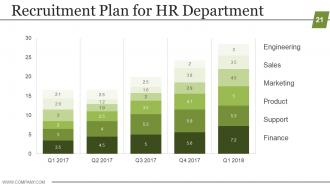
Recruitment Plan for HR Department
-
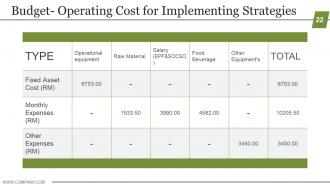
Budget Operating Cost for Implementing Strategies
-
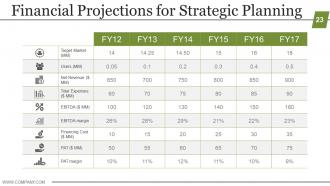
Financial Projections for Strategic Planning
FAQs for Business Strategic Planning Template For Organizations
You'll need an exec summary, mission/vision stuff, market analysis, and SWOT. Don't forget strategic objectives with actual timelines and KPIs to track everything. Budget allocation is huge too - assign owners for each piece or nothing gets done. Honestly? Most templates I see are total garbage with sections nobody touches after the first meeting. Keep yours simple and actionable. Your team should actually want to look at this thing quarterly, not just check a box once. Oh, and resist adding fancy sections unless you really need them. Start basic, then build up.
Honestly, having that template is like putting up guardrails for yourself. You're not just going with whatever feels right in the moment or chasing the shiniest thing. Quick gut check against your actual priorities and resources - does this fit or nah? It's wild how much clearer decisions become when you have that framework to bounce ideas off. Plus you'll catch stupid conflicts before you're already knee-deep in something. I'd probably use it for anything that's gonna eat up real time or money. The difference hits you pretty fast once you start.
SWOT analysis is your starting point for any strategic planning - can't skip this step. You're mapping out internal strengths/weaknesses plus what's happening externally (opportunities and threats). Think of it like checking what's in your fridge before planning meals, you know? Do this with your whole team though, not just by yourself. You'll spot blind spots that way. The stuff you uncover here becomes the backbone for setting realistic goals and figuring out where to actually spend your resources. Honestly, trying to plan without doing this first is just shooting in the dark.
Write your mission and values at the top of whatever planning doc you're using - seriously, make them impossible to ignore. For every goal you're thinking about, just ask "does this actually fit our mission?" and "are we living our values here?" Companies skip this all the time then act shocked when nothing feels connected. I swear it's like they forget why they exist in the first place. Make a quick checklist to run each decision through before you commit to anything. Your mission is basically your GPS - use it.
Honestly, mix financial stuff with the operational metrics - revenue growth, margins, ROI on big projects. Customer data matters way more than people think though. Satisfaction scores, how many customers stick around, market share. Don't forget internal metrics like employee engagement and how often you actually finish projects on time. Keep it to maybe 5-7 metrics tops or you'll go crazy trying to track everything. Each one needs a starting point, target, and deadline so you can check progress every quarter. I learned this the hard way - too many metrics = analysis paralysis.
Honestly, I'd check it quarterly if you can manage it. Yeah, the "official" answer is yearly, but things change way too fast now. Markets shift, competitors do weird stuff, your own company pivots – suddenly your template's outdated. Every three months, just review your key numbers and assumptions. Takes like an hour max. Then once a year, do the full deep dive and overhaul everything. My advice? Put those quarterly reviews on your calendar right now. I know it sounds boring but trust me, you'll thank yourself later when you're not scrambling to catch up.
Don't just fill in the blanks like it's some worksheet - that's how you end up with fancy-sounding goals that do absolutely nothing for your business. The real magic happens in those awkward conversations about what's actually broken (trust me, there's always something). Most people spend forever perfecting the format but never have the tough talks. Oh, and here's the thing everyone screws up: they finish it, feel accomplished, then let it collect dust. Set reminders to actually revisit this thing regularly. Otherwise you just paid someone to help you make very organized shelf decoration.
Honestly, templates are game-changers for strategic planning. Your team stops wandering around with different ideas about what you're even doing. Everyone fills out the same sections, follows the same flow - it's like having bumpers at a bowling alley but less embarrassing. You'll spot gaps in your logic way faster, plus it's obvious when people are making totally different assumptions about the same thing. I learned this the hard way after too many meetings that went nowhere. Send the template out before your next session so people can actually think through their ideas first.
SWOT analysis is your best starting point - maps out strengths, weaknesses, opportunities, and threats super clearly. Business Model Canvas is amazing for seeing how everything connects (I use it all the time). For tracking progress, OKRs keep your goals actually measurable instead of just wishful thinking. Porter's Five Forces works well if you're dealing with competitive stuff. But honestly? Don't go crazy with frameworks. I've watched people try to use like six different ones and just confuse themselves. Pick maybe 2-3 that make sense for your situation and actually stick with them.
Dude, you really can't skip market research if you want your strategic plan to actually work. Start there first, then use what you find to fill in your template sections. Like, your competitor analysis and target audience stuff will be way more solid with real data backing it up. I've watched so many plans crash because people just winged the market size estimates - not pretty. The research helps you figure out which parts of your template need the most work too. Your SWOT analysis gets way better when it's not just guesswork. Plus you'll set goals that aren't completely unrealistic, which honestly saves everyone a headache later.
Dude, visuals are a game-changer for strategic plans. Nobody wants to read through pages of dense text - I swear those documents just collect digital dust. Flowcharts show how your goals connect, timelines keep milestones visible, and dashboards give you those key metrics instantly. When you're presenting to leadership, people actually stay awake and engaged. It's crazy how much easier it becomes to spot roadblocks and keep everyone on the same page. Oh, and stakeholders can quickly grasp complex relationships between objectives without getting lost in the weeds. Start with a simple one-page visual overview first.
Honestly, I'd just start with Google Sheets or Excel - they're super flexible and I still use them for most of my planning stuff. If you want to get fancy later, check out Cascade Strategy or ClearPoint for the dedicated platforms. Miro's great too if your team likes visual mapping (though sometimes those sessions get a bit chaotic lol). OnStrategy and Lucidchart are solid options as well. My advice? Don't overthink it at first. Nail down your process with a free template, then you can always upgrade once you figure out what bells and whistles you actually need.
Templates are honestly a lifesaver for keeping stakeholder meetings from turning into total chaos. Break them into sections where people can actually contribute - SWOT worksheets, voting exercises, that kind of thing. I've sat through way too many planning sessions that just became endless arguing with no direction! Different groups can tackle different sections, then you bring everyone together to compare notes. It keeps people focused on the same questions instead of wandering off topic. Makes the whole thing feel collaborative rather than just going through the motions, you know?
Honestly? Keep it stupid simple. McKinsey's one-page canvas works because it forces you to cut the fluff. Start with where you are now, then vision/goals, then how you'll get there with actual metrics. Amazon's backwards template is genius - write the press release first like you already won. Makes you think differently. Don't let people hide behind corporate speak. Your template needs owners, timelines, and checkpoint dates. Oh, and assumptions/risks - that's where you actually figure out if this thing will work. Short sentences mixed with longer explanations. People skip walls of text anyway.
Honestly, I'd just bake tech trend analysis right into your regular planning. Pick 3-5 trends that actually matter for your industry - not random stuff you saw on LinkedIn. Then figure out how they might mess with (or help) your business over the next couple years. Quarterly reviews work well since everything changes so fast now. Ask yourself concrete questions like "what could automate our biggest headaches?" or "how's AI gonna change what customers expect from us?" The trick is making it routine instead of something you remember to do twice a year when you're panicking.
-
csac
-
Topic best represented with attractive design.
-
Awesome use of colors and designs in product templates.