


Team charter with strengths corporate program improving work team productivity




Try Before you Buy Download Free Sample Product
 Impress Your
 Audience
 100%
100% Editable
 Save Hours
 of Time


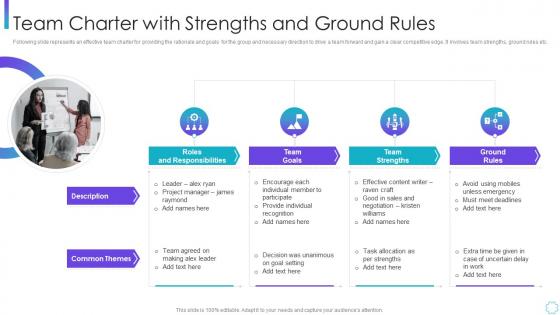
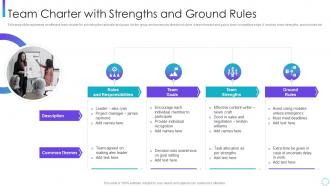
Following slide represents an effective team charter for providing the rationale and goals for the group and necessary direction to drive a team forward and gain a clear competitive edge. It involves team strengths, ground rules etc.
People who downloaded this PowerPoint presentation also viewed the following :
Team charter with strengths corporate program improving work team productivity with all 6 slides:
Use our Team Charter With Strengths Corporate Program Improving Work Team Productivity to effectively help you save your valuable time. They are readymade to fit into any presentation structure.





FAQs for Team charter with strengths corporate program improving
A comprehensive team charter includes team purpose and objectives, clearly defined roles and responsibilities, communication protocols, decision-making processes, and success metrics. These components work together to establish accountability, streamline collaboration, and minimize conflicts, with many organizations finding that well-structured charters enhance project efficiency, reduce misunderstandings, and ultimately deliver faster results and improved team performance.
A team charter facilitates better communication by establishing clear roles, responsibilities, communication protocols, decision-making processes, and conflict resolution methods from the outset. These structured guidelines streamline information flow, minimize misunderstandings, and create accountability frameworks, with many organizations finding that teams with formal charters experience significantly fewer communication breakdowns and deliver projects more efficiently.
A well-defined team charter enhances accountability by establishing clear roles, responsibilities, decision-making processes, performance metrics, and communication protocols from the outset. Through structured expectations and measurable outcomes, team members understand their individual contributions while maintaining collective ownership, with many organizations finding that charter-driven teams deliver faster project completion and improved collaboration across departments.
A team charter establishes clear, measurable goals and objectives by defining the team's purpose, scope, deliverables, and success metrics from the outset. This foundational document aligns all members on priorities, timelines, and expected outcomes, while providing a reference point for decision-making throughout the project lifecycle, ultimately enhancing accountability and reducing scope creep.
A team charter helps manage conflicts by establishing clear communication protocols, defining roles and responsibilities, setting behavioral expectations, and outlining decision-making processes before disputes arise. These proactive frameworks enable teams to address disagreements constructively through predetermined conflict resolution procedures, ultimately reducing misunderstandings while fostering collaborative problem-solving and maintaining team cohesion.
Common pitfalls when creating team charters include making them too vague or overly detailed, failing to involve all team members in the development process, setting unrealistic goals or timelines, and neglecting to establish clear accountability measures. These oversights often result in confusion about roles, misaligned expectations, and reduced team effectiveness, with many organizations finding that regular charter reviews and collaborative creation processes ultimately deliver stronger team cohesion and project outcomes.
Teams should revisit their charter quarterly or during major project milestones, significant team changes, or strategic pivots that affect objectives and processes. Regular reviews enable teams to adapt to evolving business priorities, incorporate lessons learned, and maintain alignment with organizational goals, with many high-performing teams finding that scheduled charter updates enhance collaboration and deliver sustained competitive advantage.
Teams can ensure buy-in by facilitating collaborative workshops where every member contributes to defining goals, roles, and working agreements, conducting individual consultations to address specific concerns, and using structured decision-making processes that give everyone equal voice. This inclusive approach builds ownership and commitment, with many organizations finding that teams with co-created charters demonstrate higher engagement, reduced conflicts, and stronger alignment toward shared objectives.
A team charter focuses specifically on team dynamics, roles, communication protocols, and working relationships, while project charters emphasize scope, deliverables, timelines, and resource allocation for specific initiatives. Unlike broader organizational documents that address company-wide policies, team charters create targeted frameworks for collaboration, decision-making processes, and conflict resolution, with many cross-functional teams finding that this focused approach enhances productivity and reduces miscommunication significantly.
Effective practices include conducting structured orientation sessions, pairing new members with charter mentors, providing interactive workshops on team values, and creating accessible digital charter resources. These approaches enhance integration by reinforcing behavioral expectations, clarifying role definitions, and establishing communication protocols, with many organizations finding that systematic charter introduction accelerates team cohesion and performance outcomes.
Visual elements in a team charter enhance understanding by making complex information more digestible through charts, diagrams, infographics, and color-coded sections that clarify roles, processes, and objectives. These visual components significantly boost engagement by creating memorable reference points, streamlining communication across diverse team members, and ultimately delivering improved collaboration and faster project alignment in increasingly complex organizational environments.
Teams should measure charter effectiveness through engagement indicators like meeting attendance and participation rates, goal achievement metrics including milestone completion and timeline adherence, and collaboration quality assessments. These measurements enable organizations to track team alignment, productivity improvements, and communication effectiveness, with many finding that regular charter reviews ultimately deliver enhanced project outcomes and stronger team performance.
Technology streamlines team charter creation through collaborative platforms like Microsoft Teams, Slack, and Google Workspace, enabling real-time editing, version control, and accessible documentation. These digital tools enhance transparency by centralizing charter elements, automating progress tracking, and facilitating continuous updates, with many organizations finding that cloud-based solutions ultimately improve team alignment and accountability.
A team charter aligns with organizational values by incorporating core principles into team objectives, decision-making processes, communication standards, and behavioral expectations. This strategic alignment ensures team activities directly support company culture, with many organizations finding that charter-driven teams demonstrate stronger cohesion, enhanced accountability, and improved performance outcomes that reinforce organizational identity.
Cross-functional teams can adapt their charters by incorporating diverse communication styles, flexible decision-making processes, varied expertise recognition, and inclusive goal-setting approaches. This strategic combination enables teams to leverage different departmental perspectives, from finance and marketing to operations and technology, ultimately delivering more comprehensive solutions and enhanced innovation while streamlining collaboration across organizational boundaries.
-
Wonderful templates design to use in business meetings.
-
Visually stunning presentation, love the content.