


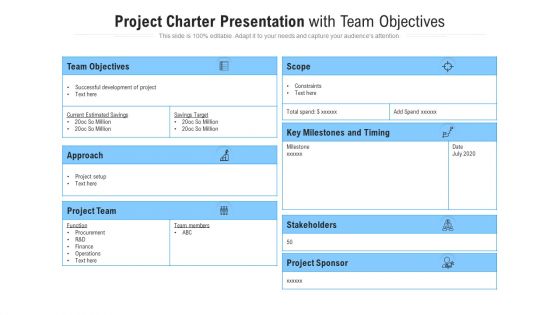
Project charter presentation with team objectives





Try Before you Buy Download Free Sample Product
 Impress Your
 Audience
 100%
100% Editable
 Save Hours
 of Time


Our Project Charter Presentation With Team Objectives are topically designed to provide an attractive backdrop to any subject. Use them to look like a presentation pro.
People who downloaded this PowerPoint presentation also viewed the following :
Project charter presentation with team objectives with all 2 slides:
Use our Project Charter Presentation With Team Objectives to effectively help you save your valuable time. They are readymade to fit into any presentation structure.
FAQs for Project charter presentation
Alright so you'll need project objectives, scope, stakeholders, timeline, budget, and success criteria. Don't forget roles and responsibilities too. Oh and assumptions/constraints - I always miss those at first and it bites me later! Your sponsor absolutely has to sign off before you do anything else. That signature is literally what gives you the power to make decisions and push things forward. Think of the charter as your project's anchor - when people start asking for random stuff or the scope gets weird (and it will), you can point back to it. Honestly it's saved my butt so many times.
So the project charter is like getting the green light to start - it's your official permission slip that says "yes, this project exists and you can run it." Pretty basic stuff at this point. The scope statement comes after and gets into the nitty-gritty. That's where you figure out exactly what you're delivering, all the requirements, boundaries, the whole nine yards. Charter = approval to begin. Scope statement = the actual roadmap your team follows. I always think of it as charter answers "should we do this?" and scope answers "what exactly are we doing?" You'll need the charter first to get buy-in, then hammer out the detailed scope during planning.
Honestly, you gotta figure out who's involved before you do anything else. I've watched projects completely blow up because someone forgot the compliance people existed, or some random exec decided they hated the color scheme halfway through. Cast a wide net at first - way easier than scrambling to add people later when they're already annoyed. You need to understand everyone's expectations and how much power they actually have from the start. Missing key stakeholders is like... the fastest way to watch your project turn into a dumpster fire. Better to include too many people initially than deal with surprise drama down the road.
Honestly, don't skip the project charter - it's like your safety net when everything goes sideways (and it will). Gets everyone on the same page about what you're actually building and why. You'll have formal backing to grab resources and pull people onto your team, which is huge. The best part? It locks down scope and stakeholder expectations early, so you won't get those annoying "can we just add one more thing" requests later. Well, you'll still get them, but at least you can point to the charter and say no. Make it detailed - trust me, you'll reference it constantly when the project gets chaotic.
Your project charter? It's literally the foundation for everything scope-related. Defines what you're building and why the project even exists. I always think of it as my go-to weapon when stakeholders start pushing for random add-ons - which happens every single time, honestly. Charter gives you the initial scope statement, deliverables, and objectives. Later when you're deep in detailed planning, you'll keep referencing it to stay on track with the original vision. Seriously, print that thing out and wave it around during meetings. Best scope creep defense you've got.
Dude, use SMART criteria for your objectives - specific, measurable, achievable, relevant, time-bound. Don't write "improve customer satisfaction" like everyone does. Say "increase customer satisfaction scores from 3.2 to 4.0 by Q3 2024." Way too many project charters have these super vague goals that you can't even measure later. Focus on outcomes, not activities. Skip "conduct training sessions" and go with "achieve 90% employee certification rate." For each objective, ask yourself: how will we actually know if we succeeded? If you can't answer that clearly, rewrite it. That's honestly the best test.
Ugh, the scope thing will bite you every time - everyone thinks they're on the same page until suddenly they're not. Get real sign-offs from actual decision makers, not just head nods in meetings (learned that one the hard way). New PMs always want to make everything perfect and complicated, but honestly? Keep it simple and measurable. Don't assume people are available just because they haven't said no yet. Figure out what success actually looks like before you start - like, write it down specifically. And map out who's doing what early on. I know it feels like extra work upfront, but trust me, that one hour now saves you ten hours of confusion later.
Think of a project charter as your team's shared roadmap. Everyone knows what you're building and why it actually matters. No more awkward meetings where half the team thought you were doing something completely different. Honestly, I've seen projects crash because people were working toward different goals without realizing it. The charter fixes that - it's got your scope, success metrics, who's doing what. Just make sure people actually look at the thing instead of letting it collect digital dust. Oh, and don't forget to update it when things inevitably change direction.
Oh totally - industry makes a huge difference! Healthcare and pharma have to document every regulatory approval detail, which is honestly a nightmare. Construction charters are all about permits and safety stuff. Tech ones are way more relaxed on compliance but get super detailed with technical specs and those agile timelines. Financial services? They go crazy with risk assessments that most other industries barely think about. The basic stuff like scope and budget stays the same everywhere though. Definitely find a template from your specific industry instead of using some generic one - it'll save you hours.
Honestly, most people just write the charter and never look at it again - huge mistake. You need to pull it out whenever major stuff happens: scope changes, budget shifts, new stakeholders joining. I'd say quarterly reviews minimum, but really anytime you hit a roadblock or things feel off-track. Before steering committee meetings is clutch - gets everyone back on the same page about what you're actually building. Oh, and set those calendar reminders because you'll totally forget otherwise. The charter's basically your project's GPS, but sometimes you gotta recalibrate when the route changes, you know?
Honestly, bring your key people into the process way earlier - don't just spring the final draft on them for approval. I'd set up actual review meetings where you go through each section together and ask what they think. Too many projects get stuck because stakeholders feel ambushed later. Scope, success metrics, and resources? Those are where things usually blow up. Oh and definitely don't just email it and cross your fingers. Face-to-face or video calls work so much better for getting real feedback and getting everyone on board before you need signatures.
Dude, just throw in some visuals - makes a huge difference. Charts work great for timelines, and infographics break down scope way better than paragraphs. I always add team structure diagrams too. Color coding is clutch for showing what's priority vs nice-to-have. Flowcharts help map out processes without confusing everyone. Icons seem silly but honestly they make everything less intimidating to read. Your stakeholders will actually absorb the info instead of skimming past walls of text. Maybe start small - timeline graphic or stakeholder map. Trust me, even basic visuals beat dense paragraphs every time.
So basically, your project charter is like your safety net for risk management. It maps out what you're actually trying to do and what you've got to work with - makes spotting potential problems way easier. The charter also backs you up when you need stakeholders to get on board with your risk strategies (honestly, good luck without that authority piece). Short sentences help too. When you've got clear success metrics written down, you'll know right away if risks are messing with your deliverables. Just treat the charter like your reference point when deciding if something's actually worth stressing about.
Honestly, just go with a simple one-page format. Hit the basics - what you're doing, why, timeline, budget, who's involved. I've watched teams waste hours on these massive 10-page templates that collect dust (been there). PMI's got decent ones if you want something official, but a Google Doc works just as well. Maybe even a PowerPoint slide if that's your thing. Visual stuff helps too. The whole point is everyone should be able to glance at it and get what's happening without decoding some novel. Pick whatever your team will actually look at and keep current - that's what matters.
Honestly, ditch the Word doc madness - there are way better options now. Miro and Mural are great for those visual brainstorming sessions where everyone can jump in and map stuff out together. For the actual charter, tools like Asana or Monday let you embed links and timelines that actually update themselves. No more "final_final_v3" files cluttering your desktop! The best part? Everyone's working in the same live document at once. I'd say just start with whatever platform your team's already comfortable with - most have decent templates anyway. Makes the whole process so much smoother than passing docs back and forth.
No Reviews