


Project charter document project management professionals required documents





Try Before you Buy Download Free Sample Product
 Impress Your
 Audience
 100%
100% Editable
 Save Hours
 of Time


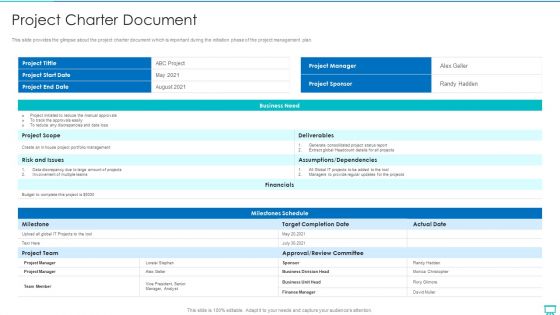
This slide provides the glimpse about the project charter document which is important during the initiation phase of the project management plan.
People who downloaded this PowerPoint presentation also viewed the following :
Content of this Powerpoint Presentation
The project charter is a must-have document for project management professionals in today’s landscape. This document provides them with the leverage to track projects and ongoing activities. Tracking a project is essential to know the project scope, risk issues, and mitigation strategies that need to be used for a successful project.
Download our HR transformation mini project charter PPT templates!!!
SlideTeam has specially designed a customizable project charter document to demonstrate the details of a project. This PPT slide helps highlight the different components of a project efficiently. The color scheme that has been used in this template makes it attractive and easy to understand at the same time.
Explore our work plan project charter PPT slides with scope deliverables and risks!!
Template 1: Project Charter Document
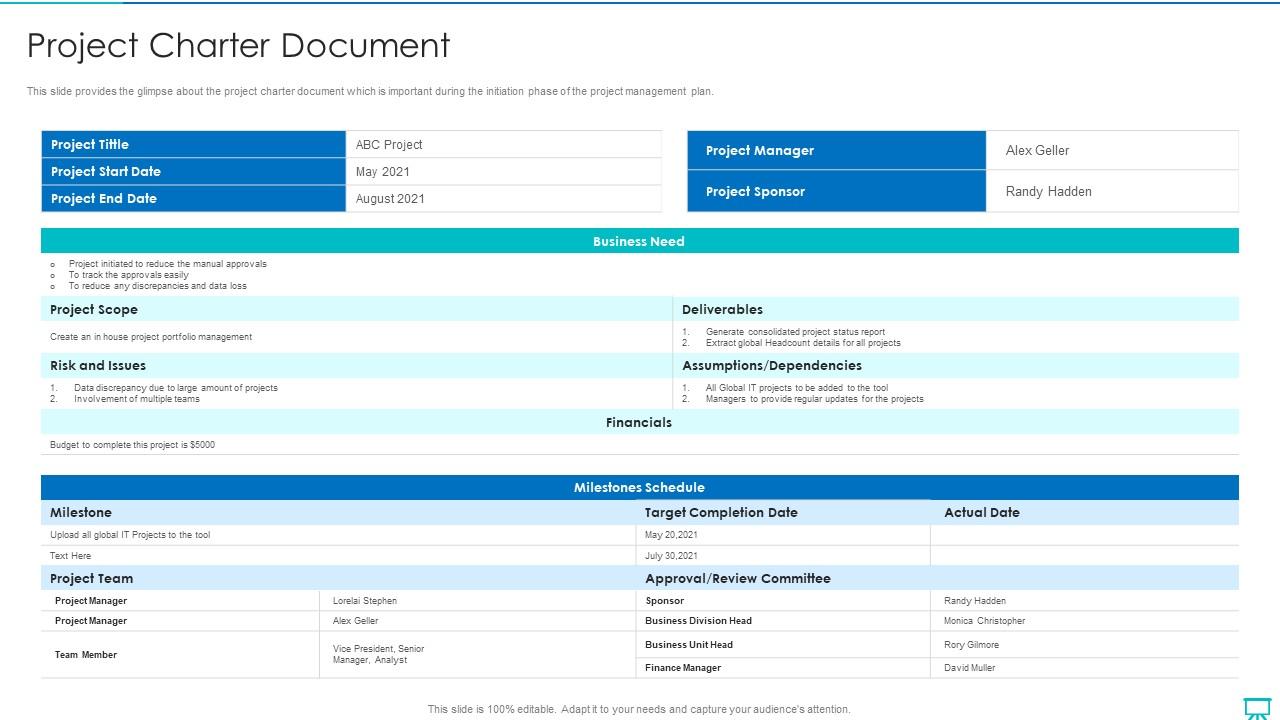
Many projects are being executed at the same time in an organization, and keeping track of the important aspects of each has more chances for it to be successful. This specific slide is designed to meet your requirements for making a chart for any ongoing project in your organization. This template will provide you the opportunity to add the project title, project manager, project sponsor, project start date, and project end date. An additional block is provided to add the project scope, risk issues, mitigation strategies, assumptions, and deliverables. You can also add the financials for the project with the milestones schedule, such as target completion date, approval committee, and many more. Grab this template to demonstrate all parts of a project.
The project chart PPT Slides are useful for every organization in tracking ongoing activities of the project. You will get a clear idea of when the project will end and what milestones have been completed for a specific project.
P.S. Download our CRM Mini Project Charter With Project Goals CRM Digital Transformation Toolkit templates!
Project charter document project management professionals required documents with all 2 slides:
Use our Project Charter Document Project Management Professionals Required Documents to effectively help you save your valuable time. They are readymade to fit into any presentation structure.
FAQs for Project charter document project management
Okay so your project charter needs the basics covered - purpose, objectives, scope boundaries, who's involved and what they do. Don't forget timeline, budget limits, and risks you've spotted. Here's what I always mess up: the assumptions section. Sounds boring but trust me, document what you think is already sorted. Also throw in how much authority you actually have as PM and any constraints boxing you in. Honestly, this thing becomes your best friend when people start asking for random additions later. Keep it short but detailed enough that some random person could read it and get why this project actually matters to the company.
So the charter is like your "sell the idea" doc - super high-level stuff about why this project matters and what you're trying to fix. Keep it short, maybe 2-3 pages tops. That's what gets you approval to actually start. The project plan comes after and gets into all the nitty-gritty details. Tasks, deadlines, who's doing what, dependencies - basically your roadmap for getting shit done. Way more detailed than the charter. I always write the charter first to get stakeholders on board, then use it as my guide when I'm building out the full plan. Makes the whole process way smoother.
Honestly, you've gotta figure out who matters before you even start. Map out everyone - sponsors, users, department heads, even people who might hate the project. Trust me, I've watched stuff crash because nobody thought about some random VP with opinions. Your charter needs to list the main players and what they care about. Otherwise you'll be blindsided when decisions need approval. Start by throwing names at the wall, then figure out who actually has power vs. who just thinks they do. Oh and prioritize by impact - saves you headaches later.
So your project charter is basically where risk management starts. It lays out all your objectives, scope, and constraints - which becomes your baseline for spotting problems later. Authority gets established there too, so you won't be sitting around wondering who's supposed to deal with stuff when it hits the fan. Honestly, I always go back to mine during risk assessments because it keeps me focused on what we're actually trying to build. Sometimes I forget that part when I'm deep in the weeds. Just makes everything clearer, you know?
Honestly, a good project charter is like having a roadmap everyone can actually agree on. It stops those awkward meetings where half the team thinks you're building one thing and the other half is totally confused. Once you nail down your scope and goals upfront, people feel way more comfortable calling out when stuff starts going sideways (which it will). I always tell teams to share it right away, then keep coming back to it during decisions. Oh, and definitely update everyone if things change - nothing worse than outdated docs floating around. Trust me on this one.
Ok so don't be vague about what you're actually trying to accomplish - spell out exactly what success looks like. Stakeholder mapping is huge too. Trust me, having some random VP pop up halfway through saying "wait, I never agreed to this" is the worst. Timeline-wise, don't promise the moon just because leadership wants it yesterday. That never ends well. Oh and resist cramming every possible feature into your goals without ranking them. Be super specific about deliverables instead of using fluffy corporate speak. What does "done" actually mean? Get everyone to sign off on the plan upfront. Saves you so much grief later when people try to move the goalposts.
Honestly, treat your project charter like your project's GPS - refer back to it constantly. During planning, check if scope decisions match what you originally mapped out. When stakeholders start adding random stuff (because they always do), whip it out to show what's actually included. Team meetings going in circles? Point everyone back to those original objectives you wrote down. I probably sound like a broken record here, but seriously - don't just write it and forget about it. Keep comparing your actual results against what you planned. The charter only works if you actually use it throughout the whole thing.
Dude, a project charter is basically your safety net against chaos. It forces everyone to agree upfront on what you're actually doing and - this is key - what you're NOT doing. When stakeholders inevitably come asking for random additions later (and they will), you just point back to the charter. "Sorry, that's out of scope." Done. Getting specific, measurable goals written down saves you so many arguments down the road. Plus having all the key people sign off means you've got that alignment documented. Honestly, I've seen too many projects go sideways because nobody bothered with this step. It's like your project's rulebook that everyone agreed to follow.
Dude, you've got a bunch of routes to go here. PMI's got some solid templates if your company's into that formal stuff. Microsoft Project has decent ones built in too. But honestly? Sometimes a simple Google Docs template does the trick just fine - no need to make it complicated. If your stakeholders are visual people, Miro or Lucidchart work great for charter stuff. Really depends on what your team actually vibes with and will use. I'd grab a basic template first - scope, objectives, who's involved, success metrics - then tweak it however you need. Oh, and don't pick something fancy that'll just sit there unused.
Check your project charter at major milestones - phase gates, big scope changes, when stakeholders shuffle around. For longer projects, I'd review every 2-3 months minimum. Shorter ones? Maybe halfway through and near the end. Don't let it just sit there collecting digital dust! Scope creep happens (and it will), so update immediately when priorities shift. Everyone needs to stay on the same page or things get messy fast. Pro tip: build these review dates right into your timeline from the start. You'll definitely thank yourself later when everything's not falling apart.
Don't just email it to everyone - trust me, nobody actually reads those. Set up a proper meeting instead and walk through the whole thing together. The scope and success criteria sections? That's where people will argue, so spend extra time there. After the meeting, give them a day or two to think it over, then hit them up with a formal approval request (with a deadline, obviously). Oh and definitely get it in writing - I can't stress this enough. Verbal agreements are useless when someone inevitably tries to add random stuff later. You'll thank me for that advice!
Honestly, think of your project charter as your "receipts" for what success looks like. You define objectives, scope, deliverables upfront - then later you can point back and say "see, we actually hit what we promised." I've been on projects without one and it's chaos... nobody agrees on what "done" even means. Your stakeholders stay aligned because they know exactly what they're getting. Quick tip though - actually bring that thing to your status meetings! It keeps people from going off on random tangents and shows real progress against your original commitments.
Look, you really need solid ROI numbers - stakeholders want to see the money side first. What exactly are you delivering? Spell it out clearly because vague project scopes kill funding faster than anything. I've watched amazing ideas get shot down just because nobody could figure out what they were actually paying for. Your timeline and resources better be realistic too. Oh, and definitely run it past someone in finance before you present - they'll catch the stuff that makes executives roll their eyes. Trust me on that one.
Honestly, your project charter is like having a referee in your back pocket. When people start arguing about scope or who's supposed to do what, just pull it out. "Hey, remember we all agreed on this?" It shuts down those annoying "but I thought we said..." fights before they get ugly. Instead of getting into personal drama, you've got actual documentation backing you up. Way better than just telling everyone to play nice, right? I'd keep that thing handy and reference it the second you feel tension starting. Trust me, it'll save you so many headaches.
Honestly, your project charter is like your best friend when everyone starts demanding changes. It's got all the original goals and scope written down, so when stakeholders come asking for random new features, you can point to it and be like "okay but does this actually fit what we agreed on?" Super helpful for those awkward scope creep moments - trust me on this one. You've got documented proof of what the project should look like. Use it to either green-light changes that make sense or bump the bigger requests up the chain. Seriously, keep that thing close by.
-
Great experience, I would definitely use your services further.