


Project management methodology including planning





Try Before you Buy Download Free Sample Product
 Impress Your
 Audience
 100%
100% Editable
 Save Hours
 of Time


There are a variety of project management methodologies that can be used to plan and execute projects. The most common methodology is the waterfall approach, which involves a linear process of designing, developing, testing, and deploying a project. If you're looking for a comprehensive guide to project management, or just want some helpful tips on how to get started planning your next project, look no further than the SlideTeam collection of project management PowerPoint presentations. Our templates provide an overview of all the major project management methodologies, from traditional waterfall approaches to agile and scrum development. Plus, with our easy-to-use templates, you can create custom slides that reflect your own unique approach to project management. So don't wait any longer - download our project management PowerPoint templates today.
People who downloaded this PowerPoint presentation also viewed the following :
Content of this Powerpoint Presentation
Description:
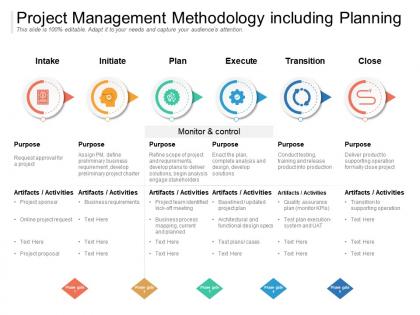
The image depicts a PowerPoint slide outlining a project management methodology, including various stages and their corresponding purposes and activities. Each stage—Intake, Initiate, Plan, Monitor & Control, Execute, Transition, and Close—is represented by a circular icon and is linked in a linear sequence, suggesting the flow of activities from one phase to the next.
1. For the "Intake" phase, the purpose is to request approval for a project, and associated activities include liaising with a project sponsor and submitting a project proposal.
2. In the "Initiate" stage, the purpose is to assign a project manager (PM), define requirements, and develop a preliminary project charter. Artifacts include business requirements documentation.
3. The "Plan" phase involves refining the project scope and requirements, and delivering solutions. Activities include identifying the project team and conducting a kick-off meeting.
4. "Monitor & Control" pertains to enacting the plan, completing analysis and design, and developing solutions, with associated activities like baselining the project plan.
5. For "Execute," the slide mentions enacting the plan, completing analysis and design, and developing solutions, with actions such as architectural and functional design specs.
6. The "Transition" phase is about conducting testing, training, and releasing the product into production, involving quality assurance plans and test plan execution.
7. Finally, the "Close" phase's purpose is to deliver the product to supporting operations and formally close the project. This includes transitioning to supporting operations.
Use Cases:
Here are seven industries where such a slide might be used, each with a specific use case, presenter, and audience:
1. Construction:
Use: To outline the project phases in construction projects.
Presenter: Project Manager.
Audience: Construction team, stakeholders.
2. Information Technology:
Use: For software development life cycle presentations.
Presenter: IT Project Coordinator.
Audience: Development team, IT management.
3. Manufacturing:
Use: To manage product development timelines.
Presenter: Production Manager.
Audience: Production staff, quality control.
4. Healthcare:
Use: Implementing new healthcare systems.
Presenter: Healthcare Administrator.
Audience: Medical staff, department heads.
5. Education:
Use: Planning educational program rollouts.
Presenter: Academic Project Leader.
Audience: Educators, administrative staff.
6. Marketing:
Use: Launching marketing campaigns.
Presenter: Marketing Director.
Audience: Marketing team, creative staff.
7. Financial Services:
Use: Compliance project implementations.
Presenter: Compliance Officer.
Audience: Financial analysts, regulatory staff.
Project management methodology including planning with all 2 slides:
Our Project Management Methodology Including Planning cover it end to end. Discuss every element of your subject.
FAQs for Project management
So basically Waterfall is super linear - you finish design, then dev, then testing, one after the other. Agile does everything in short cycles where you're tweaking stuff constantly. Waterfall's nice because you know what to expect upfront, but good luck changing anything mid-project. With Agile you can pivot easily, though it feels like chaos at first (trust me on this one). Most teams I know just mix both approaches anyway. Clear requirements that won't change? Waterfall's your friend. Need flexibility and quick feedback? Go Agile.
Honestly, just figure out your biggest headaches first - timeline, budget, team size, how much stuff will probably change. Agile's your friend if you need to move fast and pivot. Waterfall actually rocks when requirements are locked down and timelines are clear. You don't have to be a purist either - mixing approaches works fine. How comfortable are your stakeholders with different methods? What's your team used to? There's no magic formula here. Write down your top 3 constraints, then see which methodology doesn't make you want to cry. That's probably the right one.
Look, stakeholder communication basically makes or breaks any project - doesn't matter what methodology you're using. Waterfall does the formal route with status reports and milestone check-ins. Scrum's got it built right in with standups, sprint reviews, all that stuff. Kanban uses those visual boards (which honestly save my sanity half the time). The real trick is figuring out *how* to communicate based on your approach. Some are super structured, others let you wing it more. Just match whatever style actually works for your stakeholders instead of forcing them into some rigid format they'll hate.
Honestly, Scrum's biggest win is forcing people to actually talk. Daily standups mean no more disappearing for weeks - everyone knows what you're doing. The backlog transparency is clutch too since priorities are crystal clear. Those sprint reviews? Game changer for keeping stakeholders happy so you don't build useless stuff (learned that the hard way lol). Time-boxed sprints create this natural urgency that actually works. If your team's all over the place with communication, just start with basic Scrum meetings. You'll see immediate improvement in how people collaborate.
Honestly, I'm obsessed with how Kanban lets you actually *see* your workflow. Like, you can spot bottlenecks instantly and fix them. Way more flexible than being locked into sprints, and it stops your team from taking on too much at once - which we all know is a problem lol. The tricky part? Without clear priorities, things get messy fast. Stakeholders also freak out when there aren't hard deadlines to point to. Really needs a team that can self-manage. Just start super simple - three columns: To Do, Doing, Done. Add more complexity once everyone gets the hang of it. Trust me on this one.
Hybrid works great when your project has some predictable stuff mixed with uncertainty. Say you're building software - use waterfall for the compliance parts that can't change, but go agile for development where you need user feedback. Also helps when your stakeholders want different things. Executives usually love waterfall's clear timelines, but developers work better with agile freedom. Most projects end up being messy combinations anyway, so why fight it? Just figure out which pieces need strict structure and which need flexibility, then build around that.
Honestly, just start by hunting down all the wasteful stuff in your current process - like those approval chains that take forever or documentation nobody reads. Most projects are bloated with this junk. Try value stream mapping to actually see where things get stuck. Instead of waiting till the end to figure out what went wrong, do small improvement cycles throughout. Don't flip everything upside down at once though, that's a recipe for chaos. Pick one annoying process this week and cut the fat from it. You'll be surprised how much smoother things run.
Honestly, start with pilot projects instead of going all-in right away. I've seen so many companies crash and burn trying to flip everything overnight. Training is huge though - get your team actually learning Scrum or Kanban properly, don't just wing it. The cultural piece is what trips most people up. You need real feedback loops and open communication, not just daily standups that feel like status reports. Agile isn't some checkbox exercise - it's genuinely about changing how you think about work. Measure what's working, ditch what isn't. Every team's different so your approach should be too.
So project tracking tools are pretty flexible - they adapt to whatever methodology you're using. Jira's perfect for Agile since it handles sprints and backlogs really well. Waterfall projects? Gantt charts in Microsoft Project are your best bet for tracking those sequential phases. Kanban boards work for continuous flow stuff (honestly became obsessed with them last year). The trick is matching tools to your methodology's workflow instead of cramming your process into whatever tool management decided to buy. Figure out what you need most first - visibility, collaboration, or milestone tracking - then pick from there. Way better than fighting against the wrong tool.
So it really comes down to timing and what you're focusing on. Agile means you're tracking sprint stuff - velocity, burn-down charts, how happy customers are after each iteration. Waterfall? You're watching those big milestone dates and whether you're sticking to budget and scope. Agile metrics are honestly a pain because everything shifts constantly, but that's kinda the whole point - you get feedback that actually helps. With Waterfall you're measuring schedule variance, cost performance, quality checks at major gates. My advice? Pick maybe 3-4 metrics tops that match whatever method you're using. Then just track them consistently.
Waterfall makes you lock down every requirement upfront - super detailed docs, then you're basically stuck with that scope. Changes? Good luck, they'll cost you. Agile's the total opposite though. Your scope shifts constantly based on feedback and what actually matters. I'll be honest, it felt chaotic at first but now I love the flexibility. There's also hybrid approaches like SAFe that try doing both. Really depends on how much you don't know going in - the more uncertainty, the more you'll want that Agile wiggle room.
So yeah, team size totally changes which approach you should pick. Small teams (like 5-9 people) do great with Agile or Scrum - everyone can actually talk in those daily standups without it dragging on forever. But once you hit 20+ people? That's when you need something more structured like SAFe or even old-school Waterfall with clear chains of command. Medium-sized teams usually nail it with hybrid approaches. Honestly, I've seen too many big teams try to force Scrum and it just becomes chaos. The whole thing comes down to how much coordination you can handle before everyone starts moving like molasses.
Honestly, leadership has to go first on this one - they need to actually walk the walk and listen when teams flag broken processes. Let smaller projects be your testing ground for new approaches. Nobody wants their big initiative to become the cautionary tale, you know? Make sure people can speak up without getting their heads bitten off. Train managers to care about results, not whether someone followed the rulebook perfectly. Here's the thing though - you've got to celebrate the smart pivots just as much as the original wins. Maybe more, actually.
Honestly, documentation is such a pain but you gotta keep it lean yet useful. With Agile, stick to living docs - user stories, sprint notes, that kind of stuff. Skip the heavy upfront planning. Waterfall though? You'll need detailed project plans from day one. Feels excessive but trust me, it prevents chaos later. Whatever method you're using, pick one central spot for everything and actually update it - don't let your docs turn into museum pieces lol. I'd start by looking at what you have now and figuring out where the gaps are causing confusion.
Honestly, getting your team trained on PM stuff is a game changer. Everyone starts speaking the same language - like when someone mentions sprint planning or Kanban, nobody's sitting there confused. Decisions happen way faster because you're all following the same playbook. I'd pick whatever methodology actually fits what you're doing now (don't go crazy with Agile if you're building bridges or something). People get more confident too when they have a real structure to lean on. You can always add other approaches later once the first one sticks.
No Reviews