


Project planning in agile methodology powerpoint presentation slides




Try Before you Buy Download Free Sample Product
 Impress Your
 Audience
 100%
100% Editable
 Save Hours
 of Time


Project planning helps project managers build activities with minimal downtime and optimize the schedule while improving the plan. Here is an efficiently designed template on Project Planning in Agile Methodology that focuses on company profile. We have covered the company overview and the advantages of choosing our company. The company's current themes include the traditional approach and implementation of agile project management using schedule, process, and planning techniques along with features, levels, and benefits. With this proposal, companies will be able to promote adaptability and speed, focus on the principles and processes of agile project management and deliver the project promptly throughout the life cycle. We have outlined the process and principles such as agile project planning, agile steps, framework, different phases, strategies and techniques. We have covered the roles and structures of agile teams along with the activities, responsibility map and reporting tool. You can even show the role and structure of the agile management team with the weekly agile reporting tool. Businesses can recognize various reporting tools through tables, charts, graphs, infographics, etc. Book a free demo with our research team and customize the template. Get access now.
People who downloaded this PowerPoint presentation also viewed the following :
Content of this Powerpoint Presentation
Slide 1: This slide displays title i.e. 'Project Planning in Agile Methodology' and your Company Name.
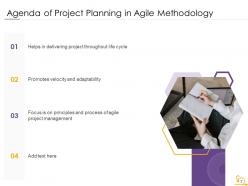
Slide 2: This slide presents agenda.
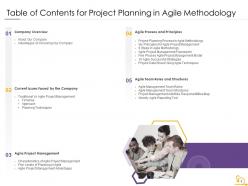
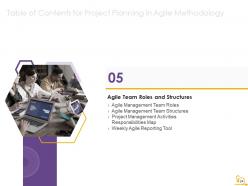
Slide 3: This slide exhibits table of contents.
Slide 4: This slide shows title for two topics to be covered next in the template.
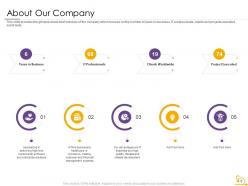
Slide 5: This slide provides the glimpse about brief overview of the company which focuses on the number of years in business, IT professionals, etc.
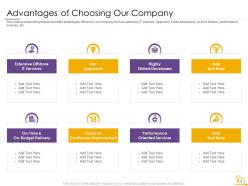
Slide 6: This slide provides the glimpse about the advantages offered by our company such as extensive IT services, approach, skiled developers, etc.
Slide 7: This slide depicts title for next three topics to be covered.
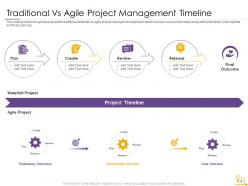
Slide 8: This slide provides the glimpse about the traditional waterfall vs agile project management approach.
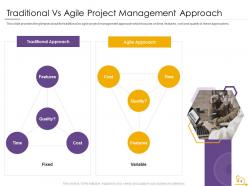
Slide 9: This slide provides the glimpse about the traditional vs agile project management approach which focuses on time, features, etc.
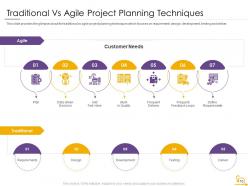
Slide 10: This slide provides the glimpse about the traditional vs agile project planning techniques which focuses on requirement, design, etc.
Slide 11: This slide highlights title for next three topics to be covered in the template.
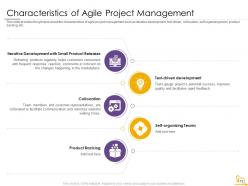
Slide 12: This slide provides the glimpse about the characteristics of agile project management such as iterative development, test driven, etc.
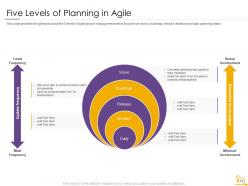
Slide 13: This slide provides the glimpse about the 5 levels of agile project management which focuses on vision, roadmap, release, etc.
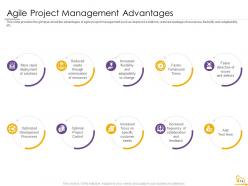
Slide 14: This slide provides the glimpse about the advantages of agile project management such as deployed solutions, reduced wastage of resources, etc.
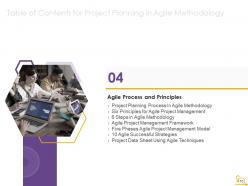
Slide 15: This slide displays title for next seven topics to be covered.
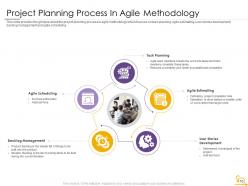
Slide 16: This slide provides the glimpse about the project planning process in agile methodology which focuses on task planning, agile estimating, etc.
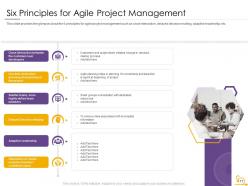
Slide 17: This slide provides the glimpse about the 6 principles for agile project management such as close interaction, delayed decision making, etc.
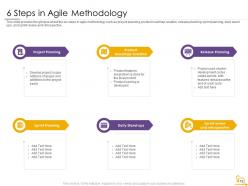
Slide 18: This slide provides the glimpse about the six steps in agile methodology such as project planning, product roadmap creation, etc.
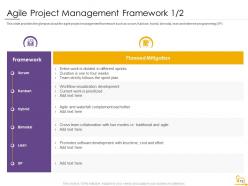
Slide 19: This slide provides the glimpse about the agile project management framework such as scrum, Kanban, hybrid, bimodal, etc.
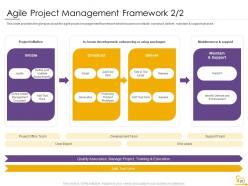
Slide 20: This slide provides the glimpse about the agile project management framework which focuses on initiate, construct, deliver, etc.
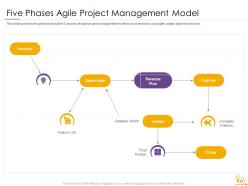
Slide 21: This slide provides the glimpse about the 5 phases of agile project management model such as envision, speculate, adapt, explore and close.
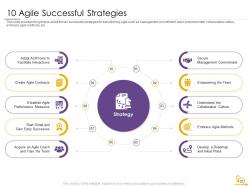
Slide 22: This slide provides the glimpse about the ten successful strategies for transitioning agile such as management commitment, team empowerment, etc.
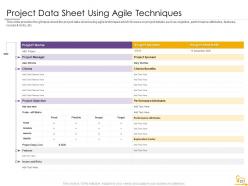
Slide 23: This slide provides the glimpse about the project data sheet using agile techniques which focuses on project details such as objective, etc.
Slide 24: This slide presents title for four topics to be covered next in the template.
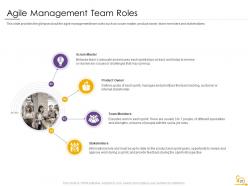
Slide 25: This slide provides the glimpse about the agile management team roles such as scrum master, product owner, team members and stakeholders.
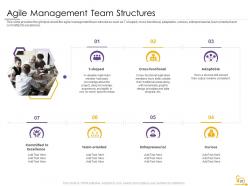
Slide 26: This slide provides the glimpse about the agile management team structures such as T shaped, cross functional, adaptable, curious, etc.
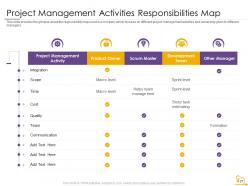
Slide 27: This slide provides the glimpse about the responsibility map used in a company which focuses on different project management activities.
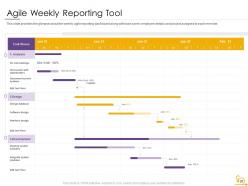
Slide 28: This slide provides the glimpse about the weekly agile reporting dashboard along with task name, employee details, etc.
Slide 29: This is the icons slide.
Slide 30: This slide presents title for additional slides.
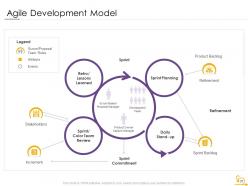
Slide 31: This slide exhibits 'Agile Development Model'.
Slide 32: This slide shows targets.
Slide 33: This slide displays puzzle.
Slide 34: This slide depicts posts for past experiences of clients.
Slide 35: This slide displays Venn.
Slide 36: This is thank you slide & contains contact details of company like office address, phone no., etc.
Project planning in agile methodology powerpoint presentation slides with all 36 slides:
Use our Project Planning In Agile Methodology Powerpoint Presentation Slides to effectively help you save your valuable time. They are readymade to fit into any presentation structure.


FAQs for Project planning in agile methodology
Key Agile principles impacting project planning include iterative development, customer collaboration, responding to change, working software over documentation, and continuous feedback loops. These principles revolutionize traditional planning by emphasizing adaptive planning, shorter sprint cycles, and regular stakeholder input, with many organizations finding that this approach delivers faster time-to-market, reduced project risks, and enhanced customer satisfaction.
Iterative planning in Agile involves continuous short-term planning cycles with regular reassessment, adaptive scope changes, and frequent stakeholder feedback, while traditional planning relies on comprehensive upfront documentation and fixed timelines. This approach enables organizations to respond quickly to market changes, minimize project risks through early problem identification, and deliver incremental value, with many software development teams finding significantly improved customer satisfaction.
User stories serve as fundamental building blocks in Agile project planning, defining features from the user's perspective, establishing acceptance criteria, guiding sprint planning decisions, and enabling effective backlog prioritization. These narrative-driven requirements help development teams in software companies, financial services, and healthcare organizations deliver customer-focused solutions by breaking complex projects into manageable increments, ultimately enhancing product quality and user satisfaction.
Teams effectively prioritize tasks during Agile planning sessions by using techniques like MoSCoW prioritization, story mapping, value-based ranking, stakeholder feedback analysis, and business impact assessment. These approaches streamline decision-making by evaluating user value, technical dependencies, and strategic alignment, with many development teams finding that combining multiple prioritization methods ultimately delivers faster releases and enhanced customer satisfaction.
Successful sprint planning meetings require clear sprint goals, prioritized product backlogs, accurate story point estimation, team capacity assessment, and defined acceptance criteria. These practices enhance collaboration by establishing realistic commitments, minimizing scope creep, and ensuring alignment between development priorities and business objectives, with many agile teams finding that structured planning ultimately delivers faster iterations and improved stakeholder satisfaction.
Agile teams estimate timelines through story points, planning poker sessions, velocity tracking, and sprint capacity analysis, focusing on relative effort rather than absolute time. These estimation techniques enable teams to deliver predictable value by leveraging historical data, team consensus, and iterative refinement, with many organizations finding that velocity-based planning significantly improves delivery predictability and resource allocation.
Agile project planning tools include Jira, Azure DevOps, Trello, Asana, and Monday.com, along with specialized platforms like Rally and VersionOne. These technologies streamline sprint planning, backlog management, and team collaboration by enabling real-time updates, automated reporting, and seamless integration, with many organizations finding that strategic tool selection significantly enhances delivery speed and project transparency.
MVP fundamentally reshapes Agile project planning by prioritizing essential features for early market validation, enabling iterative development cycles, and reducing time-to-market risks. This approach allows teams to gather real user feedback quickly, adjust priorities based on actual market response, and allocate resources more strategically, with many organizations finding that MVP-driven planning delivers faster product launches and significantly lower development costs.
Teams adapt project plans through regular sprint reviews, continuous stakeholder feedback, and flexible backlog prioritization that allows for requirement changes without derailing timelines. Agile frameworks enable rapid pivoting by incorporating change requests into upcoming sprints, reassessing project scope during retrospectives, and maintaining open communication channels, ultimately delivering products that better meet evolving business needs while preserving team momentum and resource efficiency.
Main challenges include scope creep, shifting priorities, stakeholder alignment, resource allocation uncertainties, and balancing flexibility with predictability. Agile teams overcome these through iterative sprint planning, regular retrospectives, stakeholder collaboration frameworks, and adaptive resource management, with many organizations finding that continuous communication and transparent backlog prioritization ultimately deliver better project outcomes and enhanced team responsiveness.
Cross-functional teams enhance Agile project planning by bringing diverse expertise together, eliminating knowledge silos, accelerating decision-making, and identifying potential roadblocks early in the planning cycle. These collaborative structures streamline sprint planning through real-time input from development, testing, design, and business stakeholders, ultimately delivering more accurate estimations and faster project iterations.
Key Agile project planning metrics include sprint velocity, burndown charts, cycle time, team capacity utilization, and story point accuracy. These measurements enable teams to track delivery predictability, identify bottlenecks, and optimize resource allocation, with many organizations finding that combining velocity trends with cycle time analysis delivers enhanced forecasting accuracy and improved sprint planning effectiveness.
Agile ceremonies enhance project planning by providing structured touchpoints for continuous alignment, progress tracking, and adaptive planning throughout development cycles. Stand-ups enable daily coordination and obstacle identification, while retrospectives facilitate team learning and process refinement, with many organizations finding that these regular ceremonies significantly improve project visibility, team collaboration, and delivery predictability.
Stakeholder feedback is crucial in Agile project planning because it ensures continuous alignment with business objectives, validates product direction, and identifies potential issues early in development cycles. Through regular sprint reviews, stakeholder sessions, and iterative demonstrations, organizations enhance product quality, reduce costly late-stage changes, and ultimately deliver solutions that meet actual user needs, with many teams finding significantly improved project success rates.
Agile project planning supports continuous improvement through regular retrospectives, iterative feedback loops, and adaptive sprint planning that identifies bottlenecks and optimization opportunities. Through frequent reviews and data-driven insights, teams streamline workflows, enhance collaboration, and accelerate delivery cycles, with many organizations finding that this structured reflection ultimately delivers higher productivity and better project outcomes.
-
Easily Understandable slides.
-
Great designs, Easily Editable.
-
Great designs, really helpful.
-
Awesome use of colors and designs in product templates.
-
Excellent design and quick turnaround.
-
Great quality slides in rapid time.
-
Informative design.
-
Innovative and attractive designs.
-
Visually stunning presentation, love the content.