

Five phases of project management framework





Try Before you Buy Download Free Sample Product
 Impress Your
 Audience
 100%
100% Editable
 Save Hours
 of Time


Following slide exhibits five phases of project management framework such as discovery, initiation, planning, execute and closure. This slide also contain information about gate criteria, key metrics and deliverables for each phase by which project manager can check the success rate of each stage.
People who downloaded this PowerPoint presentation also viewed the following :
Content of this Powerpoint Presentation
In the world that we live in, project management will increasingly emerge as the critical competency that businesses must possess. Be it power, roads, the internet of things, or even artificial intelligence, project management expertise comes in handy.
Understand phase-gate review framework for project management, here.
Firms that execute projects well are so well placed as compared to others that they get more work, at better terms than companies without such skills.
The one core skill to master in project management is the understanding of its five key phases and how are these linked to each other.
Stakeholders and client need to updated real-time on the status of these phases and when the five phases of project management integrate to form a new whole.
Here's a product on project delivery framework showing pre project initiation delivery and close to really make the most of your project management knowledge.
At SlideTeam, we have curated 100% editable and customizable PPT Templates that explain project management phases in detail. The aim is to help businesses capture more work, and ensure that project management gets a new lease of life.
Let’s explore!
Template 1 Five Phases of Project Management Framework PPT Template
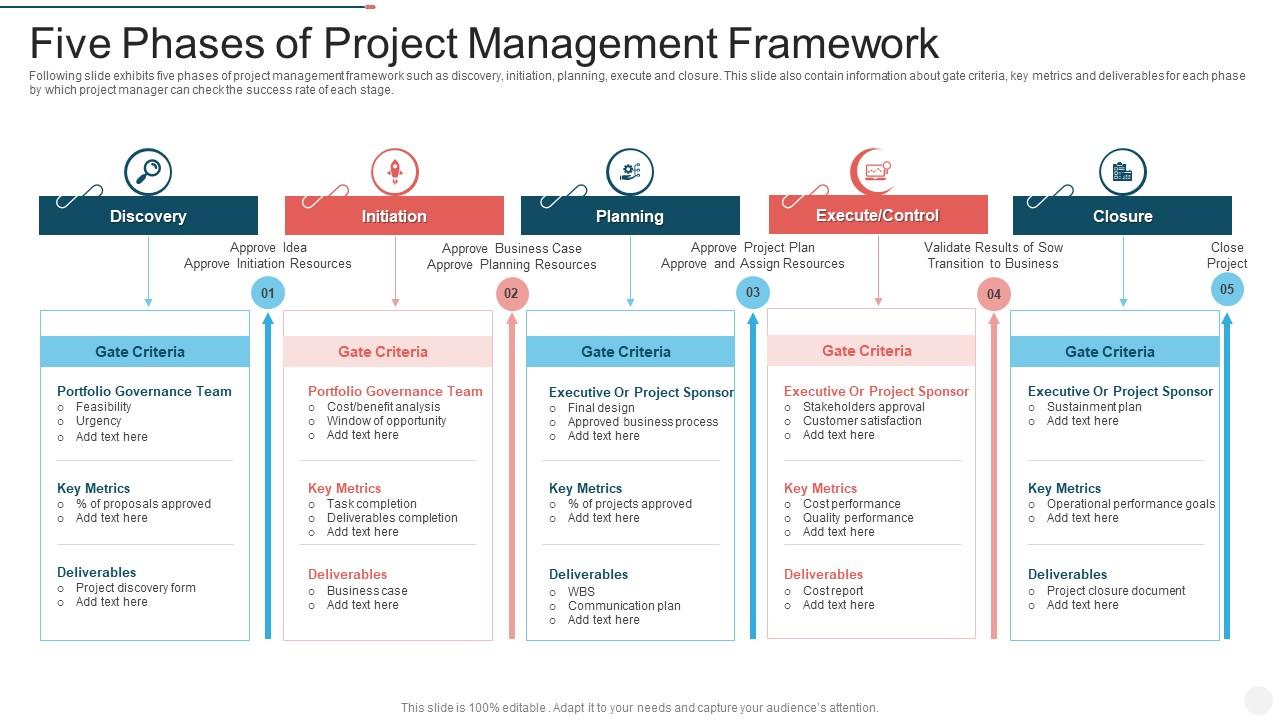
Use the following well-researched PPT Template to exhibits all five phases of project management framework, such as discovery, initiation, planning, execute and closure. This slide also contain information about gate criteria, key metrics and deliverables for each phase by which project manager can check the success rate of each stage. In the discovery stage, the emphasis is on getting the nod to the idea an approving the initiation resources. In initiation and planning, it is the business case and planning resources that assume prominence. In the execute/control project management phase, the project plan is approved and resources are assigned.
Finally, in the closure stage, we have validated results to show and we transition to business phase. For each of the phases, it in important to maintain stringent entry (gate) criteria, key metrics and deliverables.
PROJECTS ARE THE LADDER TO SUCCESS
Whether internally or externally, businesses need projects to grow, earn more revenue and generate greater profits. So, use SlideTeam’s five-phase project management PPT Templates to flawlessly learn and execute projects. The stages are universal, but the perspective from Slide Team is unique and brings you sure-shot options and routes for project management success.
PS Find a world-class project on Devops Project Management Framework with Key Practices here.
Five phases of project management framework with all 6 slides:
Use our Five Phases Of Project Management Framework to effectively help you save your valuable time. They are readymade to fit into any presentation structure.





FAQs for Five phases of
So each phase has specific stuff you gotta deliver. Your project charter and stakeholder register happen during initiation - basically you're proving this thing's worth doing. Planning gets messy but that's where you build your project plan, scope, risk assessments, all that. Execution is actually creating whatever you're supposed to make. Throughout everything, monitoring gives you status reports and handles change requests. Closure wraps it up with lessons learned and final docs. Honestly? Those planning deliverables will save your butt when everything inevitably goes wrong - I'd focus there first.
So basically your stakeholder game changes big time throughout the project. At the start, you're mostly schmoozing sponsors and decision-makers for money and approval. Planning gets messy - suddenly everyone and their brother wants to weigh in (technical folks, SMEs, you name it). During execution you're juggling your delivery team plus end users who actually have to use this thing. Honestly, the feedback loop can be intense. Closing brings you back to the sponsors for final sign-offs and that whole "what did we learn" conversation. My advice? Map out who needs what attention in each phase early on. Trust me on this one.
Honestly, keep it simple during initiation - don't overcomplicate things yet. Project charter templates are clutch because they force you to actually define your objectives and success criteria upfront. Stakeholder analysis matrices help you figure out who matters and who doesn't (sounds obvious but trust me, people skip this). I love using Miro for mind mapping project boundaries, though honestly a whiteboard works just as well if you're old school like me. Business case templates are pretty essential too. The fancy PM software can wait - nail down these basics first and you'll save yourself headaches later.
So risk management totally changes as you move through project phases. At the start, you're just throwing everything at the wall - what could go wrong? Planning phase is where you actually dig into analysis and figure out your responses. Execution gets messy though - you're watching known risks while new ones keep popping up (honestly, they never stop coming). I always tell people their risk register can't just sit there collecting dust. It needs to grow with your project. By the end, you're documenting what you learned for next time.
Dude, communication literally makes or breaks every single phase. You'll start by gathering requirements and setting expectations with stakeholders. Then during planning, you're working with your team on scope and timelines - honestly this phase is where I've seen most projects crash and burn if people aren't aligned. Execution means constant updates and putting out fires. Monitoring is all about progress reports and handling scope creep (ugh). Finally, closing involves documenting what you learned and getting those final approvals. The key thing? Match your communication style to whatever each phase actually demands from you.
Get that project charter locked down first - seriously, don't skip this step. Make stakeholders actually sign off on deliverables, boundaries, all that stuff before you start. Once you're rolling, stick to your change process like your life depends on it. I swear, projects go sideways so fast when someone's like "oh just add this tiny thing" without going through proper channels. Break everything into chunks with your WBS and check scope at each phase. Honestly? Treat any scope creep like it's about to blow your budget (because it will) and force people through formal change requests.
Track your team's actual workload against what you planned - that's honestly where most projects start falling apart. I check in with people daily because you can catch bottlenecks before they explode. Half my team burned out mid-sprint once and I swore I'd never let that happen again. Your resource dashboard needs real-time updates so stakeholders aren't blind to what's happening. Short check-ins work better than long meetings, trust me. Always build in 15-20% buffer capacity too - something unexpected will definitely pop up.
So here's the thing - your methodology totally changes how project phases work. Waterfall is super linear: you do initiation, then planning, execution, monitoring, and closure in order. Can't really jump ahead. Agile's different though - you're basically doing mini-versions of all those phases at once during each sprint. Way more flexible but honestly can feel chaotic at first. Go with Waterfall if you need that clear structure and predictable handoffs between teams. Pick Agile when requirements might change and you'll need to pivot quickly based on what users actually want.
So I'd go with regular status meetings and milestone tracking - those are your bread and butter. Weekly check-ins help you catch stuff before it gets messy. Traffic light reporting (red/yellow/green) honestly works way better than getting fancy with complicated metrics. Dashboard tools are great for seeing progress vs timeline and budget at a glance. Oh, and definitely keep an eye on your actual work completion compared to what you planned. Critical path stuff needs close monitoring too. Don't go overboard though - pick like 2-3 methods that actually fit how your team works.
Jump on conflicts right away - they turn into disasters fast during execution. First figure out what's actually going on. Usually it's either resource fights, scope creep, or people just not getting along (honestly, scope creep causes like 80% of these). Get everyone in a room together and stay neutral while you help them work it out. The key is making sure whatever you decide actually supports the project goals. Don't let this stuff sit and get worse. Write down what you all agree on and actually check back later to see if it's happening.
For project closing, you'll want to track the basics - budget and schedule variance first. Did you hit deadlines? Stay on budget? Scope completion percentage matters too. Client satisfaction scores are honestly make-or-break for getting future work with them. I'd also watch deliverable acceptance rates and how fast you're wrapping up loose ends. Oh, and if you're doing any handoffs, measure how well that knowledge transfer actually worked (because we've all seen those go sideways). Pro tip: start gathering this stuff early in the closing phase. You don't want to be hunting down data at the last minute.
Look at what actually broke in your last project and fix those specific spots. Scope creep during design handoff? Build tighter approval steps right there. Document the real failure points - not just "communication sucked" but exactly where things fell apart. Maybe you always forget to loop in stakeholders when switching phases, or dev requirements get mangled somewhere. Those recurring headaches? Turn them into standard checklist items. Honestly, most teams make the same 3-4 mistakes over and over. Your transition templates should catch whatever your team's blind spots are so you're not having that "oh crap, not again" moment six months later.
Dude, you HAVE to get stakeholder feedback during planning. Seriously. They'll catch stuff you missed and tell you when your timeline is totally unrealistic. Way better to hear "actually we need X feature" now versus three weeks from deadline, you know? Plus they know their business way better than you do - I've learned this the hard way. Don't just show them your plan and wait though. Ask specific questions or they'll just nod along and surprise you later. Changes are cheap now but expensive once you're halfway through building everything.
Honestly, tech makes project management so much less painful. AI tools can knock out feasibility studies super fast during initiation. For planning, Gantt chart software is a lifesaver - seriously can't imagine doing complex timelines by hand anymore. Collaboration platforms keep everyone on the same page during execution, plus dashboards show you what's actually happening in real time. Automated reports save you from those mind-numbing status updates too. My advice? Don't go crazy trying to digitize everything at once. Pick one solid tool for each phase and you'll be golden.
Don't skip proper sign-offs when moving between phases - trust me, stakeholders will suddenly have amnesia later about what they approved. Super annoying but happens all the time. Try not to overlap phases too much either, like starting execution while you're still finishing up planning docs. Gets chaotic quick. Your team needs to know how their roles change between phases too. I've watched projects crash because people thought execution would be identical to planning (spoiler: it's not). Oh and do those retrospective meetings even if they feel pointless - they actually catch stuff.
-
Great designs, really helpful.
-
Great quality slides in rapid time.