

Agile project plan by phase agile project management with scrum ppt graphics




Try Before you Buy Download Free Sample Product
 Impress Your
 Audience
 100%
100% Editable
 Save Hours
 of Time


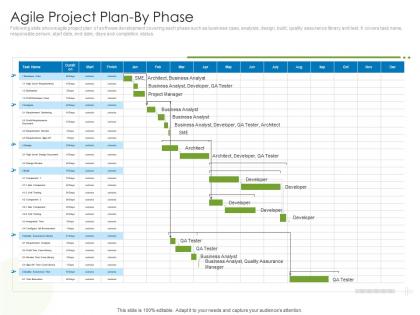
Following slide shows agile project plan of software development covering each phase such as business case, analysis, design, build, quality assurance library and test. It covers task name, responsible person, start date, end date, days and completion status.
People who downloaded this PowerPoint presentation also viewed the following :
Content of this Powerpoint Presentation
Agile Project Plan has to be able to cope with projects with potential shifting, changing, and unfolding requirements and be agile enough to offer the functional parts of the entire final solution to the end user promptly as required. This methodology is applicable to various project types and teams. Agile methodology is an accommodating approach to project management that focuses on rapid change and flexibility. This allows us to deliver value to the customer faster. Our PowerPoint template contains all of the necessary information for creating an agile project plan.
Agile planning focuses on teamwork and open communication, which aid in the efficient completion of any assignment or work. Our template covers all the information you want, such as the business case, analysis, design, build, quality assurance library, and test. This PPT also addresses the task name, responsible person, start date, end date, days, and completion status. The planning of the upcoming iteration is the main emphasis of agile project management.
Template: Agile Project Plan-By Phase

Using this Agile Project Planning PowerPoint Presentation, you can understand a lot more about this topic. Agile Project Plan templates help teams plan and manage thoroughly, plan pensively, pursue constantly, and proceed purposefully.
Conclusion
Agile planning is an iterative, supportive method that aids teams in continuously combining goals and advancement. To effectively exhibit your company to the public, you can use our template to draw together your agile business plan. You can easily plan out all your projects and design them for your business with these customizable slides.
Agile project plan by phase agile project management with scrum ppt graphics with all 2 slides:
Use our Agile Project Plan By Phase Agile Project Management With Scrum Ppt Graphics to effectively help you save your valuable time. They are readymade to fit into any presentation structure.

FAQs for Agile project plan by phase agile project management with
So there are four main things: people over processes, working software over tons of documentation, collaborating with customers instead of just following contracts, and being flexible rather than sticking to some rigid plan. It's honestly pretty straightforward once you get it. The whole point is delivering actual value fast and adapting as you go. Don't get stuck building what you *think* people want six months from now - focus on what users need right now. Your team keeps iterating based on real feedback. Way better than drowning in paperwork while your project goes nowhere.
So basically, Agile chops your project into these short 2-4 week chunks instead of planning everything upfront like traditional methods do. Think of it this way - traditional is following a recipe exactly, while Agile is more like... I dunno, winging it and tasting as you go? You're constantly tweaking things based on feedback. With traditional approaches you don't see anything until the very end, but Agile gives you working pieces regularly. Honestly, the constant feedback thing is pretty nice once you get used to it. Just try starting with daily check-ins and sprint reviews.
So there's three key people you need: Product Owner handles what gets built and ranks priorities by business value. Your Scrum Master basically keeps the chaos under control - removes roadblocks and stops everyone from having mental breakdowns mid-sprint (honestly the unsung hero role). Development team does the actual building and they're supposed to be cross-functional and self-managing. The real trick is getting these people to actually talk to each other daily instead of hiding in their corners. I'd start by figuring out who's doing what in your current mess first.
Oh man, agile is seriously night and day compared to waterfall - you actually talk to people instead of radio silence for weeks. Daily standups are clutch (just 15 minutes but everyone knows what's happening). Retrospectives help you figure out what's broken. Sprint planning keeps priorities straight. The biggest thing though? Your whole team works together instead of tossing stuff over the fence to the next department. I was skeptical at first but honestly, just try the daily standups if you're not already. You'll see the difference immediately.
So there's basically three big ones: Scrum, Kanban, and SAFe. Scrum works really well when you're building something specific - all those sprints and daily standups actually help. For ongoing stuff like bug fixes or support work, Kanban's way better since it just flows continuously. SAFe is what big companies use when they have like 50+ people working on related projects, but honestly it can get pretty bureaucratic. Quick rule of thumb - got a clear end goal? Go Scrum. More of a continuous workflow thing? Kanban all the way. Multiple teams that need to stay coordinated? That's SAFe territory, even if it feels overkill sometimes.
Dude, the difference is huge. Instead of waiting months to show customers anything, you're demoing actual working features every couple weeks. They get to see real stuff and give feedback that actually matters. When something's off, you can fix it fast instead of finding out way too late. Honestly, customers love feeling heard - when they suggest something and see it in the next sprint, they're suddenly way more invested. It's more like having an ongoing conversation than dropping some big presentation on them. Definitely try doing demos after each sprint with your main stakeholders. The end result is always so much better.
Honestly? Change is hard and people hate it. Your team's gonna resist at first because waterfall feels safer - sprints can seem like pure chaos when you're not used to them. Daily standups will feel awkward too. Start with just one small project to test things out. Get leadership on board early (trust me on this one). Training is crucial - don't skip it even if budgets are tight. Find a decent Scrum Master who actually knows what they're doing. Oh, and don't judge anything until you've done at least 3-4 sprints. Takes time to click.
So MVP is like your product's rough draft that actually works. You're not building the whole thing upfront - just enough to solve one core problem for users. Honestly, I've seen too many teams overthink this part. Build something people can actually use, ship it, then see what happens. With Scrum you'll probably have something testable after a few sprints. Kanban's more fluid - features just flow through until you've got enough. The trick is figuring out what "enough" looks like for your specific user problem. Don't go crazy with features yet.
Dude, Agile is perfect for this stuff. You work in these short 1-4 week sprints instead of planning everything forever upfront. Daily standups keep everyone synced, and sprint reviews let you pivot when things change - which they always do, let's be real. Your backlog becomes totally flexible, so you can shuffle priorities around as needed. Stakeholders actually see working software every few weeks, not after months of silence. Way better than waterfall where you're basically crossing your fingers until the end. Honestly? Start thinking of changes as normal part of the process rather than some annoying curveball.
Honestly, skip the usual velocity and burndown charts - they're kinda overrated and can fool you. Focus on stuff that actually matters: how happy your customers are, cycle time from idea to shipped feature, and whether you're delivering real business value. Your team's mood is huge too - miserable devs build crappy products, period. Lead time and bug rates tell you about quality. Oh and defect tracking helps catch issues early. Don't go crazy with like 10 different metrics though. Pick 3-4 max or you'll waste time tracking instead of shipping.
Honestly, retros are where you'll see the biggest wins if you do them right. Focus on stuff you can actually fix instead of just complaining about everything - I've watched way too many turn into pointless venting sessions. Track what you try and check back in a sprint or two to see if it worked. Get people talking about problems early, not just during meetings. Make sure everyone feels safe speaking up about what's broken. But here's the thing - you absolutely have to follow through on what you decide. Nothing kills the whole process faster than talking about changes that never happen.
Jira's pretty much the go-to for sprint tracking and user stories. Trello's solid too if you want something simpler - I actually prefer the Kanban boards there. Slack works great for daily standups, and Azure DevOps is clutch if you're already using Microsoft stuff. Honestly? Teams overthink this way too much. Just pick something your crew already knows instead of spending weeks debating features. You can always add Confluence later for docs or whatever. Start simple and build from there as you figure out what actually matters for your workflow. Most tools do the same basic stuff anyway.
So with Agile, you're basically doing mini risk checks every sprint instead of waiting until everything blows up at the end. Daily standups catch blockers right away, which is clutch. Then sprint reviews and retros become your regular "what's broken and how do we fix it" sessions. The constant customer feedback loop is huge too - honestly saves you from building something nobody wants (been there, it sucks). Oh, and try treating your retros like actual risk review meetings if you're not doing that already. Way better than the old waterfall approach where you'd just cross your fingers and hope for the best.
Honestly? Leadership buy-in is everything - if your execs aren't walking the walk, forget about it. Psychological safety comes first so people actually feel okay messing up and learning. Oh, and break down those department silos because cross-functional teams are where the magic happens. The trickiest part is getting folks to ditch their old ways of working. Don't just do some quick weekend training - invest in real coaching. Build feedback loops into everything: standups, retros, customer sessions. Celebrate wins AND failures equally (sounds weird but trust me). Start small with pilot teams, prove it works, then expand slowly.
Honestly, daily standups over video are a game-changer - way better than just Slack updates. Get a good sprint board going (Jira, Trello, whatever) so people aren't guessing what's happening. Retrospectives are where the magic happens though. People bottle up frustrations when working remote, so you gotta create space for real talk. I'd suggest starting with shorter sprints at first - helps build momentum. The biggest thing? Don't assume everyone's on the same page just because nobody's complaining. When something feels off, just jump on a call. Better to over-communicate than have things blow up later.
-
Design layout is very impressive.
-
Easily Understandable slides.
-
Excellent work done on template design and graphics.
-
Helpful product design for delivering presentation.