


Lean Agile Project Management Playbook Powerpoint Presentation Slides





Try Before you Buy Download Free Sample Product
 Impress Your
 Audience
 100%
100% Editable
 Save Hours
 of Time


Agile playbook enables development teams to manage software development life cycle and current state assessment. It ensures teams and stakeholders align with goals associated with the pilot project. Here is an efficiently designed Lean Agile Project Management Playbook covering best practices for deploying agile. The template covers an agile overview in terms of fundamental principles of the agile manifesto, critical phases in the agile product development lifecycle, and agile project management workflow. The agile development strategies include agile framework and practices through scrum and Kanban. Essential components of agile such as product vision board, work prioritization, agile sprints, user story, etc. are presented over the deck. Agile project events such as release planning, iteration planning, and valuable meetings associated with agile project management are captured. Agile progress tracking is managed through a software development timeline roadmap, schedule planning, work breakdown structure, and overall progress tracking. The playbook covers information about the agile team along with key people involved. The cost estimation analysis is done by managing the agile project budget. The agile project progress is tracked through dashboards. Download our project management ppt now.
People who downloaded this PowerPoint presentation also viewed the following :
Content of this Powerpoint Presentation
Slide 1: This slide introduces Lean Agile Project Management Playbook. State Your Company Name and begin.
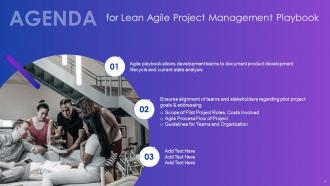
Slide 2: This is an Agenda slide. State your agendas here.
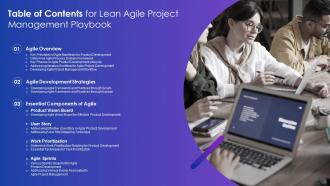
Slide 3: This slide presents Table of Content for the presentation.
Slide 4: This is another slide continuing Table of Content for the presentation.
Slide 5: This slide highlights title for topics that are to be covered next in the template.
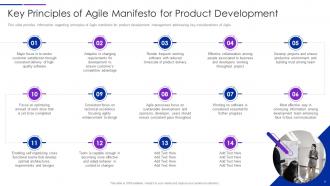
Slide 6: This slide shows Key Principles of Agile Manifesto for Product Development.
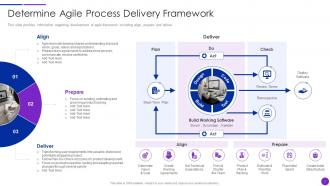
Slide 7: This slide presents Determine Agile Process Delivery Framework.
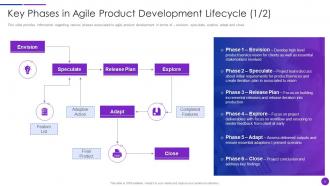
Slide 8: This slide displays Key Phases in Agile Product Development Lifecycle.
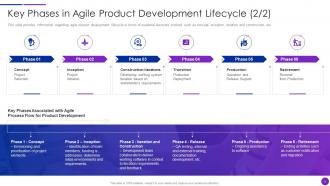
Slide 9: This is another slide continuing Key Phases in Agile Product Development Lifecycle.
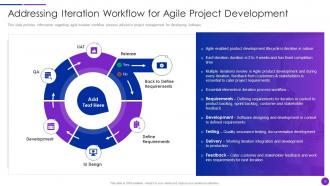
Slide 10: This slide represents Addressing Iteration Workflow for Agile Project Development.
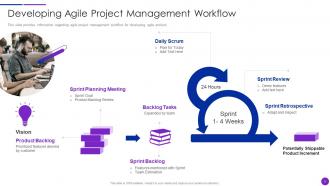
Slide 11: This slide showcases Developing Agile Project Management Workflow.
Slide 12: This slide highlights title for topics that are to be covered next in the template.
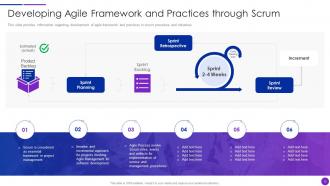
Slide 13: This slide shows Developing Agile Framework and Practices through Scrum.
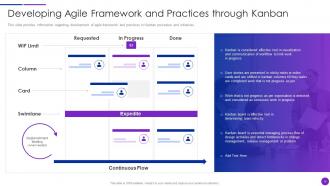
Slide 14: This slide presents Developing Agile Framework and Practices through Kanban.
Slide 15: This slide highlights title for topics that are to be covered next in the template.
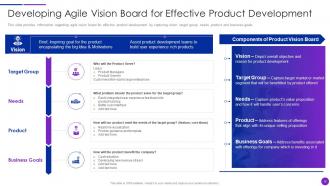
Slide 16: This slide displays Developing Agile Vision Board for Effective Product Development.
Slide 17: This slide highlights title for topics that are to be covered next in the template.
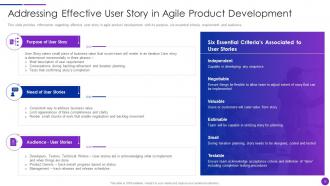
Slide 18: This slide represents Addressing Effective User Story in Agile Product Development.
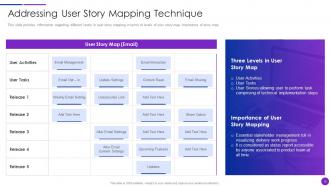
Slide 19: This slide provides information regarding different levels in user story mapping in terms of levels of user story.
Slide 20: This slide highlights title for topics that are to be covered next in the template.
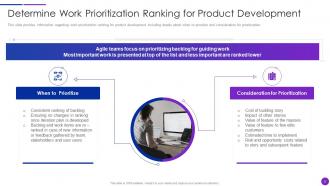
Slide 21: This slide represents Determine Work Prioritization Ranking for Product Development.
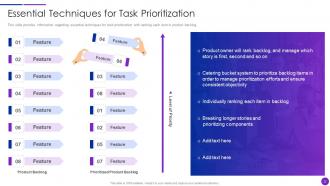
Slide 22: This slide provides information regarding essential techniques for task prioritization.
Slide 23: This slide highlights title for topics that are to be covered next in the template.
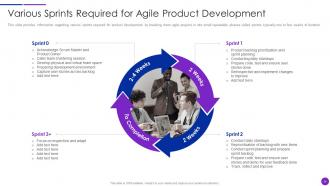
Slide 24: This slide showcases Various Sprints Required for Agile Product Development.
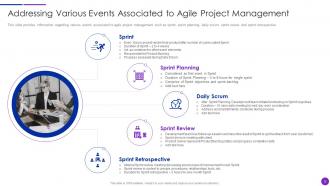
Slide 25: This slide shows Addressing Various Events Associated to Agile Project Management.
Slide 26: This slide highlights title for topics that are to be covered next in the template.
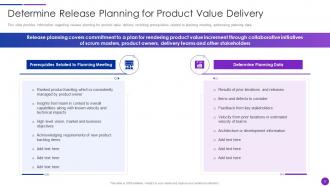
Slide 27: This slide presents Determine Release Planning for Product Value Delivery.
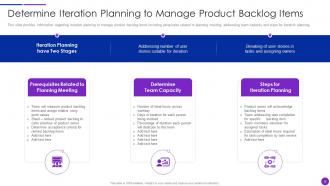
Slide 28: This slide displays Determine Iteration Planning to Manage Product Backlog Items.
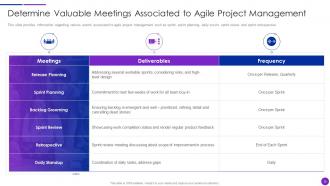
Slide 29: This slide represents Determine Valuable Meetings Associated to Agile Project Management.
Slide 30: This slide highlights title for topics that are to be covered next in the template.
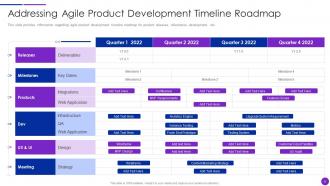
Slide 31: This slide showcases Addressing Agile Product Development Timeline Roadmap.
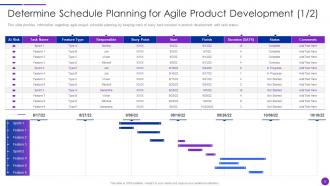
Slide 32: This slide shows Determine Schedule Planning for Agile Product Development.
Slide 33: This is another slide continuing Determine Schedule Planning for Agile Product Development.
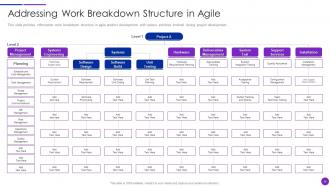
Slide 34: This slide presents Addressing Work Breakdown Structure in Agile.
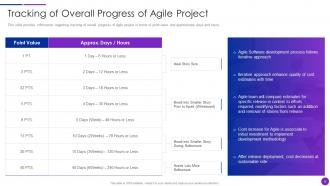
Slide 35: This slide displays Tracking of Overall Progress of Agile Project.
Slide 36: This slide highlights title for topics that are to be covered next in the template.
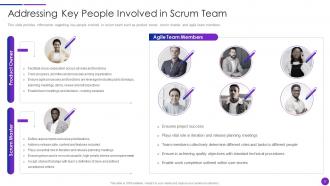
Slide 37: This slide presents Addressing Key People Involved in Scrum Team.
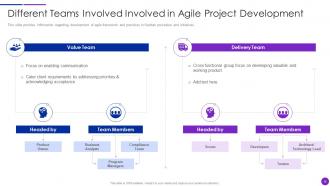
Slide 38: This slide represents Different Teams Involved Involved in Agile Project Development.
Slide 39: This slide highlights title for topics that are to be covered next in the template.
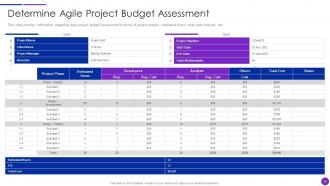
Slide 40: This slide showcases Determine Agile Project Budget Assessment.
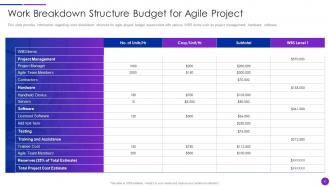
Slide 41: This slide shows Work Breakdown Structure Budget for Agile Project.
Slide 42: This slide highlights title for topics that are to be covered next in the template.
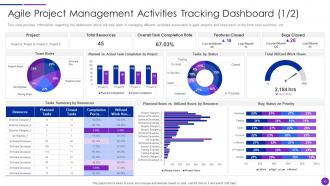
Slide 43: This slide presents Agile Project Management Activities Tracking Dashboard.
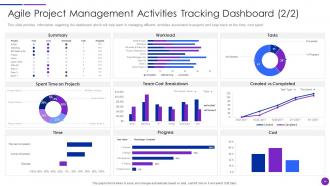
Slide 44: This is another slide continuing Agile Project Management Activities Tracking Dashboard.
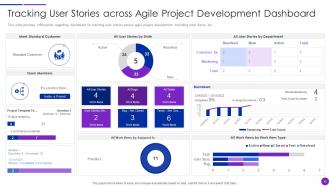
Slide 45: This slide displays Tracking User Stories across Agile Project Development Dashboard.
Slide 46: This slide displays Icons for Lean Agile Project Management Playbook.
Slide 47: This slide is titled as Additional Slides for moving forward.
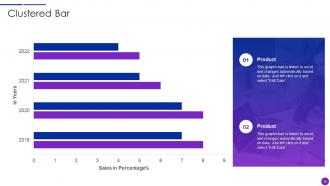
Slide 48: This slide provides Clustered Column chart with two products comparison.
Slide 49: This is Our Target slide. State your targets here.
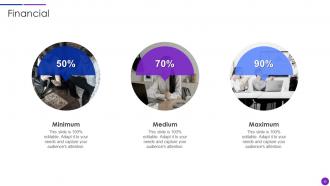
Slide 50: This is a Financial slide. Show your finance related stuff here.
Slide 51: This slide shows Post It Notes. Post your important notes here.
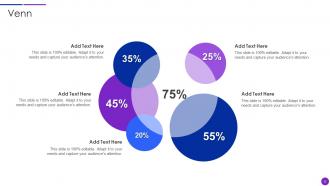
Slide 52: This slide depicts Venn diagram with text boxes.
Slide 53: This slide contains Puzzle with related icons and text.
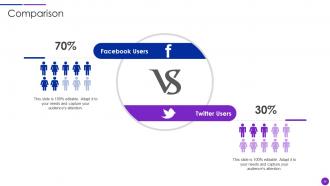
Slide 54: This is a Comparison slide to state comparison between commodities, entities etc.
Slide 55: This is a Thank You slide with address, contact numbers and email address.
Lean Agile Project Management Playbook Powerpoint Presentation Slides with all 60 slides:
Use our Lean Agile Project Management Playbook Powerpoint Presentation Slides to effectively help you save your valuable time. They are readymade to fit into any presentation structure.













FAQs for Lean Agile Project Management Playbook
Look, it's really about three main things: cut the waste, get value to customers fast, and let your team actually make decisions. Waterfall makes you plan everything upfront then pray it works. Lean Agile? You adapt as you go. Work with customers instead of hiding behind contracts. Respond to change rather than sticking to some plan you made months ago. Honestly, it's like using GPS instead of those terrible paper maps we used to fight with in the car. The whole mindset shifts from trying to control everything to just flowing with what you learn. Figure out what customers actually want, then dump the rest.
Map your value streams first to spot waste, then layer your Agile ceremonies on top. Use Kaizen events during retrospectives - that's where the real improvements happen. Pull systems work great with iterative delivery, but honestly most teams make this way more complicated than it needs to be. Keep WIP limits tight and obsess over cycle time (sounds boring but it actually tells you everything). Customer value should drive both your Lean metrics and sprint priorities. Oh, and definitely pilot with one team first - I've seen too many companies try to boil the ocean right away.
Look, continuous improvement is what keeps Lean Agile teams from stagnating. Run regular retrospectives where people actually speak up about what's broken. Small changes work way better than massive overhauls - learned that the hard way on my last project. Pick metrics that show real progress, not just feel-good numbers. Here's what I'd do: each sprint, grab one concrete thing from your retro and fix it. Don't try to solve everything at once. Actually makes a difference when you stay focused like that.
Honestly, you need to track two main things - how fast you're shipping and whether your team's actually happy. Cycle time and throughput show delivery speed, but customer satisfaction scores matter way more (nobody cares if you ship garbage quickly, right?). Team burnout is huge too since stressed developers don't exactly produce quality work. Feature adoption rates tell you if people actually use what you built. I'd keep it simple - maybe 3-4 metrics on a basic dashboard that your stakeholders will actually look at. Oh, and start measuring this stuff now so you've got something to compare against later.
Honestly, just stick with simple tools that won't make your team groan. Jira's pretty decent for kanban boards, or Azure DevOps if you're already in that ecosystem. Miro is clutch for planning sessions - I'm basically glued to it these days. Slack keeps everyone chatting without drowning in emails. Don't overthink it though. Your team actually using the tools matters way more than getting the "best" ones. Start basic with kanban visualization. You can always add fancy stuff later if needed, but most teams never do anyway.
Honestly, stakeholder collaboration can totally make or break your Lean Agile project. You need them giving feedback, clarifying what they actually want, and making decisions fast so your team can pivot when needed. Otherwise you're just building stuff in the dark and will probably end up redoing half of it later - which defeats the whole point of Lean, right? The regular communication helps you spot problems early and validate you're on the right track. I'd say set up consistent check-ins beyond just sprint reviews. Those formal reviews are fine but sometimes you need more frequent touchpoints.
Honestly, the hardest part is dealing with people freaking out about losing that detailed planning safety net. Teams really struggle with the whole self-organizing thing too - it's messier than most expect. Resistance to change is huge. Start with just one pilot team instead of going company-wide right away. Your leadership better be genuinely on board because everyone can tell when it's just lip service. Heavy investment in coaching helps a ton. Be crazy transparent about why you're switching - like, over-communicate everything. Get some quick wins with that first project, then slowly expand from there. The uncertainty makes people nervous but that passes once they see results.
Honestly, I'd start with SAFe, LeSS, or check out Spotify's model - they're built for this exact problem. SAFe gets a bad rep for being too heavy, but it actually works pretty well in big companies that love their processes. The trick is keeping your lean stuff intact (kill waste, get feedback fast) while adding coordination between teams. Program increments are clutch for alignment. Pick one product area to test it out first though - don't go crazy and roll it everywhere at once. You'll need some cross-team ceremonies to handle dependencies, but honestly that's where most people mess up the implementation.
Honestly, daily standups and retrospectives are where you'll see the biggest wins - they build those agile habits naturally. Let your team experiment without worrying about getting blamed when stuff doesn't work out. Cross-training is a game changer too; people can jump between roles and you get way more flexibility. Here's something that might sound backwards - celebrate failures just as much as successes. It totally changes how people think about trying new things. Also, shorten those feedback loops however you can, whether it's with clients or just internal team stuff. And here's the real key: you've got to model it yourself by being willing to pivot when new information shows up.
Honestly, visual management is huge - probably one of the best things about Lean Agile. Kanban boards show you everything at once: workflow, bottlenecks, who's swamped. No more "hey, what's the status on X?" meetings. You'll catch issues early instead of scrambling later. There's also something weirdly satisfying about dragging cards to "Done" - maybe that's just me though. Keep your board current and reference it during standups. Start basic with To Do/In Progress/Done, then add columns as needed. Don't overcomplicate it right away.
Start with daily check-ins and regular retrospectives - boring but they work. Slack's great for quick stuff, but honestly? Video calls are way better for anything complicated. People connect more when they can actually see each other. Document everything in shared spaces like Confluence so remote folks don't get left out. You really need 2-3 hours where most people overlap time-wise. Oh, and don't try fixing everything at once - just pick one communication gap this week and focus on that. Makes a huge difference when you're not spreading yourself thin.
So basically, Lean Agile is awesome for spotting risks because you're always checking in. Daily standups and sprint reviews? Perfect for catching stuff before it blows up. Short sprints mean you're never stuck waiting months to pivot - honestly way smarter than waterfall where you find out everything's broken at the end (been there, not fun). Your retrospectives are goldmines for this too. Turn them into mini risk sessions and watch how fast you start seeing problems coming. The constant feedback loops just make everything so much more manageable.
Dude, the biggest thing is you're showing them actual working stuff every couple weeks instead of vanishing for months. Customers feel way more involved when they see demos and can give feedback that actually matters. When you pivot based on what they say, they feel heard - plus you catch problems early which saves your butt later. Honestly, nothing beats showing real progress over those boring status emails. Sprint demos are a game changer if you're not doing them yet. The transparency thing really builds trust too.
So Netflix is the obvious one - went from mailing DVDs to streaming by constantly testing stuff and pivoting based on what users actually did. Spotify's squad thing is pretty cool too, basically small teams that can move super fast. ING Bank restructured their whole company around these "tribes" (yeah, corporate buzzwords are weird but whatever). Toyota started the whole lean thing that became agile. Oh, and don't go all-in immediately - try it with just one team first to see if it actually works for you.
So Lean Agile is basically about hunting down waste - anything that doesn't help your customers. Map out your current workflow first, then spot where work just sits around doing nothing. Cut down work-in-progress limits and ditch features nobody actually wants (we've all built those, right?). Visual boards help tons because suddenly everyone can see the problems. Your team gets addicted to fixing bottlenecks once they start. No more unnecessary handoffs or waiting around. The whole thing works because you're constantly improving instead of just accepting broken processes.
-
I had them make a presentation for an office retirement party. They were very helpful in understanding what we wanted and delivered the perfect presentation. Highly recommended!
-
Wide collection of templates available. SlideTeam has made it easier to create presentations in just a few minutes.