


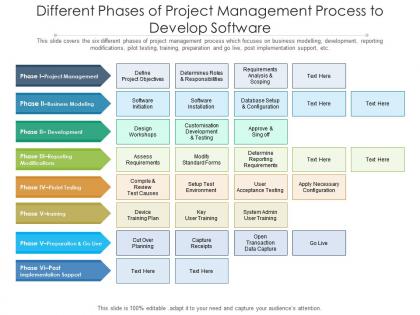
Different phases of project management process to develop software




Try Before you Buy Download Free Sample Product
 Impress Your
 Audience
 100%
100% Editable
 Save Hours
 of Time


This slide covers the six different phases of project management process which focuses on business modelling, development, reporting modifications, pilot testing, training, preparation and go live, post implementation support, etc.
People who downloaded this PowerPoint presentation also viewed the following :
Different phases of project management process to develop software with all 2 slides:
Use our Different Phases Of Project Management Process To Develop Software to effectively help you save your valuable time. They are readymade to fit into any presentation structure.
FAQs for Different phases of project management process
So basically you want checkpoints after each big phase. Project charter gets approved first, then scope/planning docs, then your major deliverables during execution, and finally acceptance at the end. Think of them as pause points where stakeholders actually sign off before you keep going. Look, they can feel like a pain sometimes - kinda bureaucratic honestly - but trust me, when scope creep starts happening you'll be so glad you have those gates! Your specific ones will change depending on what methodology you're using or what industry, but the general pattern's always the same. Just define yours upfront and make sure everyone agrees on what "done" actually means.
Look, the biggest thing is jumping in early when they're still figuring out what they actually want. That's your golden window to define success on your terms. Push back hard during planning if timelines look crazy - nobody thanks you for being polite about unrealistic deadlines. Once things get rolling, don't wait for meetings to mention problems. Just flag stuff immediately. Ask for metrics you care about, not whatever generic dashboard they throw at you. Oh, and show up to those post-project wrap-ups even though they're boring. Your complaints today become someone else's avoid-this-mistake tomorrow.
Start with a project charter to nail down your scope and what you're actually trying to accomplish. Stakeholder analysis templates are super helpful too - they show you who has power and who's just noise. Business case templates justify the whole thing existing, which honestly saved my butt more than once. Don't sleep on SWOT analysis either, it catches risks you'd totally miss. Oh and feasibility studies keep you from chasing impossible stuff. Pick like 2-3 depending on how complex things get and you're golden.
You start super broad when kicking things off, then dive deeper as you go. Planning phase is when you brainstorm all the "what could go wrong" scenarios. During execution, you're watching those risks like a hawk - plus new ones always pop up (honestly, there's always something you missed). Wrap-up time means comparing what actually happened vs what kept you up at night. Your risk register needs constant updates though. Don't be that person who writes it once then never touches it again - I've seen that backfire too many times.
Dude, communication will make or break your project execution - I've watched way too many crash and burn from this alone. Set up your daily standups and status reports early. Keep stakeholders updated on progress and any roadblocks that come up (and trust me, they will). You'll be juggling expectations between team members constantly. The key is picking consistent communication channels and actually sticking to them. Regular check-ins save you from those "wait, what are we doing?" moments. Honestly, I'd rather deal with technical problems than communication failures - at least code doesn't get its feelings hurt.
Honestly, get everyone to sign off on a solid project charter first - that's your lifeline. Weekly check-ins are clutch for most teams. I can't tell you how many projects I've watched crash because people thought they were aligned (they definitely weren't). Shared dashboards help everyone see what's actually happening and where things are stuck. Document everything right away and make sure stakeholders actually respond to updates - don't just assume they read them. Oh, and whatever communication rhythm you pick during kickoff? Stick to it religiously. That consistency makes all the difference.
Hey! So you'll want to watch your schedule (staying on track?), budget variance, and scope creep - that last one's a killer if you're not careful. Quality stuff like defect rates matters too. Resource utilization is huge because nobody wants their team either bored out of their minds or completely fried. Risk indicators and how engaged your stakeholders are can totally derail things. Honestly, pick like 5-7 metrics that actually make sense for your project instead of tracking everything under the sun. Weekly dashboard reviews work well - catches problems before they blow up in your face.
Honestly, just write down what actually happened - the good and the messy stuff. Like when stakeholder approval dragged on forever because nobody thought to loop in legal early on. That's gold right there. Create some kind of shared doc where future teams can search before they start similar work. I'm telling you, most people only document the wins, but the failures are way more useful. Make it brutally honest or it's pointless. Even a basic wiki works - doesn't need to be fancy. Your future self will thank you when you're not making the same mistakes twice.
Ugh, project closing is the worst part honestly. Getting final approvals takes forever - everyone drags their feet when you're 99% done. Then there's all the contract stuff and trying to get people to finish their documentation when they've already checked out mentally. Knowledge transfer gets messy too, especially if someone's leaving for a new job. Oh and don't get me started on budget reconciliation with random invoices still floating around. The admin work like archiving and lessons learned sessions? People rush through those so fast it's basically useless. Start your closing checklist way earlier than you think and just keep bugging people about it.
So basically, Waterfall keeps everything super structured - you finish planning completely before moving to execution. Agile flips that around and runs those phases in mini-cycles every sprint. You're constantly planning, executing, and wrapping up small pieces. Scrum throws in all those ceremonies on top, which honestly can feel like a lot sometimes. Kanban just flows through phases based on what your team can actually handle. The same core work gets done either way. Your rhythm changes dramatically though. Pick whatever actually matches how your team operates - there's no point forcing a methodology that fights against your natural workflow.
Okay so first thing - create a skills matrix to see what everyone's actually good at. Then do resource leveling to smooth out those crazy busy periods. A work breakdown structure is honestly a lifesaver because you can see exactly what each task needs resource-wise. I always use resource histograms too, they're great for spotting when you're totally swamped or have people sitting around. The critical path method shows you which delays will really mess you up. Oh and definitely track everything in whatever project tool you use - otherwise you're just flying blind against your plan.
Honestly, tech can save you so much time if you pick the right stuff. Project management tools automatically track where everything stands, plus you get alerts when deadlines are slipping. AI can actually predict delays now - kind of wild how accurate it's gotten. Set up automated workflows for approvals so you're not chasing people down constantly. Cloud platforms make remote collaboration way easier than email chains (thank god). The key is figuring out what's eating most of your time first, then finding tools to fix those specific pain points. Don't try to automate everything at once though.
Honestly, scope management is pretty straightforward - it just gets more detailed as you go. You start with the big picture stuff in initiation, figuring out what you're actually building. Planning phase is where things get real though - that's when you create the work breakdown structure and nail down specific requirements. Once you're executing, you're basically just fighting scope creep (and trust me, it's a constant battle). The closing phase is verification time - making sure you delivered what was promised. My advice? Document EVERYTHING early on. When stakeholders come asking for "tiny changes" later, you'll need that paper trail to save yourself.
Start with templates for the basic stuff - project charters, status reports, change requests. Trust me, you don't want your team making these from scratch every single time. Pick someone who actually likes organizing (yeah, those people exist) to own the documentation process. The trick is making it routine - update everything during your weekly meetings when it's still fresh in everyone's heads. I've watched too many teams try to recreate what happened months later and it's painful. Also, don't let it become something you deal with at the very end. That never works out.
Honestly, just stay ahead of the communication game instead of playing catch-up. Weekly updates work great, but tailor them - execs want budget/timeline stuff while regular users care about how their day-to-day changes. Video calls beat emails every single time, even quick 10-minute ones. Ask people what they actually think, then do something visible with their feedback. Nothing beats making someone feel heard. Oh, and set up some kind of schedule so you're reaching out before they start hunting you down. Trust me, being proactive saves so much headache later.
-
Designs have enough space to add content.
-
Illustrative design with editable content. Exceptional value for money. Highly pleased with the product.
-
The Designed Graphic are very professional and classic.
-
Editable templates with innovative design and color combination.
-
The Designed Graphic are very professional and classic.