


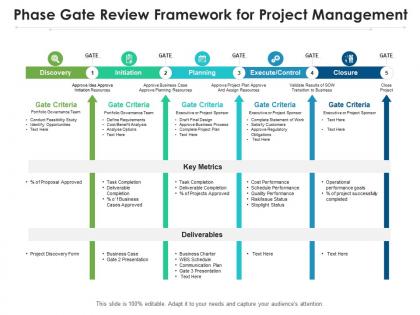
Phase gate review framework for project management




Try Before you Buy Download Free Sample Product
 Impress Your
 Audience
 100%
100% Editable
 Save Hours
 of Time


Our Phase Gate Review Framework For Project Management are topically designed to provide an attractive backdrop to any subject. Use them to look like a presentation pro.
People who downloaded this PowerPoint presentation also viewed the following :
Phase gate review framework for project management with all 2 slides:
Use our Phase Gate Review Framework For Project Management to effectively help you save your valuable time. They are readymade to fit into any presentation structure.
FAQs for Phase gate review framework
So the Phase Gate Process breaks down into 5 stages: Discover (evaluating your initial idea), Define (building the business case), Develop (actually creating the product), Deliver (prepping for launch), and Deploy (releasing to market). Each gate is basically a checkpoint where you decide if you should keep going, change direction, or just kill the whole thing. What I love about it is that costs ramp up at each stage - so you're catching expensive problems when they're still cheap to fix. Don't skip the checkpoints though. I know it's tempting when you're excited about an idea, but those gates will save your butt more than you realize.
Look, you've gotta match your gate criteria to what could actually kill your project at each stage. Think technical issues, market problems, budget disasters - whatever's your biggest worry. Map those to things you can actually measure: prototype performance, customer feedback numbers, budget tracking. I've watched way too many companies turn these into pointless checklists that completely miss the real problems. Your criteria should predict if the project will actually succeed, not just check random boxes. Keep them specific to your situation and tied to outcomes your stakeholders care about. Otherwise you're just wasting everyone's time with generic templates.
Honestly, cross-functional teams make or break the Phase Gate Process. You get all these different perspectives - finance, tech, operations, marketing - spotting risks and opportunities that one department would totally miss. The trick is nailing down who does what upfront and having regular check-ins between the big gate meetings (not just winging it). Someone needs to actually run these conversations though, because they turn into chaos real quick with everyone throwing in their two cents. I'd start by figuring out what each person brings to each gate, then build your meeting schedule around that. Makes everything way smoother.
Don't just slap engagement stuff on at the end - weave it into every gate from the start. Map out who you need buy-in from at each phase, then set up regular touchpoints with them. Weekly updates work, or quick review sessions. Here's the thing though: treat them like actual partners, not people you just report status to. That distinction matters way more than you'd think. Give them real channels to voice concerns early (and actually listen). Most crucial part? Let their input actually shape decisions at each gate. When stakeholders see their feedback mattering, they'll stay invested without you having to chase them down.
Honestly, the worst thing is when companies make their gates super rigid - teams either freeze up overthinking everything or just blast through to meet deadlines. Most places won't actually kill projects once they've burned cash on them, which is dumb but totally predictable. And God, they always put the wrong people in those review meetings - you get cheerleaders instead of people who can actually make tough calls. My advice? Keep your criteria flexible, don't be afraid to axe bad projects (seriously), and make sure whoever's reviewing has real authority. Otherwise you're just playing theater.
Phase gates are pretty adaptable actually - just switch up what you're checking at each checkpoint. Software projects? Focus on requirements, demos, user testing, deployment stuff. Product design is more about concept validation, design freeze, prototypes, manufacturing readiness. The framework stays the same but you're evaluating totally different things. I've worked with teams who got super rigid about it (mistake). Map your project's natural milestones to the gates first - that usually makes it click. Keep those go/no-go decision points but make them relevant to what you're actually building.
Pick 3-5 metrics that actually matter for each gate - don't go crazy with KPIs or you'll hate your life. Early on, focus on whether this thing is even feasible: market validation, tech risks, do we have the people? Development phases are all about milestones, budget burn, and timeline stuff. Later gates need the real performance data - quality tests, user feedback, ROI numbers. Honestly the biggest mistake is making it too complicated. Set your thresholds upfront so gate reviews aren't just everyone arguing based on feelings. Oh, and make sure each metric actually tells you something useful about the next phase.
Honestly, you gotta bake risk assessment right into every gate review - like, make it mandatory so teams can't just skip ahead without dealing with the big stuff. Document everything upfront, then watch how risks shift as things move along. I've watched way too many projects totally implode because people treated this like some box-checking exercise instead of actual protection. Before each review, update that risk register and get stakeholders talking real mitigation strategies. Not just "yeah we see the risk" but actual plans. Set hard limits on what's acceptable risk-wise to move forward. Don't cave when deadlines start breathing down your neck either.
Check out Monday.com or Asana - they've got gate review workflows built right in that'll save you tons of headaches tracking approvals. For meetings, Miro's pretty solid since everyone can see the same visual board. Honestly? Even a decent SharePoint setup beats the chaos of random emails everywhere. Risk dashboards help too, though I'd start simple. Whatever platform your team's already comfortable with, just tweak it for gate tracking. No point making everyone learn something totally new when you can build on what's working.
So Phase Gates can totally help innovation, but they can also crush it if you're not careful. Each gate gives you solid decision points and helps validate ideas before you blow your budget. Problem is, overly strict gates will murder any creative solution that doesn't check their boring boxes. I've seen this happen way too often at companies. Build in some wiggle room for those breakthrough ideas while still having enough structure to avoid wasting money on garbage. Don't just measure financial stuff at each gate - throw in some actual innovation metrics too.
Honestly, you've gotta make ownership crystal clear from day one - like, who owns what deliverable, no confusion. Regular check-ins between your gates are a game changer instead of waiting for the big review (learned this the hard way). Dashboards help tons for tracking progress transparently. When teams actually hit milestones? Celebrate it. The tough part is those gate reviews where you might have to say no if they're not ready. Oh, and train your reviewers to ask the hard questions - some people are way too nice and just wave everything through.
Set up regular retrospectives after each gate decision - that's where the real learning happens. Get your team to give input throughout, not just those random hallway chats (though honestly, those can be gold sometimes). Track what information you missed, which criteria actually worked, and how your predictions turned out. The boring part? You've got to follow through and actually change your process based on what you discover. Otherwise you're just having meetings about meetings. Keep tabs on decision outcomes over time so you can spot patterns. Short cycles work better than waiting months to review - trust me on that one.
Yeah, Phase Gates will definitely add time to your project - you're basically building in checkpoints between each phase. But trust me, catching problems early beats dealing with a total mess later. Budget for the review time upfront - stakeholder meetings, documentation, maybe some rework if things don't pass. I learned this the hard way on a project last year. Short sentences help here. Build those review periods right into your timeline from the start, and honestly, throw in a small buffer too. You'll thank yourself when you're not scrambling to fix everything at the end.
Oh man, this is such a pain point! Different cultures totally approach gate decisions differently. Some teams want to build consensus forever while others need that hierarchical sign-off structure. Communication styles clash too - one group thinks they're being thorough, another sees endless stalling. Risk tolerance? Yeah, that doesn't translate well across regions either. Honestly, I learned this the hard way on a project last year. Map out each team's preferences upfront and build in flexibility. Don't try forcing the same process everywhere if you actually want people to buy in.
Yeah, tons of big companies have had success with Phase Gate. 3M's probably the poster child - they use it across their whole innovation pipeline for thousands of products. P&G saw their development speed and success rates jump after implementing it properly. Microsoft does their own version for software releases too. Pharma's where it really shines though - Pfizer and others basically can't survive without it given how expensive drug development screwups are. Honestly, the framework's pretty flexible once you see how these companies tweaked it for their specific industries and timelines. I'd check out their approaches first.
-
Thanks for all your great templates they have saved me lots of time and accelerate my presentations. Great product, keep them up!
-
Excellent design and quick turnaround.
-
Helpful product design for delivering presentation.
-
Innovative and attractive designs.
-
Designs have enough space to add content.