


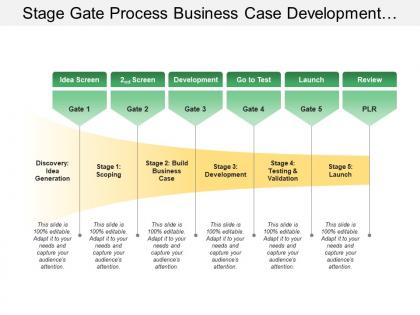
Stage gate process business case development launch review




Try Before you Buy Download Free Sample Product
 Impress Your
 Audience
 100%
100% Editable
 Save Hours
 of Time


The impact of our Stage Gate Process Business Case Development Launch Review can be highly captivating. It will get hearts to glow.
People who downloaded this PowerPoint presentation also viewed the following :
Stage gate process business case development launch review with all 5 slides:
Discourage inflated assessments with our Stage Gate Process Business Case Development Launch Review. Ensure evaluations are factual and accurate.

FAQs for Stage gate process business case
So Stage-Gate has five phases: Discovery, Scoping, Build Business Case, Development, and Testing & Validation. After each phase there's a "gate" where you decide if the project lives, dies, or needs a pivot. Discovery is for brainstorming initial ideas. Scoping nails down your concept, then Build Business Case gets into the nitty-gritty planning. Development takes forever (that's where all the real work happens), and Testing makes sure you didn't mess anything up. Honestly, the gates are the best part - they force you to actually look at risk and costs before throwing more money at something. Just don't treat them like formalities.
Set up your gate criteria before you even kick things off - that's honestly the biggest mistake I see people make. Each gate needs specific deliverables and clear success metrics. Who's making the final call? What actually counts as a go/no-go? Early gates should focus on market research stuff, later ones on execution and financials. Document it all and don't get wishy-washy when it's time to actually use them. I swear, half these gates turn into rubber stamps because teams wing it with vague criteria. Build simple scorecards that force real evaluation instead of just going with whatever feels right.
Look, Stage-Gate falls apart without cross-functional teams - learned this the hard way on my last project. You need marketing for market insights, R&D for the tech stuff, finance to keep budgets realistic, operations for manufacturing reality checks. Different stages need different expertise, right? Most projects crash because teams stay in their silos instead of actually talking to each other. Those gate reviews are pointless if you're just rubber-stamping decisions. My advice? Pull in the right people early, don't wait until the formal meetings. Trust me, it'll save you headaches later.
Build a scoring system for each gate - criteria like strategic fit, ROI, resources needed, risk level. Score everything numerically. Honestly, the real value comes from those brutal debates about what criteria actually matter (your exec team will fight over this stuff). Weight them based on company priorities - maybe strategic alignment gets 40%, timeline urgency only 15%. The whole thing needs regular updates since priorities change. But yeah, gives you something concrete to point to when people ask why their pet project got axed. Way better than gut decisions.
Match your metrics to what each gate actually needs to decide. Early on? Focus on market size, customer feedback, basic proof-of-concept stuff. Mid-stage gates need the financial picture - NPV, ROI estimates, resource planning. Later gates track execution: staying on timeline, budget control, quality hits. Most teams go overboard here and drown in data, which is so counterproductive. Just pick 3-5 metrics per gate that actually matter for your go/no-go call. Mix leading indicators (what'll predict success) with lagging ones (real results). The whole point is making clear decisions, not building some fancy dashboard nobody looks at anyway.
Honestly, the Stage-Gate thing is way more flexible than most people think. Tech companies race through with quick sprints and constant user feedback. Meanwhile pharma companies? They're stuck in clinical trials for literal years because of all the regulatory stuff. Pretty wild difference, right? Each industry just tweaks the timeframes and what they're looking for at each checkpoint. Some skip entire stages or throw in their own specialized ones. Really comes down to matching your gates to whatever risks and regulations you're dealing with. The basic framework stays put, but everything else gets customized.
Honestly, the hardest part is getting people to actually kill projects at those decision points. Everyone gets attached to their ideas or worries about wasted money. Politics plays a huge role too - nobody wants to be the bad guy. Your gates can also turn into these awful bureaucratic chokepoints if you're not watching. Resource fights are brutal when three projects all need the same developers at once. My take? Don't overthink it at first. Pick maybe three key gates, make the criteria super obvious, and - this is critical - give your gatekeepers real power to axe stuff. Otherwise you're just wasting everyone's time.
Dude, start with digitizing your gate scorecards - that change alone will save you hours every week. Project management tools like Smartsheet or MS Project can automate your approval workflows and give you real-time dashboards showing how your whole portfolio's doing. No more digging through endless spreadsheets (thank god). You can centralize all your project data, standardize gate criteria, and actually make those go/kill decisions based on solid data instead of gut feelings. Custom platforms work great too if you've got the budget. The automated workflows are honestly a game-changer for tracking deliverables and capturing lessons learned.
Honestly, communication is everything here. Set up regular check-ins at each gate so people aren't blindsided by what's happening. Quick wins between gates are huge - keeps everyone bought in when they see actual progress. Map out your stakeholders first though, because execs want the 30,000-foot view while your tech folks need all the nitty-gritty details. But here's the thing - actually let them weigh in on gate decisions. Don't just talk at them. When people feel like their input matters, they'll stick with you through the whole messy process instead of checking out halfway through.
So here's what worked for us - break those big Stage-Gate checkpoints into mini-reviews after each sprint. Way less intimidating than those brutal quarterly meetings, you know? Your gates become weekly check-ins instead. Sure, it feels super weird mixing the two at first (like putting pineapple on pizza or something), but you keep the risk management stuff while getting agile's speed. Don't try to finish whole stages before moving on - just chunk everything smaller. Test it on a pilot project first though, see how your team handles the change.
Basically, Stage-Gate makes you prove your innovation ideas are worth it before dumping more cash into them. Super different from regular project management where you just execute whatever you decided on initially. Each gate is like a reality check - you can axe terrible projects early or change direction based on what you learned. Honestly pretty harsh but it works! Regular approaches pretend you've got it all figured out from the start. Stage-Gate? It expects you'll discover stuff along the way. You'll waste way less money on duds and your wins actually solve real problems. Quick exercise - see which gates your current projects would actually survive.
Honestly, just bake the risk stuff right into your gate reviews - don't make it separate. Create 2-3 specific risk questions that every project has to answer before moving forward. Use scorecards for the technical, market, and money risks so everyone's speaking the same language. Too many teams I know wing this part and then wonder why everything falls apart later! Mix both the "gut check" discussions with actual numbers. The whole point is staying consistent so you can actually stack projects against each other. Start small though - just add those few key questions to whatever templates you're already using.
Don't turn your gates into soul-crushing bureaucracy where people just tick boxes. That kills creativity fast. Pressure will make you want to skip gates - resist that urge because it always bites you later. Zombie projects are the absolute worst though. You know, those half-dead things that should've been killed months ago but somehow keep lurching forward? Set clear criteria upfront so teams actually know what they're aiming for. Your gates need teeth - they should make real decisions about moving ahead, changing direction, or pulling the plug entirely.
Honestly, start by actually documenting what happens at each gate review - the good, the bad, and the "why did we think that was smart?" moments. Build a database that people can actually find and use later. Most companies just file this stuff away and forget about it. Take those insights and bake them into your templates and training materials for next time. Also worth doing quick debriefs with your review panels to figure out how they're making decisions. You don't want to keep making the same dumb mistakes over and over.
Honestly, Stage-Gate is perfect for this. You can bake sustainability checks right into each gate - environmental impact stuff, lifecycle analysis, all that good stuff. Products can't move forward unless they pass these criteria. Way smarter than trying to add green features after everything's already designed (learned that the hard way). Each gate also lets you evaluate suppliers based on their sustainability practices. The trick is making it mandatory, not optional. Otherwise people just skip it when deadlines get tight. It really does keep your whole innovation pipeline aligned with ESG goals from the start.
-
Presentation Design is very nice, good work with the content as well.
-
Great designs, Easily Editable.