

Stage Gate Project Management Process




Try Before you Buy Download Free Sample Product
 Impress Your
 Audience
 100%
100% Editable
 Save Hours
 of Time


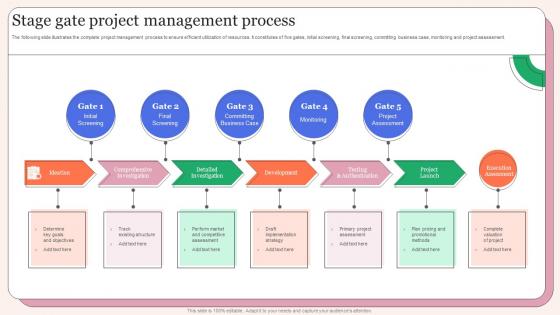
The following slide illustrates the complete project management process to ensure efficient utilization of resources. It constitutes of five gates, initial screening, final screening, committing business case, monitoring and project assessment.
People who downloaded this PowerPoint presentation also viewed the following :
Stage Gate Project Management Process with all 6 slides:
Use our Stage Gate Project Management Process to effectively help you save your valuable time. They are readymade to fit into any presentation structure.






FAQs for Stage Gate
So Stage Gate has like 5-6 main phases: Discovery, Scoping, Business Case, Development, Testing, and Launch. After each one there's a "gate" - basically where you decide if the project's worth continuing or if you should kill it. The genius part? You're cutting risk at every step. Early on you're just doing market research and checking if it's even feasible. Later you actually build and test stuff. Honestly, it stops you from wasting tons of money on dumb ideas (been there). Those gate reviews force real talk about whether something's actually viable. My advice - nail down your gate criteria right from the start or you'll hate yourself later.
Make your gate criteria SMART - specific and measurable, not just vague checkboxes. Figure out what success actually looks like first. Gate 2 might need "500+ customers willing to pay $X" instead of something useless like "market research complete." Gate 3 could be proven technical feasibility with real data backing it up. I've watched teams get totally stuck because nobody agreed on what "done" meant beforehand. Get everyone on the same page about evidence requirements upfront. Honestly, being ruthless here saves you months of arguing later. What does success look like at each stage? Pin that down and you're golden.
Honestly, Stage Gate falls apart without cross-functional teams weighing in at every checkpoint. You need marketing, engineering, finance, ops - the whole crew. Each group spots different problems that others miss completely. I've watched so many projects crash because teams stayed in their bubbles and ignored glaring issues. Short sentences work here. Before moving stages, every function should evaluate against their own criteria and give real input. Don't just invite people to check a box though - that's useless. You want actual perspectives, not warm bodies in meetings who stay quiet.
Yeah, totally customizable! You can tweak the stages, gate criteria, deliverables - whatever works for your situation. Software teams usually compress things and do more iterative testing. Pharma companies? They're stuck with tons of regulatory gates (poor them). Manufacturing needs way more upfront feasibility work. Look at your past projects first - where did you need more checkpoints vs where you could've moved faster? Map your typical risks to the gate criteria. Don't be rigid with timing either. Your risk tolerance and industry will basically dictate how you set it up.
Honestly, it depends on where you are in the process. Early on, just use basic evaluation matrices and market research templates - nothing fancy. Excel is still your best friend for financial modeling, even though everyone's pushing these new tools. I know it's old school but it works. Later you'll need project management software like Asana to track milestones. Gate review checklists are huge though - don't skip those or you'll regret it. Start with whatever templates your PMO has (if you're lucky enough to have one) then tweak them until they actually make sense for how your team works.
Honestly, the whole point is those mandatory checkpoints force you to actually stop and think about what could blow up. Instead of just charging ahead and crossing your fingers, each gate makes you sit down and figure out your risks upfront. Way better than scrambling later when everything's on fire. Your team has to systematically go through potential problems and nail down backup plans before anyone gives the green light. I mean, nobody loves extra meetings, but using those gate reviews as your risk audit has saved my butt more times than I can count. Catches the messy stuff early.
Ok so the metrics you track totally depend on what stage you're at. Financial stuff like ROI and budget variance are obviously crucial. Timeline tracking too - milestone completion, staying on schedule, all that. Quality metrics matter a ton - defect rates, customer satisfaction scores. Resource utilization is huge. Later on, market readiness becomes critical - competitive positioning, market size validation. Honestly though, don't get buried in spreadsheets! Pick maybe 3-5 metrics per gate that actually matter for decisions. I'd start by figuring out what success looks like for your specific project, then work backwards to find the metrics that'll tell you if you're hitting it.
Honestly, feedback from old projects is pure gold for tweaking your Stage Gate process. Look for patterns across multiple projects - not just one weird situation. I've watched teams completely redo their feasibility gate after repeatedly missing market risks (which happens more than you'd think). Capture what bombed and what killed it at each gate, then update your templates. Also adjust your timing and how you allocate resources based on what you learned. Document everything in a shared spot so the whole team can learn from past screwups and wins. The systematic approach really pays off here.
The worst mistake? Teams just check boxes to hit deadlines instead of actually making real decisions. I've seen this so many times - people rush through reviews and it's completely pointless. Don't make your criteria super rigid either. Markets shift, new tech pops up, you need wiggle room. Also, stakeholder fatigue is brutal. Too many review meetings and everyone's brain dead. Be upfront about what your gate criteria actually are. Tie them to business value, not some random internal metrics that don't matter. That's honestly half the battle right there.
Honestly, customer feedback is like your bullshit detector at every stage gate. Real insights about what people actually want to pay for will trump your internal assumptions every single time. I've watched teams with rock-solid presentations get absolutely demolished because customers were like "yeah, no thanks." The trick is getting quality feedback early - not just asking your mom if she'd buy it, lol. Use what you learn to tweak your pricing or scope. Sometimes you'll need to pivot the whole thing before burning through more budget. Way better than finding out later when you've already spent everything.
Build simple templates for each gate - track your decisions, assumptions that panned out (or totally bombed), and major risks you spotted. Honestly, documenting the failures is way more useful than celebrating wins. Keep the format consistent so teams can actually compare notes across projects. The "why" behind decisions matters more than just what you decided, since everyone forgets context super quickly. Stick everything in a shared folder where people can find it. Oh, and actually look at old gate docs before starting new stuff - you'd be shocked how much useful info just sits there collecting digital dust.
Honestly, digital tools are a lifesaver for all that boring admin work that slows down Stage Gate reviews. Project management apps can track your deliverables and send automated reminders. You'll want digital scorecards too - they keep evaluation criteria consistent across teams. The best part? No more digging through endless emails to find that document from last month (we've all been there). Real-time dashboards show exactly where projects stand, which makes steering committee meetings so much better. I'd start with Asana or Monday.com for digitizing gate checklists, then build from there.
So basically, Go/No-Go decisions are those make-or-break checkpoints where you decide if your project keeps going or gets axed. You're looking at whether it actually meets your criteria - market potential, can you even build this thing, does the business case still make sense? Smart teams set clear criteria upfront so you're not making emotional calls later. Honestly, these gates are lifesavers because they stop you from dumping more money into something that's clearly not working. Plus they keep everyone focused instead of wandering off into random features. Way better than realizing six months later you should've killed it at gate two, you know?
Map out who actually makes decisions vs who just needs updates first. Then bake in regular touchpoints between your formal gate reviews - coffee chats, quick pulse surveys, maybe a shared dashboard they can check whenever. I learned this the hard way when stakeholders ghosted until the final presentation and killed a project I thought was solid. Short check-ins work better than another boring meeting invite. The trick is making them feel like they're part of the journey, not just showing up to judge at the end. Nobody likes surprises in project reviews.
Honestly, the hardest part is getting people to stop skipping steps - everyone wants to rush straight to coding. Teams hate the upfront planning because it feels slow at first. Plus you need people dedicated to actually reviewing at each gate, which is annoying to schedule. Oh, and don't even get me started on defining the criteria - too strict and nothing moves, too loose and it's pointless. Resource planning gets weird too. I'd definitely try it on just one project first though. Get some wins under your belt before you make it a company thing, trust me on that one.
-
Editable, diversified, compatible with MS PPT and Google Slides, and on top of that finest graphics!! I mean in the words of the famous Ross Geller, “What more do you want!”
-
Superb! The innovative and inspiring template designs provide an edge to the presentation.