Project Approval Process Flow With Funding Scenarios
Try Before you Buy Download Free Sample Product
Audience
Editable
of Time
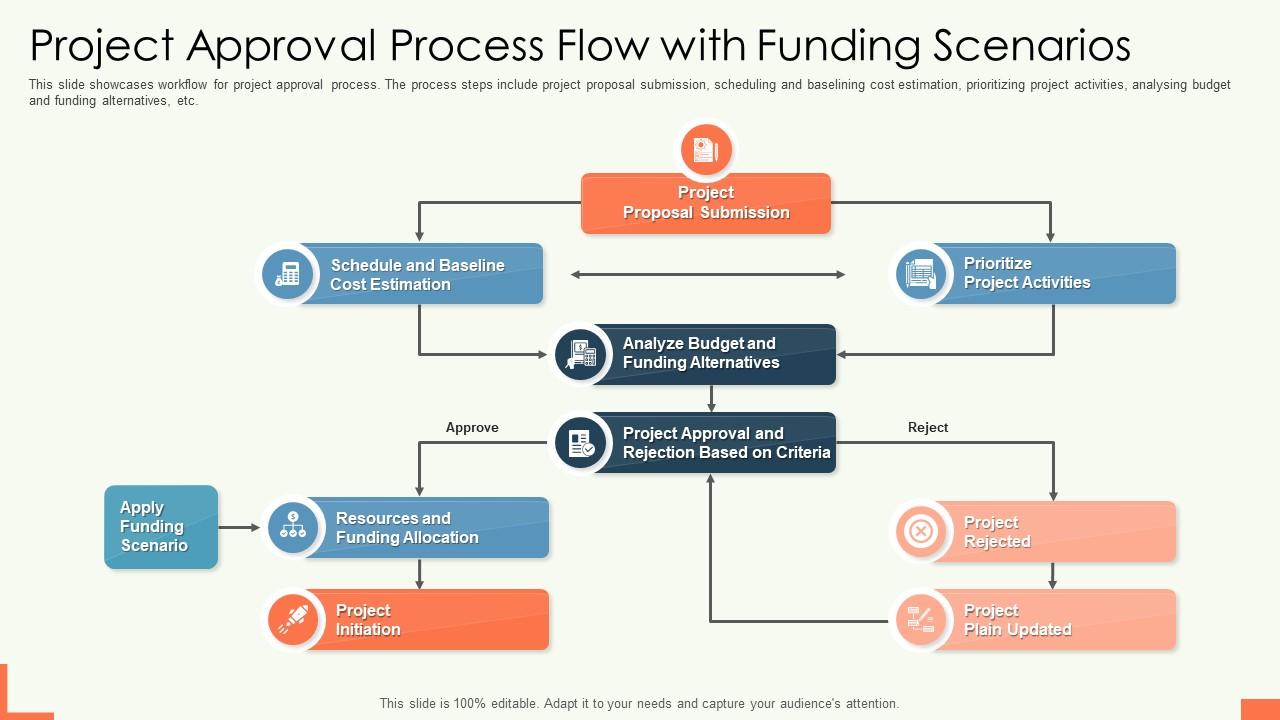
This slide showcases workflow for project approval process. The process steps include project proposal submission, scheduling and baselining cost estimation, prioritizing project activities, analysing budget and funding alternatives, etc.
People who downloaded this PowerPoint presentation also viewed the following :
Project Approval Process Flow With Funding Scenarios with all 6 slides:
Use our Project Approval Process Flow With Funding Scenarios to effectively help you save your valuable time. They are readymade to fit into any presentation structure.
FAQs for Project Approval Process Flow
So there's five main steps you'll go through. First is project initiation - basically defining what you want and putting in your funding request. Then comes the approval review where finance people and stakeholders look at whether it's actually doable. After that, budget allocation happens and they set aside your money. The execution phase is where you spend it while hitting your milestones. Finally there's project closure with all the financial wrap-up stuff. Heads up though - that approval stage is always a pain and takes way longer than you think. I'd honestly build in extra time there and get your paperwork sorted early.
Oh man, funding sources completely change how you run projects. Grants? Super rigid - you're stuck with their timeline and can't really pivot. Internal funding is way more chill, you can actually adjust things as you go. VC money though... that's intense. They want everything fast and keep adding more stuff to the scope. Government contracts are weird - they're super detailed about what you have to deliver but they'll usually let you extend deadlines if needed. Honestly, you've gotta match your approach to whoever's writing the checks right from the start. Don't wait until you're already drowning.
Think of stakeholders as the people controlling your money pipeline. Sponsors hold the budget keys, steering committees decide where funds go, and end users push their priorities. Finance teams can be total micromanagers (honestly the worst), but they all have veto power over your funding. Map out who controls what early on - you'll thank me later when you need approvals fast. Some are way more hands-on than others. Bottom line: figure out the decision-makers and keep them on your side, or your project's dead in the water.
So first thing - map out which activities actually deliver results and their ROI. Fund the stuff that hits your main deliverables first, then worry about the extras. I'm obsessed with impact vs cost matrices because honestly, they save your sanity when you're drowning in budget spreadsheets. Check your spending weekly against milestones. That way you can switch gears fast if something's tanking. Don't get attached to your original plan either - reallocating mid-project isn't failure, it's smart. Fund what works, watch it like a hawk, pivot when needed.
For tracking project funding, I'd check out Deltek or Unanet if you're doing government work - they're built for all that compliance stuff. QuickBooks Project works great for simpler setups. Honestly though? Some of the best tracking I've seen was just Excel with pivot tables. People get fancy with software but sometimes the basics work perfectly fine. Monday.com and Smartsheet are solid middle options too. Just figure out what features you actually need first, then try demos of maybe 2 or 3 tools. Don't overthink it - pick what your team will actually use.
Honestly, grants are way more of a pain than regular funding requests. The structure is super rigid - you have to hit every guideline perfectly or you're toast. Budget breakdowns, timelines, impact measurements, all that stuff. Regular funding? Way more chill. You can just pitch investors with a deck or ask your boss for budget money without jumping through crazy hoops. Grants take forever to get approved too. Oh, and once you get the money, they want reports on everything. You're basically fighting hundreds of other people for the same pot of money. My advice? Start stupidly early and read those requirements obsessively.
Dude, the timeline thing gets everyone - it takes WAY longer than you think, so add like 30% buffer time minimum. Most people just throw their wishlist at funders instead of actually figuring out what they want to fund. Bad move. Budget stuff trips people up constantly too, either going crazy high or being unrealistic about actual costs. But honestly? The relationship piece is what really matters. I've seen solid projects get rejected because nobody knew anyone, while mediocre ideas sailed through because they had connections. Start schmoozing now, not when you're desperate.
Honestly, risk management saves your ass when projects go sideways (and trust me, they always do). You gotta spot the big threats early - budget blowouts, scope creep, stakeholders bailing. Then work contingency plans right into your funding pitch. Funders love seeing you've thought through the disaster scenarios because it shows you're not just winging it with their money. I'd start with your top 3-5 risks, figure out what they'd actually cost you, then bake those buffers into your proposal numbers. Makes you look way more credible than just crossing your fingers and hoping for the best.
Honestly, you need to watch four main things. Time-to-funding is huge – how long are projects sitting around waiting for cash after approval? Track your fund utilization too, because money sitting idle is just wasteful. Budget variance will show you where things are going sideways (and trust me, big deviations always mean something's broken). Don't sleep on cash flow predictability either – it saves you from those super awkward "oops we're broke" moments. Oh, and milestone achievement rates compared to funding releases. Start there and you'll figure out what's actually working.
Honestly, it's mostly about where your cash flows from and approval headaches. For-profit stuff? Way simpler - you've got budgets, investors, revenue coming in. Decisions happen fast because it's just ROI math. Non-profits are a totally different beast though. You're constantly dealing with grants, donations, restricted funds - all with crazy compliance rules attached. Board approvals take forever, plus you have to jump through donor hoops. The worst part? Everything comes with spending restrictions, so you'll be doing detailed tracking and reporting constantly. Such a pain but that's just how it works.
Dude, government funding totally flips the script on project money. You're trading speed for stability - bigger budgets but holy hell, the paperwork is brutal. Approval takes forever and you'll be drowning in compliance reports. Plus now taxpayers are breathing down your neck instead of just regular stakeholders. But honestly? That consistent cash flow means you can actually plan those crazy long-term projects private investors would laugh at. Oh, and seriously - pad your timelines with like 30% extra time for all the bureaucratic nonsense. Trust me on that one.
Honestly, funders eat this stuff up - they love seeing partnerships because it shows you're bringing different skills and resources together. You'll want to find people whose expertise fills your gaps, not duplicates what you already do. Some programs basically require collaboration anyway. The cool thing is you can split costs and tap into their connections too. I'd start by figuring out what you're missing in your project, then hunt down organizations or researchers who need what you've got while offering what you lack. It's like academic dating but with grant money.
Hey! So transparency's huge - document everything and make your funding sources super clear. Watch out for conflicts of interest too, that stuff gets messy fast. Make sure money actually goes where it's supposed to (you'd be shocked how often it doesn't). Also check that your funding priorities match what your org claims to stand for. Honestly, the approval process part is kinda boring but set up clear steps for decisions. Regular audits help catch problems before they blow up. It's really about keeping everything above board so nobody can question your motives later.
Yeah so basically when the economy's doing well, investors throw money around like crazy - VCs are happy, banks say yes to everything, everyone's cool with risk. But when shit hits the fan (like lately), suddenly everyone gets super picky. Higher interest rates, they want more of your company, shorter timelines. Plus they only want "safe" bets with actual revenue instead of wild experimental stuff. Honestly the timing thing is huge - you gotta hit them when they're feeling generous and always have backup plans ready.
You need solid monthly reports showing budget vs actual spending - track every dollar with clear audit trails. Flag any variances and document who approved what. I've watched projects completely implode because nobody bothered telling stakeholders about budget changes (painful lesson there). Don't bury reports in some random shared drive where no one can find them. Consistent templates are your friend, and always include projections, not just what already happened. Oh, and automate whatever you can - saves so much headache. Regular finance team check-ins are non-negotiable too.
-
Really like the color and design of the presentation.
-
“The presentation template I got from you was a very useful one.My presentation went very well and the comments were positive.Thank you for the support. Kudos to the team!”