


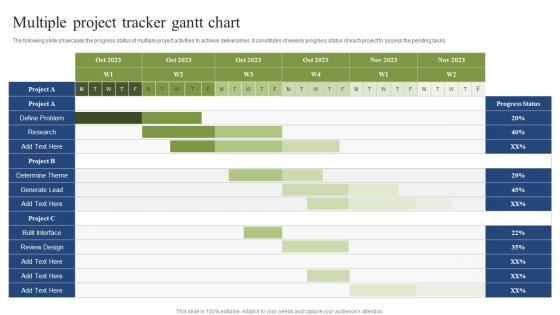
Multiple Project Tracker Gantt Chart




Try Before you Buy Download Free Sample Product
 Impress Your
 Audience
 100%
100% Editable
 Save Hours
 of Time


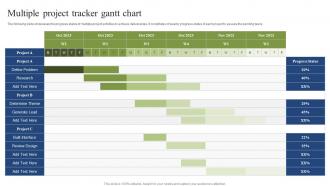
The following slide showcases the progress status of multiple project activities to achieve deliverables. It constitutes of weekly progress status of each project to assess the pending tasks.
People who downloaded this PowerPoint presentation also viewed the following :
Multiple Project Tracker Gantt Chart with all 6 slides:
Use our Multiple Project Tracker Gantt Chart to effectively help you save your valuable time. They are readymade to fit into any presentation structure.





FAQs for Multiple Project
Okay so first thing - nail down exactly what you're actually building and break it into chunks you can tackle. Set deadlines that aren't completely insane (seriously, everyone thinks they can do twice as much as they actually can). Figure out who's handling what parts and when they'll be free. Most projects blow up right here because someone's already swamped but says yes anyway. You'll want rough budget numbers even if they're kinda messy estimates. Oh, and think through what could go wrong ahead of time - have backup plans ready. Just throw it all in whatever system your team actually uses and tweak as you go.
Honestly, most people think it's just about hitting deadlines and staying on budget, but that's barely half the story. Yeah, scope/time/money matter - that's your foundation. But did stakeholders actually get what they wanted? Was your team miserable the whole time? I track the obvious stuff like delivery dates and budget, plus things like client satisfaction scores and how burnt out everyone feels. Oh, and here's the thing nobody talks about - you've gotta nail down what "success" means before you start. Otherwise you'll be arguing about it at the end when everyone remembers things differently.
You gotta get everyone on board early or you'll regret it later. Map out who actually matters - sponsors, users, your team, basically anyone who can mess things up. I learned this the hard way when some random department head appeared out of nowhere and nearly killed a project I thought was going smoothly. Communication is everything here. Figure out what each group needs to hear and how often they want updates. Some people want weekly emails, others just need the big milestones. The worst thing? Forgetting someone exists until they're already pissed off about changes.
Okay so basically Agile works because you're shipping stuff in small pieces instead of disappearing for months. Every 1-2 weeks you're showing stakeholders actual progress - saves you from building the wrong thing entirely (been there). Short cycles mean you catch problems when they're still easy to fix. Your team doesn't get burned out either since they see wins regularly. Plus honestly? You get way better at estimating timelines. I'd say start with 2-week sprints and just focus on getting something real done each time, even if it's rough around the edges.
Honestly, just pick Asana, Monday, or Trello and stop overthinking it - I've watched teams argue about this for weeks when they're all pretty much the same. Get Slack or Teams for messaging too. You'll need somewhere to dump files like Google Drive. Oh, and if you're billing hours, grab some time tracking thing (there's tons of them). My advice? Start simple with just one project tool and one chat app. You can always add more stuff later when you actually know what's missing. Trust me, beginning with 10 different tools is a nightmare.
Don't just do risk management once at the beginning - that's a mistake I see all the time. Build it into every phase instead. Start with a risk register during initiation, then do weekly check-ins throughout planning and execution. Things change so damn fast you'll miss stuff otherwise. Keep an eye on your mitigation strategies and watch for new risks. Always have backup plans ready with clear triggers so you know exactly when to switch gears. Update stakeholders when big risks shift. Making it routine instead of reactive is what actually works.
Honestly, just get everyone on the same page from day one about who's doing what and when stuff's due. That's like 80% of it right there. Set up regular check-ins but don't go crazy with meetings - we've all been in those pointless daily standups that should've been a Slack message. Tools like Asana help people stay connected without bugging each other constantly. The biggest thing though? Make sure your team feels safe calling out problems early. Nobody should be scared to say "hey, this isn't working." Have everyone agree on how you'll communicate before you even start.
Document everything first - seriously, get it in writing before agreeing to anything. Those "quick additions" are never actually quick (learned this the hard way). When stakeholders want new stuff, show them the real trade-offs right away: "Sure we can add Feature X, but you're looking at two extra weeks or we drop Feature Y." Set up a formal change process early so people can't just ambush you with new requirements in random meetings. Oh, and always communicate the actual costs upfront - it really helps them figure out what they actually need versus what sounds nice.
Honestly, scope creep is the worst - clients always want "just one tiny addition" but won't budge on deadlines. Communication falls apart because people assume everyone gets it (they don't). Unrealistic timelines? Total morale killer. Lock your scope down early and make changes go through a formal process. Check in constantly - like, more than feels necessary. Build buffer time into everything because something always goes sideways. Oh, and don't be afraid to push back on crazy deadlines. I learned that one the hard way.
Good communication basically prevents everything from going to hell. Your team will catch problems early instead of finding them the night before launch (been there). People stay on the same page about what you're actually building, so no weird surprises or expensive do-overs. Stakeholders won't bug you as much when they feel looped in. Plus it stops scope creep dead - everyone knows what's in and what's not. Weekly check-ins work great. Oh, and write stuff down because you'll definitely forget those random decisions later.
So for good estimates, I'd start with bottom-up - break everything into tiny tasks, estimate each one, then add them up. That's honestly the most reliable method I've used. Three-point estimation is clutch too where you do best case, worst case, and realistic scenarios. If you've got data from old similar projects, use it! That stuff's incredibly valuable. There's also parametric estimation with statistical models - sounds nerdy but it works. Oh and definitely pad some buffer time because projects always hit weird snags. Maybe start with the bottom-up approach first?
The basics don't change much, but man does industry context matter. Construction projects are brutal - weather screws you over, everything's locked in sequence, and regulatory stuff is insane. Software's the opposite though, you can actually pivot when things aren't working. Healthcare? Forget moving fast, documentation takes forever. I learned this the hard way switching from tech to manufacturing. Your planning style has to match what you're dealing with - some industries need everything mapped out upfront, others work better when you're flexible. Match your methods to how fast your industry moves and how much red tape you'll hit.
PM skills are kinda all over the place tbh. Yeah, you need the basics like Agile and budgeting, but soft skills are where people really succeed or fail. Communication is everything - you're constantly dealing with stakeholders who want completely different things. Being able to influence people when you can't actually boss them around? That's the real challenge. Problem-solving becomes second nature since fires pop up daily. Oh and emotional intelligence matters way more than most job descriptions mention. I'd figure out what you suck at first and work on that.
Think of performance metrics like your project's report card - they'll show you what's working and what isn't. Track things like budget variance, timeline slips, team velocity. But here's the thing: don't just collect data for the sake of it (I've watched teams drown in spreadsheets). You need to dig into why the numbers look that way. Then use what you find to tweak your process or shift resources around. My advice? Pick maybe 3-4 metrics that actually matter for your specific project and check them weekly. Short, focused reviews beat massive data dumps every time.
Oh man, cultural stuff can totally derail global projects. Like, Americans are super direct but other cultures hint around problems - creates massive confusion. Time zones are one thing, but time *perception* is worse. "Urgent" means totally different things everywhere. Some places need group consensus for decisions that you'd make solo in five minutes. Honestly, hierarchy expectations mess with teams the most though. Meeting styles, who talks when, all that matters more than you'd think. Best bet? Learn your team's cultural norms early and don't assume your way works everywhere.
-
Colors used are bright and distinctive.
-
“Slides are formally built and the color theme is also very exciting. This went perfectly with my needs and saved a good amount of time.”