


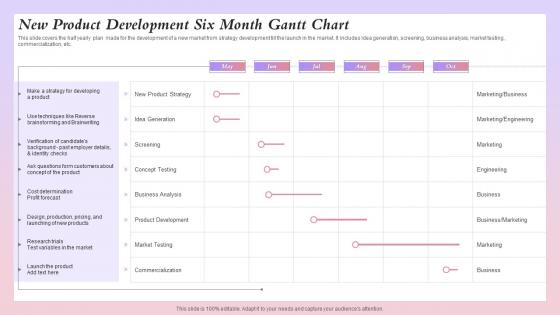
New Product Development Six Month Gantt Chart




Try Before you Buy Download Free Sample Product
 Impress Your
 Audience
 100%
100% Editable
 Save Hours
 of Time


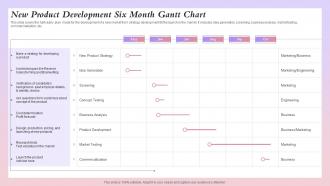
This slide covers the half yearly plan made for the development of a new market from strategy development till the launch in the market. It includes idea generation, screening, business analysis, market testing , commercialization, etc.
People who downloaded this PowerPoint presentation also viewed the following :
New Product Development Six Month Gantt Chart with all 6 slides:
Use our New Product Development Six Month Gantt Chart to effectively help you save your valuable time. They are readymade to fit into any presentation structure.





FAQs for New Product Development Six
The key stages of new product development include idea generation, concept development, market research, design and prototyping, testing and validation, and commercialization. These stages streamline innovation by systematically evaluating market needs, minimizing development risks, and ensuring product-market fit, with many organizations finding that structured processes accelerate time-to-market while enhancing competitive positioning.
Market research significantly influences new product launch success by identifying target customer needs, validating product concepts, analyzing competitor positioning, and determining optimal pricing strategies. Through comprehensive market analysis, companies can minimize launch risks, refine product features, and develop targeted marketing campaigns, with many organizations finding that data-driven insights ultimately deliver higher adoption rates and stronger market penetration.
Customer feedback serves as a critical validation and refinement tool, helping identify market gaps, usability issues, feature priorities, and pricing expectations early in development cycles. Through surveys, focus groups, and prototype testing, companies can minimize costly redesigns, accelerate time-to-market, and enhance product-market fit, with many organizations finding that customer-driven iterations significantly improve launch success rates.
Companies effectively manage cross-functional collaboration through unified project management platforms, regular cross-departmental meetings, and clearly defined roles and responsibilities. These approaches streamline communication between engineering, marketing, and design teams, while shared dashboards and milestone tracking ensure alignment, ultimately reducing development cycles and delivering products that better meet market demands.
Common pitfalls in new product development include insufficient market research, ignoring customer feedback, poor project management, inadequate testing, and rushing to market without proper validation. These challenges often result from resource constraints, timeline pressures, and communication gaps, with many organizations finding that thorough planning and iterative testing ultimately deliver better products and stronger market positioning.
Prototyping accelerates product development by enabling early testing, rapid iteration, and immediate feedback collection, while reducing costly late-stage design changes. Through digital modeling and physical mockups, organizations streamline validation processes, minimize development risks, and enhance team collaboration, with many companies finding that strategic prototyping ultimately delivers faster time-to-market and significantly improved product outcomes.
Key metrics for new product success include revenue growth, market share capture, customer acquisition costs, user engagement rates, and profitability timelines. These indicators work together by tracking financial performance, market penetration, and operational efficiency, with many organizations finding that combining leading indicators like pre-launch interest with lagging metrics ultimately delivers comprehensive performance insights.
Businesses ensure regulatory compliance during product development by conducting early regulatory assessments, integrating compliance checkpoints throughout development cycles, and maintaining detailed documentation of all processes and decisions. Through proactive engagement with regulatory bodies and cross-functional compliance teams, organizations streamline approval processes, reduce costly delays, and accelerate time-to-market, ultimately delivering compliant products while maintaining competitive advantage.
**INPUT**: What strategies can be employed to foster innovation within a product development team? **OUTPUT**: Innovation strategies include cross-functional collaboration, design thinking workshops, rapid prototyping, customer feedback integration, and dedicated innovation time for experimentation. These approaches streamline creativity by encouraging diverse perspectives, minimizing development cycles, and enabling faster market validation, with many technology and manufacturing companies finding that structured innovation processes ultimately deliver breakthrough products and sustained competitive advantage. [Word count: 55 words]
An agile approach accelerates the new product development cycle by enabling iterative design, rapid prototyping, continuous customer feedback integration, and faster time-to-market delivery. This methodology allows companies across industries like technology, consumer goods, and automotive to reduce development costs, minimize market risks, and respond quickly to changing customer demands, ultimately delivering more competitive products.
Emerging technologies include artificial intelligence for predictive analytics, 3D printing for rapid prototyping, augmented reality for design visualization, IoT sensors for real-time testing, and cloud-based collaboration platforms. These innovations streamline development cycles by accelerating prototyping, enhancing cross-functional collaboration, and enabling data-driven decision making, with many organizations finding significantly faster time-to-market and reduced development costs.
Sustainability has become critically important in new product development, driving innovation through eco-friendly materials, energy-efficient designs, reduced waste processes, and circular economy principles. Companies across automotive, consumer goods, and technology sectors increasingly find that sustainable development practices enhance brand reputation, reduce operational costs, and meet growing consumer demand for environmentally responsible products, ultimately delivering competitive advantage.
A successful value proposition combines clear customer problem identification, differentiated benefits over competitors, quantifiable value delivery, and compelling messaging that resonates with target audiences. These elements work together by addressing specific pain points, demonstrating measurable outcomes like cost savings or efficiency gains, and communicating unique advantages, with many organizations finding that emotionally resonant propositions drive higher adoption rates.
Companies leverage data analytics in product development by analyzing market trends, consumer behavior patterns, competitor insights, and performance metrics to guide strategic decisions. Through predictive modeling and real-time feedback analysis, organizations streamline development cycles, minimize risks, and enhance product-market fit, with many finding that data-driven approaches ultimately deliver faster time-to-market and improved customer satisfaction.
Branding significantly influences new product acceptance by establishing credibility, differentiating offerings, and building emotional connections with target audiences. Strong branding enables faster market penetration and premium pricing, with companies like Apple and Tesla demonstrating how strategic brand positioning accelerates adoption, ultimately delivering higher conversion rates and sustained competitive advantage in crowded marketplaces.
-
Delighted to see unique and eye-catching PowerPoint designs that are so easy to customize.
-
“Slides are formally built and the color theme is also very exciting. This went perfectly with my needs and saved a good amount of time.”