

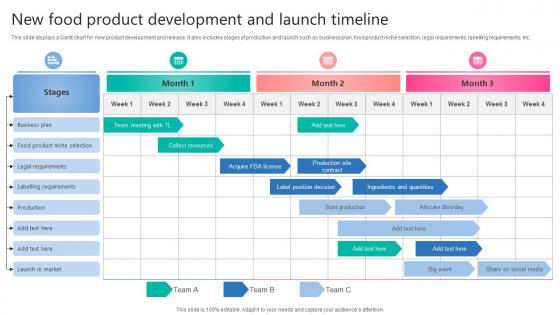
New Food Product Development And Launch Timeline




Try Before you Buy Download Free Sample Product
 Impress Your
 Audience
 100%
100% Editable
 Save Hours
 of Time


This slide displays a Gantt chart for new product development and release. It also includes stages of production and launch such as business plan, food product niche selection, legal requirements, labelling requirements, etc.
People who downloaded this PowerPoint presentation also viewed the following :
New Food Product Development And Launch Timeline with all 6 slides:
Use our New Food Product Development And Launch Timeline to effectively help you save your valuable time. They are readymade to fit into any presentation structure.





FAQs for New Food Product Development
So basically you've got five main steps: ideation, concept development, formulation, prototype testing, and commercialization. First you figure out what gap exists in the market or what people actually want. Then comes the fun lab work - creating your actual formulations and concepts. Testing is honestly where everything slows down. You'll do internal taste panels, consumer trials, all that stuff to make sure your product doesn't suck. I swear this part always drags on forever! After that you scale up production and sort out packaging before launch. Don't skip steps early on though - I've seen people rush and then have to reformulate everything later, which gets expensive fast.
Dude, you've gotta do market research before diving into product development - saves you from creating something nobody wants. It shows you flavor trends, what diets people are following, how much they'll actually pay. Consumer behavior is honestly so weird sometimes, but understanding it helps with everything from picking ingredients to designing packaging. You'll discover gaps in the market too. Oh, and figure out where your target customers shop and what makes them buy stuff. Real talk though - test your concept with actual people early on, not after you've already spent a fortune on production. That's where most people mess up.
Dude, sensory evaluations are literally your safety net for the whole development thing. Test early, test often - from your first crappy prototype to those final tweaks before launch. I swear, half the products that bomb could've been saved if teams actually listened to real people instead of just their lab nerds (no offense to lab nerds). The data keeps you from making terrible decisions about flavors and textures. Oh, and don't just test with your coworkers - they'll lie to be nice. Get your actual target customers to try it. Trust me on this one.
Ugh, food safety regs are such a pain - they'll add months or even years to your timeline. Hazard analysis alone takes forever, then you've got validation studies and approvals before launch. Failed safety test? Back to the drawing board. Honestly though, if you plan for regulatory checkpoints from the start and get food safety people involved early, it's way less painful. I learned this the hard way on my last project. Always add at least 30% buffer time for this stuff - trust me on that one.
Honestly, ingredient interactions are gonna be your biggest nightmare. Texture trips up everyone - seriously, nailing that mouthfeel is way harder than it looks. Cost vs quality is always a balancing act too. Then you've got regulatory stuff (ugh, especially if you're selling in different states), plus things that work fine in small batches sometimes completely fall apart when you scale up. Oh and color stability - forgot how annoying that one is. Flavor masking too if you're using any weird functional ingredients. Just budget extra time for redoing formulas like 3+ times, and definitely test at full production scale first.
Honestly, trends are everything in product development. Social media blows up with some ingredient? Your whole R&D team's suddenly working on it. Plant-based stuff took off and now everyone's scrambling for alternative proteins. You've got to watch this stuff like a hawk - consumer surveys, what people are posting online, actual sales numbers. The trick is spotting trends before your competition does. Don't go all-in right away though. Test small markets first instead of burning your entire budget on something that might flop. Clean labels, sustainability, convenience - whatever's trending basically becomes your roadmap.
Honestly, AI and machine learning are crushing it right now - predicting flavor combos, optimizing formulations, analyzing what people actually want from social media. Plant-based proteins are exploding too. 3D food printing is cool but still pretty niche (I mean, who's really using it yet?). Fermentation tech is creating ingredients that didn't exist before. Blockchain's helping with traceability, IoT sensors are changing quality control across supply chains. If I were you, I'd start with AI tools first. They're way more accessible and you'll actually use them right away.
Honestly, it's become a total game-changer. Customers are literally shopping based on how green your brand is now - even my nephew checks eco labels before buying anything, which still surprises me. Retailers won't work with you unless you've got sustainable sourcing down. Regulations keep getting tighter too, especially around packaging and carbon stuff. You really can't treat it as optional anymore. Start by looking at where you're doing the most environmental damage - ingredients, packaging, production methods, whatever. Then tackle the biggest problems first. It sounds overwhelming but breaking it down helps.
So there's basically three ways to test shelf life. Real-time testing is where you just store the product normally and check it until it spoils - takes forever but it's the most reliable. Accelerated testing cranks up heat and humidity to age things faster, though sometimes the results are kinda off. Mathematical modeling uses equations based on your ingredients, which honestly sounds fancier than it usually is. Most places I know mix all three approaches because using just one is risky. I'd start with the accelerated stuff for quick answers, then back it up with real-time data later.
Honestly, packaging is everything when it comes to sales. People literally decide in 3 seconds whether they want your product or not. Black packaging screams luxury, bright colors say "kid-friendly" - it's all psychological stuff that happens before they even think about it. Your package is basically selling for you when you're not there, showing off your brand's vibe and quality level. I've seen incredible products flop because of ugly packaging, and average stuff succeed just because it looked premium. Oh, and definitely test designs with focus groups first - way cheaper than realizing you messed up after launch.
Honestly, plant ingredients are a game changer right now. Better shelf life, usually cheaper, and you're hitting that whole vegan trend without scaring off regular customers. The fiber and antioxidants are a nice bonus too - clean labels sell themselves these days. Texture can be weird to work with sometimes though, not gonna lie. Sustainability messaging is massive for marketing. Oh, and don't try to overhaul everything at once. Pick one ingredient in your current formula and swap it out with a plant version first. Way less stressful that way.
Bring chefs into the process way earlier - like during brainstorming, not just when you need them to rubber stamp everything. Regular tasting sessions are crucial. Let them actually cook with your stuff because they'll spot problems you'd never see in a lab. Honestly, I've watched so many projects crash because people waited too long to get culinary people involved. You'll need to translate between food science talk and how chefs actually speak though. Give them samples to mess around with on their own time, then always circle back with real next steps based on what they tell you.
Timing's everything - don't launch during holidays unless it makes sense for your product. The food industry is insane right now, shelf space is like gold. Start with specialty stores first, they're way more willing to take risks on new brands. Your story needs to be rock solid too, what makes you different? Build relationships with buyers early, seriously can't stress this enough. Oh and get people tasting your stuff - sampling works. Actually had a friend who skipped this step and regretted it. Make sure your supply chain won't fall apart when orders start coming in. Nothing worse than running out of stock right when things take off.
Branding is seriously everything for food launches. People won't risk trying random stuff, but slap a familiar logo on it? Suddenly way less scary. Look at how Oreo can drop literally any new flavor and people grab it - that's brand power right there. Your packaging needs to scream what makes you different while still looking like something they'd actually want in their cart. The whole vibe you create sets expectations about taste and quality before they even open it. Honestly, I'd rather have amazing branding with decent product than the other way around.
Track your sales volume, market share, and profit margins - those are the basics. Customer satisfaction and repeat purchases matter just as much though. Social media sentiment is everywhere now, especially with food products since people post everything they eat lol. Don't forget distribution reach and how fast stuff moves off shelves. Monthly dashboards help you catch problems early. Brand perception surveys are worth doing too, even if they're kind of a pain. The whole point is spotting issues before they kill your launch momentum.
-
Awesome use of colors and designs in product templates.
-
Amazing variety of PowerPoint slides. Really helpful in designing professional presentations.