

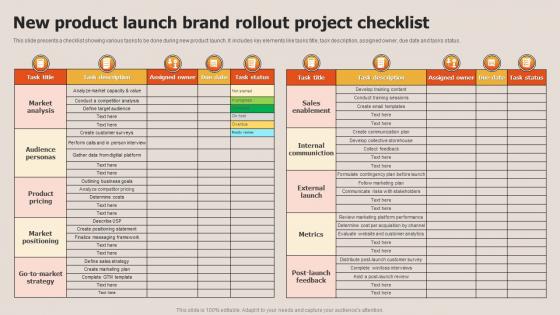
New Product Launch Brand Rollout Project Checklist




Try Before you Buy Download Free Sample Product
 Impress Your
 Audience
 100%
100% Editable
 Save Hours
 of Time


This slide presents a checklist showing various tasks to be done during new product launch. It includes key elements like tasks title, task description, assigned owner, due date and tasks status.
People who downloaded this PowerPoint presentation also viewed the following :
New Product Launch Brand Rollout Project Checklist with all 6 slides:
Use our New Product Launch Brand Rollout Project Checklist to effectively help you save your valuable time. They are readymade to fit into any presentation structure.





FAQs for New Product Launch Brand
Developing a new product launch timeline involves establishing project milestones, coordinating cross-functional team dependencies, setting realistic development phases, allocating buffer time for testing, and scheduling marketing campaign rollouts. These strategic steps streamline execution by aligning production schedules, marketing initiatives, and distribution channels, with many organizations finding that structured timelines reduce launch delays by 40% while ensuring market readiness.
Identifying target audiences involves analyzing demographics, psychographics, behavioral patterns, market research data, and competitor customer bases. Through surveys, focus groups, and analytics tools, businesses can segment potential customers by age, income, preferences, and purchasing habits, while testing messaging with different groups ultimately delivers more precise marketing strategies and higher conversion rates.
Effective market research strategies include competitor analysis, customer surveys, focus groups, social media listening, and prototype testing with target demographics. These approaches streamline product positioning by identifying market gaps, validating demand, and understanding consumer preferences, with many organizations finding that comprehensive research ultimately delivers reduced launch risks and enhanced competitive advantage in increasingly crowded markets.
Creating compelling product messaging requires identifying your unique value proposition, understanding target audience pain points, crafting clear benefit-focused statements, developing consistent brand voice, and testing messages across multiple channels. Through strategic messaging frameworks, companies in sectors like technology, healthcare, and retail enhance market positioning, accelerate customer adoption, and differentiate from competitors, ultimately driving stronger launch results and sustained market penetration.
A launch budget should include marketing and advertising costs, product development expenses, inventory and manufacturing investments, personnel allocation, distribution channel setup, and contingency reserves. These financial elements enable organizations to strategically allocate resources across pre-launch, launch, and post-launch phases, with many companies finding that comprehensive budgeting ultimately delivers smoother market entry and sustainable competitive advantage.
Post-launch success measurement involves tracking key performance indicators like sales revenue, market share, customer acquisition rates, user engagement metrics, and return on investment. These metrics enable organizations to assess market penetration, customer satisfaction, and profitability, with many companies finding that combining quantitative data with qualitative feedback ultimately delivers comprehensive insights for future product optimization.
Competitor analysis enables strategic positioning by identifying market gaps, pricing benchmarks, messaging opportunities, and potential threats before launch. Through comprehensive competitive research, companies can differentiate their offerings, avoid saturated segments, and capitalize on unmet customer needs, with many organizations finding that thorough competitor analysis ultimately delivers stronger market entry and sustainable competitive advantage.
Best practices for creating an engaging launch presentation include compelling storytelling with clear value propositions, interactive demonstrations, audience-centric messaging, visual consistency, and strategic use of data and testimonials. These approaches enhance stakeholder engagement by building emotional connection, demonstrating real-world applications, and addressing specific market needs, ultimately delivering stronger buy-in and accelerated market adoption.
Social media promotion leverages targeted advertising, influencer partnerships, content marketing campaigns, user-generated content initiatives, and community engagement strategies to maximize product visibility. Through platforms like Instagram, LinkedIn, and TikTok, companies can build pre-launch anticipation, engage directly with target audiences, and create viral moments, ultimately delivering broader market reach and faster customer acquisition than traditional marketing approaches.
Common product launch pitfalls include inadequate market research, poor timing, insufficient budget allocation, weak messaging clarity, and limited post-launch support planning. These missteps often result from rushing timelines or underestimating customer education needs, with many organizations finding that thorough preparation, stakeholder alignment, and contingency planning ultimately deliver smoother launches and stronger market adoption.
Determining the right pricing strategy involves analyzing competitor pricing, understanding your target market's willingness to pay, calculating production costs with desired profit margins, and considering your product's unique value proposition. Many companies use strategic combinations of cost-plus pricing, value-based pricing, and market penetration approaches, with businesses increasingly finding that flexible pricing models enable competitive positioning while maximizing profitability and market acceptance.
Having a contingency plan is crucial for product launches, as it enables organizations to quickly address potential delays, supply chain disruptions, marketing missteps, and competitive responses. These strategic backup plans streamline risk management by identifying alternative suppliers, adjusting messaging strategies, and reallocating resources, ultimately delivering greater launch resilience and competitive advantage during unexpected challenges.
Project management platforms like Asana, Trello, and Monday.com, along with collaboration tools such as Slack, Microsoft Teams, and Google Workspace, streamline launch coordination and task tracking. These technologies enhance team communication, automate deadline reminders, and centralize documentation, with many organizations finding that integrated dashboards ultimately deliver improved visibility and faster time-to-market execution.
Cross-departmental collaboration is ensured through establishing clear communication channels, defining shared objectives and timelines, implementing regular cross-functional meetings, and creating accountability frameworks with designated liaisons. Organizations streamline this process by using project management platforms, conducting collaborative planning sessions, and establishing feedback loops, ultimately delivering faster time-to-market and more cohesive product positioning across all departments.
Key metrics include Net Promoter Score (NPS), customer satisfaction ratings, support ticket volume, feature usage analytics, and retention rates. These measurements enable organizations to identify improvement opportunities, prioritize product enhancements, and optimize user experiences, with many companies finding that systematic feedback tracking accelerates product refinement and drives long-term customer loyalty.
-
Professional and unique presentations.
-
Loved the templates on SlideTeam, I believe I have found the go to place for my presentation needs!