


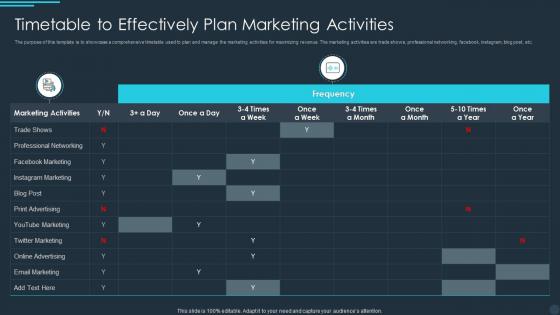
Timetable To Effectively Plan Marketing Activities




Try Before you Buy Download Free Sample Product
 Impress Your
 Audience
 100%
100% Editable
 Save Hours
 of Time


The purpose of this template is to showcase a comprehensive timetable used to plan and manage the marketing activities for maximizing revenue. The marketing activities are trade shows, professional networking, facebook, instagram, blog post, etc.
People who downloaded this PowerPoint presentation also viewed the following :
Timetable To Effectively Plan Marketing Activities with all 6 slides:
Use our Timetable To Effectively Plan Marketing Activities to effectively help you save your valuable time. They are readymade to fit into any presentation structure.





FAQs for Timetable To Effectively
Key components of an effective marketing timetable include campaign objectives, target audience segments, content creation schedules, channel deployment timelines, and budget allocation phases. These elements work together by ensuring coordinated messaging across platforms, optimizing resource distribution, and maintaining consistent brand presence, with many organizations finding that structured timelines enhance campaign effectiveness while reducing last-minute rushes and budget overruns.
Seasonal trends significantly influence marketing campaign scheduling by dictating consumer behavior patterns, purchasing cycles, and engagement windows throughout the year. Retailers align holiday promotions with peak shopping seasons, while travel companies launch summer campaigns in early spring, and financial services time tax-related messaging strategically, ultimately maximizing relevance and conversion rates.
Tools for creating and managing marketing timetables include project management platforms like Asana and Trello, scheduling software such as CoSchedule and Hootsuite, and traditional options like Excel spreadsheets and Google Sheets. These tools streamline campaign coordination by enabling automated scheduling, team collaboration, and real-time updates, with many marketing teams finding that integrated platforms ultimately deliver better resource allocation and campaign performance tracking.
Marketing timetables should be reviewed monthly for tactical adjustments and quarterly for strategic evaluations, with additional reviews triggered by market changes, campaign performance data, or competitive shifts. This approach enables organizations to maintain agility while preserving long-term strategic direction, with many companies finding that regular reviews enhance campaign effectiveness and resource allocation.
Aligning marketing activities with product launches maximizes market impact, ensures coordinated messaging, optimizes resource allocation, builds anticipatory demand, and creates unified customer experiences. This strategic synchronization enables organizations to concentrate promotional efforts during critical launch windows, streamline cross-departmental workflows, and ultimately deliver stronger market penetration and competitive advantage through cohesive timing.
Visual templates enhance marketing timetable clarity by organizing complex campaign timelines into digestible formats, color-coding different activities, and providing at-a-glance progress tracking through charts and milestone markers. These structured layouts enable marketing teams to quickly identify dependencies, resource allocation conflicts, and deadline priorities, while stakeholders can easily understand campaign flows, ultimately streamlining coordination and reducing miscommunication across departments.
Key metrics include campaign ROI, lead generation rates, conversion percentages, customer acquisition costs, and timeline adherence rates. These measurements enable organizations to optimize resource allocation, identify high-performing channels, and adjust strategies in real-time, with many marketing teams finding that consistent tracking delivers improved campaign effectiveness and competitive advantage.
Different marketing channels significantly impact campaign timelines through varying setup requirements, audience reach speeds, and engagement cycles. Digital channels like social media and email marketing deliver faster implementation and immediate feedback, while traditional channels such as print advertising require longer lead times, with many organizations finding that strategic channel combinations optimize both short-term engagement and long-term brand building.
Market research provides critical insights for developing an effective marketing timetable by identifying optimal timing for campaigns, target audience behaviors, seasonal trends, and competitive landscapes. Through comprehensive market analysis, organizations can strategically schedule product launches, promotional activities, and content releases to maximize engagement and ROI, with many companies finding that research-driven timing significantly enhances campaign effectiveness and market penetration.
A marketing timetable helps optimize resource allocation and budgeting by mapping campaign timelines, identifying resource conflicts, and enabling strategic cost distribution across quarters. This systematic approach allows marketing teams to allocate personnel efficiently, coordinate vendor relationships, and balance seasonal spending patterns, ultimately delivering better ROI and preventing budget overruns through proactive planning.
Common marketing timetable pitfalls include unrealistic deadlines, insufficient buffer time, poor stakeholder coordination, inadequate resource allocation, and neglecting seasonal market fluctuations. These oversights streamline project management by creating bottlenecks, missed opportunities, and budget overruns, with many organizations finding that strategic timeline planning ultimately delivers enhanced campaign effectiveness and competitive advantage.
Cross-departmental collaboration improves marketing timetables by aligning resources, streamlining workflows, and eliminating scheduling conflicts between teams. When marketing works closely with sales, product development, and customer service, organizations can coordinate campaigns more effectively, reduce project delays, and ensure consistent messaging, ultimately delivering faster time-to-market and enhanced customer experiences across all touchpoints.
A marketing timetable enables long-term strategic planning by mapping campaign sequences, aligning initiatives with business cycles, coordinating cross-functional resources, and establishing measurable milestones across quarters or years. Through strategic timeline visualization, organizations can synchronize product launches with market opportunities, optimize budget allocation, and maintain consistent brand messaging, while many companies finding that structured scheduling delivers enhanced competitive positioning and sustainable growth momentum.
Best practices for communicating a marketing timetable include creating visual timelines, establishing regular update schedules, defining clear milestones and deliverables, using collaborative platforms for real-time access, and providing context for dependencies. These approaches enhance transparency by streamlining stakeholder alignment, minimizing miscommunication, and enabling proactive decision-making, with many organizations finding that structured communication ultimately delivers improved campaign execution and stronger strategic outcomes.
Flexibility can be integrated into marketing timetables through buffer time allocation, modular campaign structures, agile review cycles, and contingency budget reserves. Companies across retail, technology, and financial services find that building 15-20% time cushions and establishing rapid decision-making protocols enables swift pivots during market shifts, ultimately maintaining campaign momentum while adapting to unexpected opportunities or challenges.
-
I discovered this website through a google search, the services matched my needs perfectly and the pricing was very reasonable. I was thrilled with the product and the customer service. I will definitely use their slides again for my presentations and recommend them to other colleagues.
-
Very well designed and informative templates.