


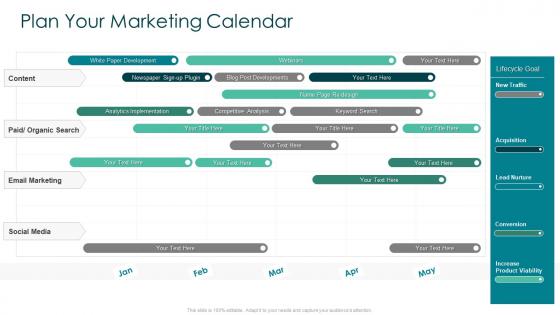
Plan your marketing calendar creating marketing strategy for your organization




Try Before you Buy Download Free Sample Product
 Impress Your
Audience
 100%
Editable
 Save Hours
of Time


Our Plan Your Marketing Calendar Creating Marketing Strategy For Your Organization are topically designed to provide an attractive backdrop to any subject. Use them to look like a presentation pro.
People who downloaded this PowerPoint presentation also viewed the following :
Plan your marketing calendar creating marketing strategy for your organization with all 6 slides:
Use our Plan Your Marketing Calendar Creating Marketing Strategy For Your Organization to effectively help you save your valuable time. They are readymade to fit into any presentation structure.






FAQs for Plan your marketing calendar creating marketing strategy
Honestly, start with figuring out exactly who you're trying to reach - that's like 80% of the battle right there. Once you nail your audience, you can position yourself against competitors and pick the right channels. Your messaging needs to actually connect with people (shocking concept, I know). Set some goals you can actually track, budget realistically across whatever channels make sense. The whole thing falls apart if these pieces don't work together though. I've seen so many people jump straight into tactics without knowing their audience first - total waste of time and money.
Here's the thing - nobody wants to get blasted with generic content that doesn't apply to them. Break your audience into chunks based on age, interests, whatever makes sense for your business. A college kid isn't gonna respond to the same message as someone's mom, you know? I learned this the hard way with my first campaigns (total disaster). Pick maybe 2-3 groups to start with. Test different angles with each one. You'll waste way less money and actually see people engaging. Honestly, it's one of those things that seems obvious once you do it.
So positioning is like your marketing GPS - it tells customers how you're different from everyone else. I made the mistake once of skipping this step and my campaigns were a total mess lol. You gotta figure out if you're the fancy option, the cheap one, or the cool innovative brand first. Everything flows from there - your ads, pricing, who you're talking to. Honestly, most people overthink it. Just write one sentence about what makes you special and use that as your filter for everything else. Trust me, it'll save you so much confusion later.
Honestly, data analytics just shows you what's actually working instead of what you *think* is working. You can finally see which campaigns bring in real customers and figure out who your best audience segments are. Super nerdy stuff but it works. I used to make decisions based on gut feelings and it was terrible lol. Now I track real customer behavior instead. You'll spot trends way before competitors catch on too. Just start with basic tracking on whatever you're running now - don't overthink it. Build up from there once you get comfortable.
Honestly? Email and LinkedIn are your money makers - especially LinkedIn if you're doing B2B stuff. Google Ads work too but you'll burn through cash before figuring out what converts. Content marketing is slow as hell but eventually pays off (I know, I know, not the sexy answer you wanted). Video's everywhere now - YouTube, TikTok, even just throwing clips in emails. My advice? Pick two channels and actually get decent at them first. Way too many people spread themselves thin trying everything at once. Oh, and don't sleep on SEO - takes forever but it's basically free traffic once it kicks in.
Dude, culture can totally make or break your global campaigns. Research local values and social norms before you do anything else - seriously, don't skip this step. Colors, humor, family dynamics, religious stuff... it all matters way more than you'd think. What crushes it in the US? Might be a disaster in collectivist countries. I've seen so many brands mess this up spectacularly. Test everything locally first. Oh, and obviously translate properly, but that's just the beginning. You'll save yourself major headaches (and money) by getting the cultural piece right upfront.
Customer feedback is your reality check - shows you what's actually working vs what you think is working. I've seen brilliant campaigns totally bomb because nobody bothered asking what customers wanted. You'll get real insights into messaging, which channels people prefer, pain points you're missing. Super helpful for pivoting fast and not wasting money on stuff that doesn't hit. Even basic surveys work - I mean, social media polls can be surprisingly useful. Helps you stop guessing and actually optimize your targeting based on what resonates.
Dude, forget just listing features - that's boring as hell. Tell actual stories about real customers who had problems your thing solved. Social media's great for this stuff. Share success stories, behind-the-scenes content, maybe how you started the company. Here's the thing though - make your customers the heroes, not your product. Nobody wants to hear you brag about yourself all day. Pick like 2-3 solid stories that match what your audience actually cares about, then just adapt them for different platforms. Way more engaging than typical marketing BS.
Honestly, just pick like 5-7 metrics that actually matter for what you're trying to do. Website traffic and conversion rates are obvious ones. Cost per acquisition too - that one's huge. If you're doing social or email stuff, track those engagement numbers. ROI is what your boss probably cares about most anyway. Brand awareness metrics like sentiment analysis can be useful but I'd focus on the money stuff first. Oh and set up some kind of dashboard so you're not pulling reports every week like a maniac. Don't try to track everything or you'll go crazy.
Honestly, just pick 2-3 platforms where your people actually are and nail those instead of being everywhere at once. Post consistently and actually respond to comments fast - like, treat it like real conversations, not broadcasting. Behind-the-scenes content works way better than polished stuff usually. Oh and video is king right now - stories and reels get pushed hard by the algorithms. Hashtags help but don't go crazy with them. I'd stalk your competitors first to see what's working for them, then adapt it to your style. Quality over quantity always wins.
Ugh, data silos are going to be your worst enemy. Each channel runs on its own timeline and nobody talks to each other - it's honestly ridiculous. Measuring ROI becomes this impossible puzzle when someone sees your billboard then clicks an Instagram ad later. How do you even track that? Start with the same customer personas across everything. Your teams need to actually communicate regularly, not just those awkward quarterly meetings. Oh, and pick shared KPIs everyone agrees on from day one - trust me on this one.
Dude, you'll love marketing automation once you dive in. It handles all the boring stuff - email sequences, social posts, lead scoring. Set up triggers based on what customers actually do and everything runs itself. I spent way too much time manually sending welcome emails before I figured this out. Start small with something like new subscriber workflows, then build out from there. The crazy part is how you can personalize content for thousands of people without doing it one by one. Honestly saves me like 10 hours a week now.
Honestly, just stick to three basics: be truthful, respect people's privacy, and play fair. Don't exaggerate benefits or hide the downsides - that always backfires eventually. Never mess with vulnerable groups like kids or seniors (seriously gross). Be upfront about sponsorships too. Think about the bigger picture of what you're pushing. I mean, would you be cool with someone doing this same campaign to your mom? If not, then don't. Oh and data privacy stuff - just don't be creepy with people's info. That golden rule thing actually works pretty well for marketing ethics.
Okay so competitive analysis is basically your cheat sheet for seeing what's actually working in your space. Look at 3-5 direct competitors and check out their messaging, pricing, channels they're using. You'll find gaps where they're weak that you can jump on. Plus you get to see what resonates with the audience you're both after. Don't just copy everything though - that's boring and obvious. The real value is understanding the whole landscape so you can figure out how to stand out. Oh and you might discover some channels they're totally ignoring. Start there.
Honestly, AI integration is huge right now - everyone's jumping on it. Privacy stuff is getting way stricter too, like GDPR but worse. People want authentic storytelling from brands, not the usual corporate BS. Short videos are still dominating (TikTok's not going anywhere), and voice search is becoming a thing since we're all getting lazier about typing. Oh, and Gen Z cares about sustainability but they'll call out greenwashing instantly. The biggest shift though? Building actual communities instead of just shouting into the void. I'd check which of your channels actually get real conversations going versus just... crickets.
-
Great product with effective design. Helped a lot in our corporate presentations. Easy to edit and stunning visuals.
-
Great quality slides in rapid time.