


Marketing budget plan with key strategies




Try Before you Buy Download Free Sample Product
 Impress Your
 Audience
 100%
100% Editable
 Save Hours
 of Time


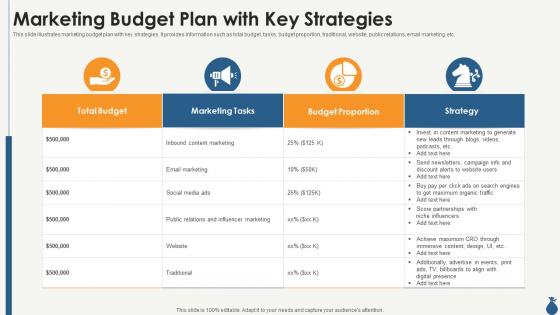
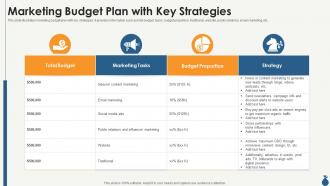
This slide illustrates marketing budget plan with key strategies. It provides information such as total budget, tasks, budget proportion, traditional, website, public relations, email marketing, etc.
People who downloaded this PowerPoint presentation also viewed the following :
Marketing budget plan with key strategies with all 6 slides:
Use our Marketing Budget Plan With Key Strategies to effectively help you save your valuable time. They are readymade to fit into any presentation structure.





FAQs for Marketing budget plan
So you need five main things: total budget, where it's going (ads, content, events etc), when you'll spend it, what ROI you expect from each channel, and - this is clutch - a buffer for random stuff that pops up. Most people skip that last part then panic later lol. Track your actual vs planned spending regularly or you'll lose control fast. I'd do 70% on what's already working, 30% testing new channels. Oh and make it specific enough to actually guide your decisions but don't box yourself in completely. You'll need to pivot sometimes.
Look, I usually tell people to start with 5-10% of revenue if you're established, maybe up to 20% when you're pushing for growth. New businesses? Yeah, you're probably looking at 15-25% because nobody's heard of you yet - harsh but true. The thing is, if you want to double your revenue, you can't keep spending like last year. Industry benchmarks are fine for reference, but honestly your specific goals matter way more. My take? Pick a number that makes you sweat a little. That uncomfortable feeling usually means you're in the right ballpark.
Look, market research is basically your roadmap for not wasting money. You'll know which platforms your customers actually hang out on, what messages get them to bite, and where your competitors are throwing their cash. Otherwise you're just guessing with your budget – which honestly feels terrible when you're the one writing the checks. The data helps you split funds between ads, content, events, whatever makes sense for your market. Oh, and definitely hit up customer surveys and scope out competitors before you even open that budget spreadsheet. Trust me on this one.
Honestly, monthly is the sweet spot if you're actively running stuff. I used to do quarterly only and missed so many red flags - learned that the hard way. Quick monthly check-ins help you catch what's tanking before you blow through cash. Save the big strategic moves for quarterly though, that's when you've got enough data to actually make smart decisions. Oh, and seriously just put it in your calendar now. I always think I'll remember and then suddenly it's December and I'm wondering where all my budget went.
Dude, the two big ones are totally underestimating costs and not tracking ROI at all. Don't spread your budget across like 10 different channels - I've seen teams just hemorrhage money that way with zero results. Build in maybe 10-15% extra for random opportunities or when stuff inevitably costs more than expected. Track everything from day one though, seriously. Otherwise you're just guessing what works. Oh and start small with fewer channels first, get obsessive about measuring, then expand based on actual data instead of just winging it. Way smarter approach.
Honestly, don't just wing it with random percentages. Pull your actual data from the last 6-12 months - Google Ads, Facebook, email platforms, whatever you're using. Then check for seasonal patterns and factor in any big campaigns you're planning. I learned this the hard way, but always add 10-15% buffer because costs somehow always creep up. Facebook's reach estimator is actually pretty solid, and Google's Keyword Planner too. Start with what you're spending now, then build realistic growth on top of that. Way better than guessing and getting burned later.
Honestly, start with the basics - set up UTM codes and conversion tracking so you can actually see what's working. Revenue attribution is huge, plus calculating customer acquisition costs and lifetime value. Your Google Analytics needs to talk to your CRM (took me forever to figure that out lol). Don't just focus on immediate conversions though. Brand awareness metrics and lead quality matter too since people don't always buy right away. Pick maybe 3-4 metrics that match your goals - otherwise you'll drown in spreadsheets. I'd tackle your biggest spending channels first and build from there.
Honestly, I'd tie your marketing budget to what's actually happening in your industry and the economy. Peak seasons are a no-brainer - pump more money in when demand's already high, like how retailers go crazy before Black Friday. Economic downturns? That's when things get messy. Don't experiment with new stuff when wallets are tight. Stick to what you know works and gives you solid returns. Here's what saved my butt last year: I kept about 15% of my budget in reserve so I could adjust fast when everything went sideways. Build that flexibility in from day one.
Start with the cheap stuff that actually moves the needle - content marketing and social media are your best friends here. Email marketing is where it's at though, honestly most people sleep on it but the returns are crazy good. Don't try to be everywhere at once. Pick maybe 2-3 channels where your people actually spend time. One thing that's been a game changer? Taking one piece of content and spinning it into like five different formats. Blog post becomes Instagram carousel, email newsletter, couple TikTok videos - you get it. Track your cost per customer religiously so you know what's actually working.
Look at your data first - see which channels convert best and cost you less to get customers. Don't get sucked into social media just because everyone's doing it; it's good for awareness but can drain your budget fast if you're not watching the numbers. SEO's slow as hell but worth it long-term, while PPC gives you instant feedback. I'd split it like 40% on whatever's working best for you right now, 30% testing new stuff that looks promising, and 30% on the slow-burn investments. Just track everything obsessively so you can move money around when something starts performing better.
Honestly, start with whatever connects to your ad platforms - saves you from copying numbers all day. Google Sheets works if you're just starting out, but it gets chaotic once you have multiple campaigns going. HubSpot and Salesforce are solid for pulling data automatically, though they're pricier. QuickBooks isn't bad either if you're already using it for other stuff. Monday.com handles campaign budgets pretty well too. I've found that the "simple" spreadsheet route always sounds good in theory but becomes a nightmare later. Pick something that updates itself - you'll thank yourself when you're not manually entering Facebook ad spend at 11pm.
First thing - figure out what you're actually trying to accomplish this quarter. Customer retention? Pour more into email and loyalty stuff, not new customer ads. Honestly, most people just throw money everywhere and wonder why nothing works. Check which channels actually bring in revenue for YOUR business specifically. Track everything back to real results, not vanity metrics. I'd review monthly and move budget around based on what's actually working. Oh, and ditch anything that's not clearly moving your main KPIs - sounds harsh but your wallet will thank you.
Zero-based budgeting basically makes you start from zero and justify every marketing expense - it's annoying but worth it. You can't just bump last year's budget by 10%. Each campaign has to prove its worth with actual data and current goals. Honestly, you'll find money disappearing into random tools you forgot you had. The upside? Dead campaigns get cut, and you might spot opportunities you missed before. My advice is list out every expense first - literally everything - then ask yourself what happens if you axe each one. Trust me, there's probably more waste than you think.
Yeah, you definitely want to keep tabs on what competitors are doing budget-wise. If they're dumping money into paid ads, you'll need enough to compete or get creative with other channels. Think of it like poker - gotta know the stakes you're playing at. But don't just copy their spending, that's how you blow through cash fast. Look at where they're putting money, then find the gaps they're ignoring. Those missed opportunities are where you can actually win without breaking the bank. Smart allocation beats big spending every time.
Honestly, digging into your past marketing spend is like finding buried treasure - you'll see which channels actually worked vs. where you just threw money away. Seasonal trends become super obvious too. Like Q4 always crushes it, but summer? Total dead zone for B2B stuff. The "brand awareness" campaigns are usually the biggest money pits, not gonna lie. Look for your lowest cost-per-acquisition campaigns and which audiences converted best. Once you find those sweet spots where small budget bumps gave you huge returns, shift money from the losers to your proven winners. Way better than guessing next time around.
-
Informative presentations that are easily editable.
-
Illustrative design with editable content. Exceptional value for money. Highly pleased with the product.