


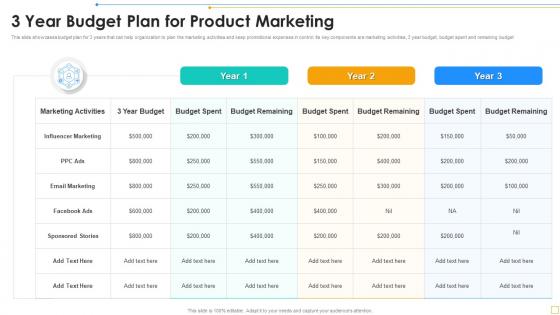
3 Year Budget Plan For Product Marketing




Try Before you Buy Download Free Sample Product
 Impress Your
 Audience
 100%
100% Editable
 Save Hours
 of Time


This slide showcases budget plan for 3 years that can help organization to plan the marketing activities and keep promotional expenses in control. Its key components are marketing activities, 3 year budget, budget spent and remaining budget
People who downloaded this PowerPoint presentation also viewed the following :
3 Year Budget Plan For Product Marketing with all 6 slides:
Use our 3 Year Budget Plan For Product Marketing to effectively help you save your valuable time. They are readymade to fit into any presentation structure.






FAQs for 3 Year Budget Plan
Track what you're making first, then write down everything you spend - both your regular bills and the random stuff. I always tell people to try that 50/30/20 thing: half for needs, 30% for wants, 20% to save. Honestly, don't skip the fun money part or you'll just end up breaking your budget anyway. Categories help too so you can see where your cash actually disappears to (spoiler: it's probably coffee). Set some savings goals that don't make you miserable. Check back monthly and tweak things - your life isn't static, why should your budget be?
Honestly just pick one thing and stick with it - Mint, YNAB, even a basic spreadsheet works. I wasted so much time switching systems every few weeks lol. Track stuff as it happens instead of trying to remember later. That never works. Set up auto-categorization if possible and check weekly, not daily or you'll get annoyed with it. Maybe start with two weeks of tracking to see what you're actually spending on. I think most people are surprised by their patterns. Build from there once you've got the habit down.
Mint's probably the easiest to start with since it syncs automatically with your accounts. YNAB is amazing if you're serious about budgeting - it's that zero-based thing where every dollar has a job. PocketGuard's good for quick checks too. I've bounced between maybe five different apps over the years lol. Honestly though, even a basic Google Sheets template works fine if apps aren't your thing. Pick something free first and actually use it for a month before switching. The "best" one is whatever you'll stick with consistently.
I always ask myself "what actually happens if I skip buying this?" Real needs = bad stuff like losing your place, getting sick, or your job being at risk. Everything else? Wants. Even when they feel super urgent. Honestly, I used to swear my Starbucks run was essential until I realized... I'd survive without it lol. Try listing your monthly expenses and putting each in either category. If you're on the fence about something, just skip it for a week. You'll know pretty fast whether it was actually important or just something you wanted in the moment.
Oh man, the biggest one is budgeting for your fantasy life instead of reality. Track your actual spending first - it's eye-opening how wrong we are about our habits! People also forget irregular stuff like car repairs or Christmas gifts, then act shocked when they happen. Don't be too restrictive either, that never works. You need fun money or you'll ditch the whole thing in like three weeks. Those little subscriptions are sneaky too - Netflix, Spotify, whatever random app you forgot about. They're small but add up to real money pretty fast.
Don't max out every category - leave wiggle room everywhere. I'd set aside maybe 10-15% as your "oh crap" fund because life loves curveballs. Use percentages instead of hard dollar amounts so everything scales if your income changes. Monthly check-ins work way better than waiting a whole year to adjust stuff. Honestly, budgets should bend with whatever's happening in your life, not the other way around. First thing though - figure out what's actually set in stone versus what you can mess with when things get tight.
Honestly, goals are what make budgeting actually worth doing instead of just moving money around randomly. Without them you're basically tracking expenses for fun, which sounds awful. Pick 2-3 specific things you want - maybe a house down payment in two years or whatever - then work backwards from there. Your goals totally change how you split money between savings and fun stuff. Like that house goal? It'll probably mean less takeout but way more motivation when you see progress. Write down your targets with actual dates, then build everything else around making those happen. Way easier than I thought it'd be.
Okay so zero-based budgeting is basically starting from scratch every month. You literally justify every single dollar instead of just copying last month's budget. Super annoying at first, not gonna lie. But here's the thing - you catch all those random expenses that somehow drain your account. Like that streaming service you signed up for ages ago? Gone. Those $5 coffee runs that add up to like $100? You'll actually see them now. It makes you way more intentional about spending since every dollar needs a job before you earn it. Just try it once.
Honestly, you gotta make it realistic from day one or you'll hate it. I always build in fun money because otherwise I feel like I'm punishing myself lol. Try the envelope method or some budgeting app to see where your money's actually going. Trust me, I've bombed so many "perfect" budgets before figuring this out. Don't scrap everything when you overspend - just tweak it next month. Auto-transfer to savings is a game changer since willpower sucks. Oh, and celebrate when you stick to it! Maybe start tracking just one category this week?
Honestly, budgeting is a game-changer because it shows you where all your money actually disappears to each month. You'll catch those random subscriptions you forgot about (seriously, when did I sign up for three streaming services?). Once you see your spending patterns, it's way easier to move money toward savings and investments. I always tell people to pay themselves first - set aside maybe 10-15% for savings and investing before you touch anything else. Even my sister started with just 10% and was shocked how painless it was. The key is automating it so you don't even think about it.
Honestly, most of us just hate facing the reality of where our money actually goes. That's the big one. Then there's perfectionism - you know, waiting for the "perfect" system instead of just starting somewhere messy. I'm totally guilty of this with like everything lol. Your brain also plays tricks on you, making you think you'll definitely resist that impulse buy next week (spoiler: you probably won't). One mistake and people throw the whole budget out the window. Money shame doesn't help either - makes everything feel heavy and personal. Just track spending for a week first. No judging yourself, just observe.
I'd say check it monthly at least, but tbh I peek at mine like every other week because stuff comes up and suddenly you're wondering where all your money went lol. Monthly is good for catching when you're overspending and tweaking categories that aren't realistic. Just starting out? Maybe do it weekly until you get the hang of things. Life changes mess with budgets too - new job, moving, whatever. The trick is actually doing it consistently though. Pick a day and set a phone reminder right now or you'll definitely forget.
Honestly, when you don't stick to a budget you're just asking for trouble. Your money disappears and you can't figure out where it went - super stressful. I did this for years and kept wondering why I was always broke lol. You end up overspending on random stuff instead of saving for things you actually want. Debt creeps up on you too. The worst part? You lose control of your finances completely. Emergencies become way scarier when you have zero cushion. Maybe try tracking just your coffee spending or something small this week to start getting back on track.
Honestly, budgeting is a game-changer for debt because you finally see where all your money disappears to. I was shocked when I realized how much I was dropping on random stuff each month - like seriously shocked. List out all your debts first, then figure out what you can trim from your spending. Put that extra cash toward whatever has the highest interest rate. The whole point is having a realistic plan that covers your bills but also chips away at those balances. Once you start tracking everything, you'll probably find some easy cuts that free up way more money than you'd expect.
Okay so first thing - figure out your lowest monthly income from this past year and budget around that. I've been tracking my irregular stuff for like 8 months now and honestly? You start seeing patterns you never noticed. Save the extra when you're killing it to cover those slow months (they always happen). What really helped me was setting up different savings accounts - sounds boring but just automate transfers when money hits. Always handle your rent, utilities, all that fixed stuff first. Then worry about everything else. Oh and don't wait until you have some perfect system figured out - just start tracking now even if it's messy.
-
Easy to use and customize templates. Helped me give a last minute presentation.
-
Fantastic collection of visually appealing PowerPoint templates. They certainly uplift the look of the presentation.