


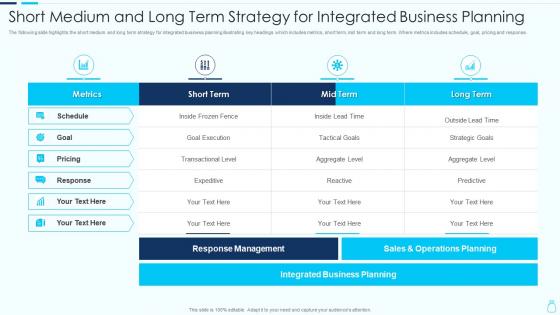
Short medium and long term strategy for integrated business planning




Try Before you Buy Download Free Sample Product
 Impress Your
 Audience
 100%
100% Editable
 Save Hours
 of Time


Our Short Medium And Long Term Strategy For Integrated Business Planning are topically designed to provide an attractive backdrop to any subject. Use them to look like a presentation pro.
People who downloaded this PowerPoint presentation also viewed the following :
Short medium and long term strategy for integrated business planning with all 6 slides:
Use our Short Medium And Long Term Strategy For Integrated Business Planning to effectively help you save your valuable time. They are readymade to fit into any presentation structure.





FAQs for Short medium and long term strategy for
You need four main things: demand planning, supply planning, financial integration, and scenario modeling. Most companies totally bomb the cross-functional part though - that's where everything falls apart. Set up monthly reviews where sales, ops, and finance actually sit down together instead of doing their own thing. Map out who's responsible for what first, then figure out where the handoffs keep failing. The whole goal is tying your operational stuff directly to money outcomes. Oh, and get executives aligned on priorities upfront or you'll be spinning your wheels forever.
Start with cross-functional teams that actually meet monthly - get finance, ops, and strategy people in the same room for S&OP cycles. Most companies totally blow this because everyone's guarding their department like it's Fort Knox. Create shared KPIs that everyone owns together, not those useless silo metrics. When your demand planning flows directly into financial forecasts AND strategic capacity decisions, that's where things click. Oh, and set up planning calendars where you can stress-test strategic moves against real operational limits and budget reality before throwing money at stuff. Sounds obvious but you'd be surprised how many skip this step.
Honestly, data analytics is what makes IBP actually work instead of just being expensive guesswork. You'll get clear visibility into demand patterns, supply chain issues, and how your financials look across different units. Predictive modeling is huge here - once you've seen accurate demand forecasting, regular planning feels ancient. It helps you catch trends early and spot risks before they blow up. Plus you can make those tough trade-off decisions with real numbers backing you up (which finance loves). I'd say pick one metric that connects sales, ops, and finance first, then expand.
So basically, IBP forces everyone to work off the same numbers instead of doing their own thing in separate spreadsheets. Sales can actually see if operations has the capacity before they promise crazy delivery dates. Finance gets real revenue projections instead of wild guesses. Operations knows when demand's gonna spike. The magic happens when you have those cross-functional meetings - honestly, they're kind of a pain to schedule but worth it. Everyone reviews scenarios together and makes trade-offs as one team. No more finger-pointing between departments when stuff goes sideways.
Honestly, data integration is gonna be your biggest nightmare - all those systems that refuse to play nice together. People hate changing how they work too, which I get but it's still annoying. You'll spend forever just trying to get leadership from different departments to actually agree on anything. Breaking down silos sounds easy in theory but it's brutal in practice. The whole mindset shift from "my department first" to thinking company-wide? That takes months, maybe years. My advice is tackle your worst data mess first, then get just one cross-functional team working smoothly before you try expanding to everyone else.
Honestly, you're gonna need solid tech to make IBP work. Cloud platforms like Anaplan or Oracle EPM are game-changers - they pull all your data together instead of juggling a million Excel files (which is a nightmare). AI helps with forecasting too, saves you from doing all that number crunching manually. Real-time collaboration is huge here. Automated dashboards keep everyone on the same page with KPIs. I'd start by figuring out what data sources you have first, then find something that connects them all. Way less headache than trying to force systems to talk to each other.
So here's what I'd focus on - start with forecast accuracy because that's your foundation. Compare what you predicted vs actual sales each month. Inventory turnover and service levels matter too, plus keep an eye on cash flow improvements. Oh, and supply chain responsiveness is clutch - basically how fast you can pivot when demand shifts. Honestly, don't go crazy with metrics at first. I've seen teams drown in data and miss the big picture. Stick to maybe 3-5 key ones and actually review them religiously in your monthly meetings. Revenue growth and collaboration scores can come later once you've got the basics down.
Market changes totally mess with your IBP planning - you're constantly tweaking forecasts when consumer habits shift or new competitors pop up. I swear it feels like you're always chasing the latest trend! Build in some flexibility so you can pivot quickly. Monthly market reviews are clutch, and honestly? Set up automatic triggers that force plan updates when certain thresholds hit. Your supply chain and resource allocation across teams will thank you later. The whole process is kinda draining but way better than getting caught off guard.
So IBP basically forces everyone to use the same data instead of each department making up their own numbers. Finance, sales, ops - they all have to look at the same scenarios during those monthly meetings. Honestly, it's such a relief after years of "wait, whose forecast are we using again?" You need shared KPIs and regular cross-functional sessions where people actually have to defend their assumptions to each other. Executive buy-in is huge too, otherwise half the team won't even show up. Oh, and definitely start with just one product line or region first - I learned that the hard way trying to do everything at once.
You've got to match your message to who you're talking to. Executives want the quick hits - dashboards with red/yellow/green lights and only the stuff that's broken. Middle management needs the tactical stuff with trends they can actually do something about. Frontline people? Give them real-time data that helps with what they're doing right now. The biggest pain point I've seen is when departments have different numbers for the same thing - kills your credibility instantly. Map out who needs what info and when, then stick to the same terms and formats so nobody's confused when they're comparing notes.
Sustainability isn't just a checkbox anymore - it's baked right into IBP planning now. Companies are tracking carbon metrics alongside their usual financial KPIs, which honestly makes sense since customers actually care about this stuff. You've gotta work environmental factors into your demand forecasts, supplier choices, even capacity decisions. The biggest mistake I see? Keeping sustainability reports separate from everything else. Put those metrics on the same dashboards as your revenue numbers. That way when you're doing monthly reviews, you're looking at both profit AND environmental impact together. Makes the whole thing way more actionable.
You need to nail the WIIFM for each group upfront - finance gets better forecasting, sales gets realistic targets, operations gets smoother workflows. But here's the thing, don't just tell them about IBP. Get your key influencers involved in designing it so they actually own the process instead of resenting it. Quick wins are everything here. Show results fast, even tiny ones, because I've watched too many rollouts die when leadership got impatient. Run pilots first and make noise about every success - you need that momentum spreading. Trust me on this one.
So basically you want to run 2-3 scenarios alongside your regular IBP cycles - your base case plus maybe an economic downturn and supply chain mess. Don't overthink it though, I've watched teams go crazy with like 8 different scenarios and it just becomes noise. The real value is when you test how your financial plans and inventory would actually hold up in each situation. Your teams can catch problems early and have backup plans ready. Oh and definitely refresh these monthly - stale scenarios are pretty much useless. It's way more effective than just hoping for the best.
So IBP basically gets all your teams talking - sales, ops, finance, demand planning. Instead of everyone doing their own thing in corners. Your forecasting gets way more accurate, which cuts down on having too much inventory or running out of stuff customers want. Honestly, the biggest win is just getting people to look at the same numbers and decide things together. It's wild how much money you stop wasting when departments actually communicate! Market changes? You can pivot faster. Operations run smoother too. Oh, and start simple - monthly meetings where planning teams review forecasts together.
Set up quarterly reviews to spot where your IBP process is getting stuck - most teams totally blow this off then can't figure out why they're spinning their wheels. Get feedback from everyone involved about what's actually bugging them. Track stuff like how accurate your forecasts are, how long planning takes, and whether people are even engaging. Make small tweaks instead of trying to revolutionize everything at once. Oh, and peek at what other companies are doing or bring in an outside perspective sometimes. Honestly just pick one annoying thing this quarter and fix it properly.
-
Amazing product with appealing content and design.
-
Great quality product.