


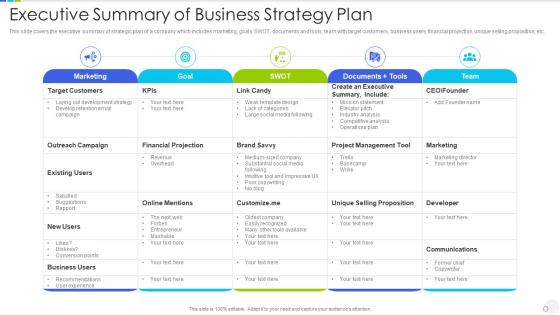
Executive summary of business strategy plan




Try Before you Buy Download Free Sample Product
 Impress Your
 Audience
 100%
100% Editable
 Save Hours
 of Time


Our Executive Summary Of Business Strategy Plan are topically designed to provide an attractive backdrop to any subject. Use them to look like a presentation pro.
People who downloaded this PowerPoint presentation also viewed the following :
Executive summary of business strategy plan with all 6 slides:
Use our Executive Summary Of Business Strategy Plan to effectively help you save your valuable time. They are readymade to fit into any presentation structure.





FAQs for Executive summary of
You need four things: what's broken, how you'll fix it, why it matters, and what you want from them. Picture explaining it during an elevator ride with your boss. Keep each part super short - like 1-2 sentences tops. Executives scan everything anyway, so make it skimmable. Honestly, most people write these way too long and hide the good stuff in paragraphs of nonsense. Do yourself a favor and write this part last, after you've got everything else done. Then go back and cut out anything that doesn't absolutely need to be there.
So an executive summary is like giving people the spoilers upfront - but in a good way. You're basically saying "here's what you're gonna learn" before diving into all the details. I always think of it as insurance, honestly. If your boss gets pulled into another meeting halfway through, at least they caught the important stuff. Put your main conclusions right there at the beginning so everyone knows where you're headed. The movie trailer comparison isn't wrong either. Oh, and definitely stick it right after your agenda slide - that's the sweet spot for maximum attention.
Honestly, stick to 1-2 pages tops - maybe 5-10% of your whole document. Twenty-page report? Two pages max for the summary. I've watched people write these massive summaries that nobody reads. Defeats the point entirely! Executives are swamped, so they'll just skim and bounce if it's too long. Hit your main findings, key recommendations, and what happens next. Short sentences work. Here's what I tell everyone: if someone reads only your summary, they should get 80% of what matters and actually be able to make decisions. That's the whole game right there.
Keep it super simple with visuals - maybe one solid chart showing your financials or market size, plus one clean graphic that hits your main value prop. That's it. I swear I've reviewed so many exec summaries that are just visual chaos. Two visuals max, and they better actually help tell your story instead of just looking pretty. Short sentences work. But mix in some longer ones that flow naturally when you're explaining the important stuff. The whole point is making your key points stick faster. Oh, and definitely run it by someone else first - you'll know right away if your visuals actually help or just confuse things.
Ugh, the worst thing people do is ramble on forever - like, you're writing an executive summary, not a novel! Write it LAST, after your full report's done. Skip the boring background stuff and cut any jargon your boss won't understand. Don't make them dig around for your main point either. I always put my biggest recommendation right at the top. Focus on what you found and what they should do about it, not how you did the research. One page max, or honestly, they probably won't read it.
Your audience is literally everything when it comes to exec summaries. Investors? Hit them with ROI numbers and market size - they want that confident, money-focused vibe. Internal execs care more about operational stuff and how it fits the strategy. Tech people need the data and methodology (they're weird like that). Board members just want the big picture strategic stuff. I've watched perfectly good summaries bomb because someone used the wrong tone. Like, imagine pitching venture capital with the same voice you'd use for your engineering team. Ask yourself what they actually care about and how they usually get info, then write for that.
Honestly, visuals are a game-changer for executive summaries. Those people have like zero attention span - they're skimming in 30 seconds max. Charts and graphs tell your story way faster than walls of text. Think revenue curves, pie charts showing market share, maybe a clean dashboard. Each visual should back up whatever you're recommending. I always go for simple, clear labels because there's nothing worse than a confusing chart. Oh, and they work great as talking points when you're actually presenting the thing in person. Saves you from just reading bullet points, which is awkward for everyone.
Here's what I've found works really well - start with a problem that makes people go "oh shit, that's exactly what I'm dealing with." Skip the boring setup stuff. Jump right into a specific scenario instead of talking in circles about concepts. Then bring in your solution like it's swooping in to save the day. Sounds cheesy but honestly? People eat this up. Make it feel like a mini story with some tension, then boom - resolution. The trick is keeping everything focused on what they actually care about, not what you think sounds impressive. Works way better than those dry, corporate intros everyone skips.
Put your main findings right at the top - decision-makers want the bottom line first. Break everything into bullet points so it's not a wall of text. Nobody cares about your methodology (harsh but true). Stick to maybe 3-4 key points max and throw in actual numbers when you can. I always do business impact first, then a quick explanation why. The whole thing should be readable in under 2 minutes - executives have zero patience for lengthy reports. They'll dig deeper if they need to, but give them what matters most upfront so they can actually make decisions.
You've gotta speak their language, you know? Tech people want to hear about scalability and user growth. Healthcare folks care way more about patient outcomes and staying compliant with regulations. Finance bros? Just show them ROI and how you're managing risk. It's basically like switching personas depending on who's in the room. Your actual work doesn't change, but you highlight different pieces. Research whatever buzzwords and metrics are trending in their industry right now - then frame everything around what they actually care about. Works every time.
Honestly, business plan competitions are your friend here - Harvard and Stanford's entrepreneurship programs have some solid examples online. Those early Airbnb and Uber pitch decks are pretty legendary too, definitely worth a look. McKinsey and Bain case studies are great since consulting firms know how to make complex stuff digestible (though sometimes they're a bit dry). I'd grab 3-4 examples from your specific industry if possible. Then figure out what grabs you in that opening line and how they organize everything. The industry-specific ones will give you the best sense of what investors in your space actually want to see.
Dude, you're way too close to your own work to spot the problems. Stakeholders will straight up tell you when your main points don't hit or when you're speaking in corporate gibberish. Finance people want numbers, ops teams need the how-to details, execs just want the big picture stuff. I've literally watched summaries get completely flipped after one feedback round - it's wild how much they change. Oh, and don't be that person who sends drafts the night before it's due. Give people actual time to read and respond, otherwise what's the point?
Look, the call to action is everything - seriously, it's the whole point of writing that summary. Be super specific about what you need: "Approve $500K for Q2 rollout" beats "please consider this" every time. I've seen way too many executives walk out of meetings totally confused because someone didn't actually ASK for anything concrete. Don't make them guess what you want! Include your timeline, next steps, who does what. Otherwise you just wrote a really expensive book report that goes nowhere.
Honestly, just use Google Docs or Word - you don't need anything special. The content's what matters anyway. Canva has some decent business templates if you want it to look more polished, and PowerPoint works great if you're doing lots of charts and visuals. I always tell people to lead with your main point right up front, then throw in the data that executives actually give a damn about. Keep it short too - they're busy. Oh, and avoid getting fancy with the formatting. Simple's usually better for this stuff since they'll probably just skim it anyway.
Before you write anything, figure out your 2-3 main goals first. Then go through each point in your summary and ask - does this actually connect to what I'm trying to accomplish? I learned this the hard way after rambling through way too many presentations. Cut anything that doesn't fit, even if it sounds impressive. Your summary should be like a preview that shows exactly how you'll hit those goals. Here's my quick test: if someone only reads your summary, will they get your main points? Also, don't get too caught up in making it perfect - sometimes the messy first draft captures what you really mean.
-
Graphics are very appealing to eyes.
-
Very well designed and informative templates.
-
Great quality slides in rapid time.
-
Informative design.
-
Presentation Design is very nice, good work with the content as well.