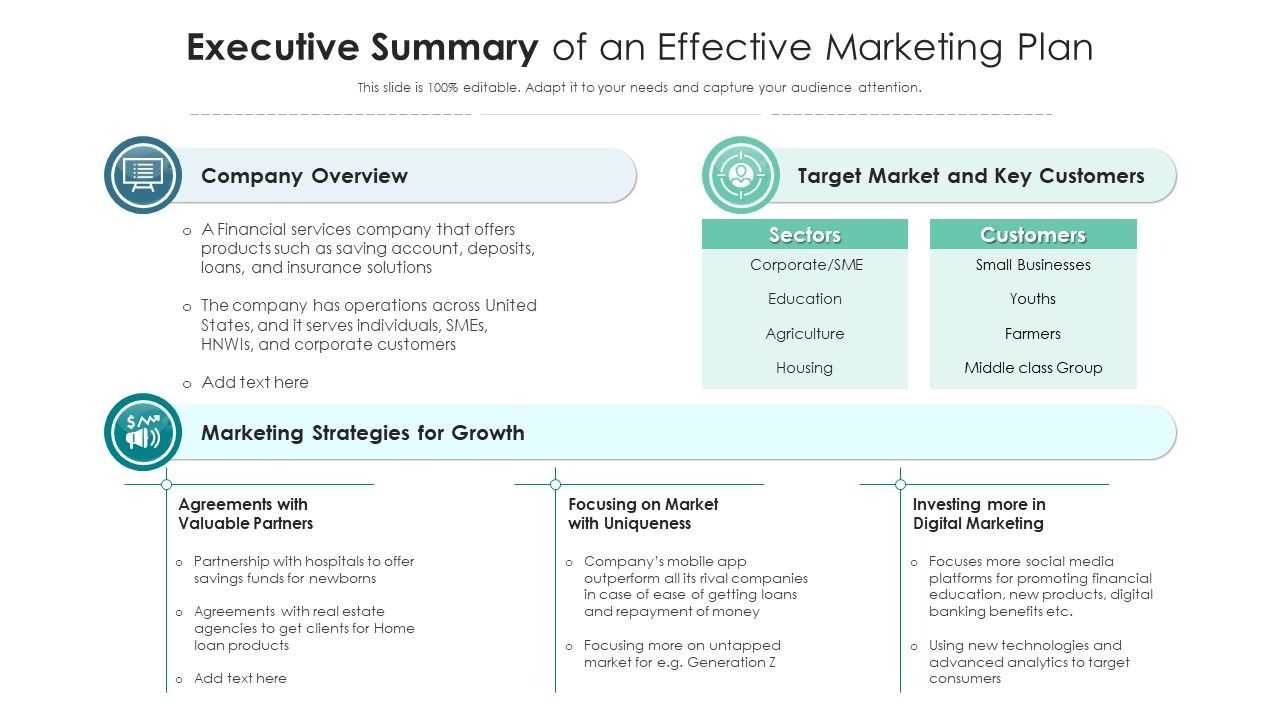
Executive summary of an effective marketing plan

Rating:
93%
Slide 1 of 2
Favourites Favourites

Try Before you Buy Download Free Sample Product

Audience Impress Your
Audience
Editable 100%
Editable
Time Save Hours
of Time
The Biggest Sale is ending soon in
0
0
:
0
0
:
0
0
Rating:
93%
Introducing our Executive Summary Of An Effective Marketing Plan set of slides. The topics discussed in these slides are Financial, Insurance, Market. This is an immediately available PowerPoint presentation that can be conveniently customized. Download it and convince your audience.

FAQs for Executive summary of an

First things first - figure out exactly who you're selling to and what you want to achieve. Then dive into your competition and see what they're doing right (or wrong). Your marketing mix is key: product, price, where you'll sell, and how you'll promote it. Budget matters too - be realistic about what you can actually spend. Oh, and this might sound boring but track everything! I swear, so many good campaigns die because people just wing it without measuring results. Get deep on your audience research - their demographics, what bugs them, how they actually behave. Your goals should connect back to real business outcomes, not just vanity metrics.

Honestly, you need both types of research - primary and secondary. Start by actually talking to your customers through surveys or interviews. That's where the gold is. Then dig into industry reports and see what competitors are up to (their social media tells you SO much). Ask about pain points, buying habits, what they actually want. Oh and here's a tip - survey your current customers first. They're usually down to help and you'll get useful stuff fast. Secondary research is great for trends and market data, but nothing beats hearing directly from people who'd buy your product.

Honestly, audience segmentation is like the foundation of everything you'll do marketing-wise. Instead of throwing ads at everyone and hoping something sticks (total money pit btw), you group people by demographics, behaviors, what they actually want. Then you can craft messages that hit different for each group. Way more personal that way. Pick your channels smarter too - like why waste time on TikTok if your audience is all LinkedIn people? I'd start small though, maybe 2-3 segments max so you don't overwhelm yourself. Build specific strategies for each one and you're golden.

Honestly, focus on the metrics that actually matter for your business - conversion rates, cost per acquisition, and ROI by channel. Those tell you what's making money. Traffic and engagement are useful too, but don't get caught up in vanity metrics (been there, done that). Attribution tracking is clutch so you know which touchpoints work. Pick maybe 3-5 KPIs max that match your goals instead of tracking everything under the sun. Check them monthly and pivot based on what you're seeing. Way better than drowning in data you can't act on.

Honestly, just focus on where your people actually are - SEO, social, email, paid ads. Content's pretty much the backbone of everything else. I'd probably start with SEO and email first since they pay off long-term, but if you need quick results, paid ads work too. Oh, and definitely set up Google Analytics or you'll be flying blind. Here's the thing though - don't try to do everything at once. Pick like 2-3 channels max and actually get good at those first. Way better than half-assing a bunch of different platforms.

Look at your past data first - see what actually converts, not just pretty vanity metrics. Put most of your money (like 60-70%) into what you know works. Then maybe 20-30% for testing new stuff or doubling down on what's showing promise. Save about 10% for wild experiments because sometimes random things just click, you know? I learned this the hard way after missing out on TikTok early on. Track everything obsessively and don't be afraid to move budget around quickly when something's clearly working or tanking. Flexibility beats rigid planning every time.

Okay so definitely make them SMART goals - you know, specific and measurable with actual deadlines. Like "increase website traffic 25% by end of Q2" instead of just "get more brand awareness." I learned this the hard way but don't set like 10 different goals or you'll be all over the place. Pick maybe 3-5 that actually matter for your business. Oh and make sure you can track whatever you're measuring! Nothing's more annoying than realizing halfway through you have no clue if you're winning or not. Start with what data you've already got, then work backwards from there.

Honestly, SWOT analysis is like getting a reality check before you jump into marketing stuff. You map out what you're good at, what sucks, opportunities worth going after, and threats that could mess you up. I kinda think of it as GPS for marketing decisions - wish I'd done this more when I was starting out instead of just winging it. The key is being super honest about each section. Don't sugarcoat your weaknesses or whatever. Then use what you find to actually guide where you spend time and money instead of just making a pretty chart that sits in a drawer somewhere.

Okay so honestly, AI and automation are massive right now - customers want that personalized stuff at scale. If you're not using AI tools yet, you're kinda screwed. Social commerce is blowing up too, especially with Gen Z buying straight from Instagram and TikTok (which still feels weird to me but whatever). Sustainability isn't just trendy anymore, people actually expect it. I'd start by looking at your current plan and seeing where these gaps are. Then just focus on whatever matters most to your specific audience first.

Look, competitive analysis is basically your shortcut to not screwing up. You get to see what's already working in your space - and what's totally bombing. Find the gaps where competitors are dropping the ball, that's where you swoop in. Check out their pricing and messaging too, then either copy what works or do it way better. I always look at direct competitors plus those sneaky adjacent ones who might poach your customers. Honestly saved me so much trial and error when I was figuring out positioning. Use all that intel to carve out your own angle that actually resonates with people.

Dude, just grab a template from HubSpot or Canva - saves you from the whole blank page nightmare. If your team needs to collaborate, Miro's pretty solid for brainstorming visually. Tools like Aha! or CoSchedule can handle most of the tedious stuff automatically. I swear people get way too stuck overthinking which platform to use (guilty of this myself tbh). Pick whatever seems easiest, give yourself a deadline, and start filling sections out. You can always tweak it later once you see what's actually working.

Honestly, content strategy is everything. Without it you're basically just posting random stuff and praying something works (trust me, I've watched brands do this - it's painful). Think of it as the thread that ties all your marketing together. What are you saying? Who needs to hear it? How does this actually help your business? Every piece of content should push people closer to buying from you. Map out what content works for each stage - like awareness vs. ready-to-purchase. Makes a huge difference. Otherwise you're just creating noise.

Honestly, focus on the metrics that actually make you money - conversion rates, cost per acquisition, and ROAS. Those vanity metrics like clicks and likes are fun to watch but they won't keep your business afloat. Lifetime customer value is huge too if you can track it properly. Makes spending more on acquiring customers way easier to justify. Attribution gets super messy when you're running multiple channels (been there), so just pick one model and stick with it. Start simple with these basics. You can always get fancy with the tracking later once things are rolling.

So here's what I do - grab their actual words and throw them straight into your ads. Super powerful stuff. Then look at who's giving you good feedback and target more people like them. Budget-wise? Put more money where customers are actually happy with what you're seeing. Their complaints are honestly where the magic happens for new campaign ideas. Set up surveys and watch social media regularly - don't just wait for feedback to come to you. I review everything monthly when planning campaigns. Your sales team usually has great intel too, so tap into that. Just ask customers what's working and what sucks, then use their answers to guide your next moves.

Honestly, branding is like your foundation - everything else just crumbles without it. Your brand voice and visuals should guide which channels you pick, how you talk to people, all that stuff. I learned this the hard way when I was just randomly trying different tactics with no real strategy. Super messy. People won't trust you or share your content if they can't figure out what you're about. So figure out your brand identity first - then let that drive your campaign decisions. It keeps everything consistent instead of looking like you're all over the place.

Ratings and Reviews

93% of 100
Review Form
Write a review
Most Relevant Reviews
  1. 80%

    by Thomas Carter

    Thanks for all your great templates they have saved me lots of time and accelerate my presentations. Great product, keep them up!
  2. 100%

    by Cristobal West

    Best Representation of topics, really appreciable.
  3. 100%

    by Dwain Johnston

    Out of the box and creative design.
  4. 80%

    by Miller Rogers

    Unique and attractive product design.
  5. 100%

    by Li Stewart

    Excellent products for quick understanding.
  6. 100%

    by Evans Mitchell

    Perfect template with attractive color combination.

6 Item(s)

per page: