


Time Management Powerpoint Presentation Slides





Try Before you Buy Download Free Sample Product
 Impress Your
 Audience
 100%
100% Editable
 Save Hours
 of Time


Our Time Management Powerpoint Presentation Slides are topically designed to provide an attractive backdrop to any subject. Use them to look like a presentation pro.
People who downloaded this PowerPoint presentation also viewed the following :
Content of this Powerpoint Presentation
In our daily lives, we often encounter people who seem to have it all figured out. They appear relaxed and are better performing than the rest of us. The rest of us can too learn how to manage, organize and allocate our time that will help you manage us time effectively and increase overall enjoyment.
Time management involves prioritizing tasks so that our time and resources are allocated accordingly. Setting goals, determining priorities, or following through with those plans also contribute to how much one succeeds within his/her allotted time frame. Managing time properly allows us to accomplish many tasks within less time as well as reduce stress levels thereby enhancing general efficiency as well as productivity.
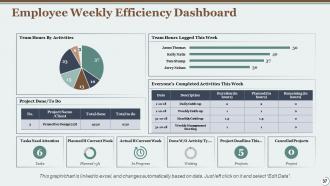
Track employee attendance with our dedicated presentation designs shown here.
If you want to share your valuable insights with your team on how to be more productive, a time management PowerPoint Presentation is all that you need. Especially, having good slides in it can make all the difference in delivering an impactful message, and that’s what we have in store for you today.
Check out SlideTeam’s PowerPoint Template bundle on time management that is 100% editable and customizable. It provides a much needed headstart for effective time-management.
Let’s explore!
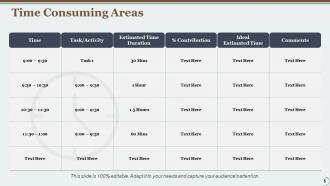
Template 1: Time Consuming Areas
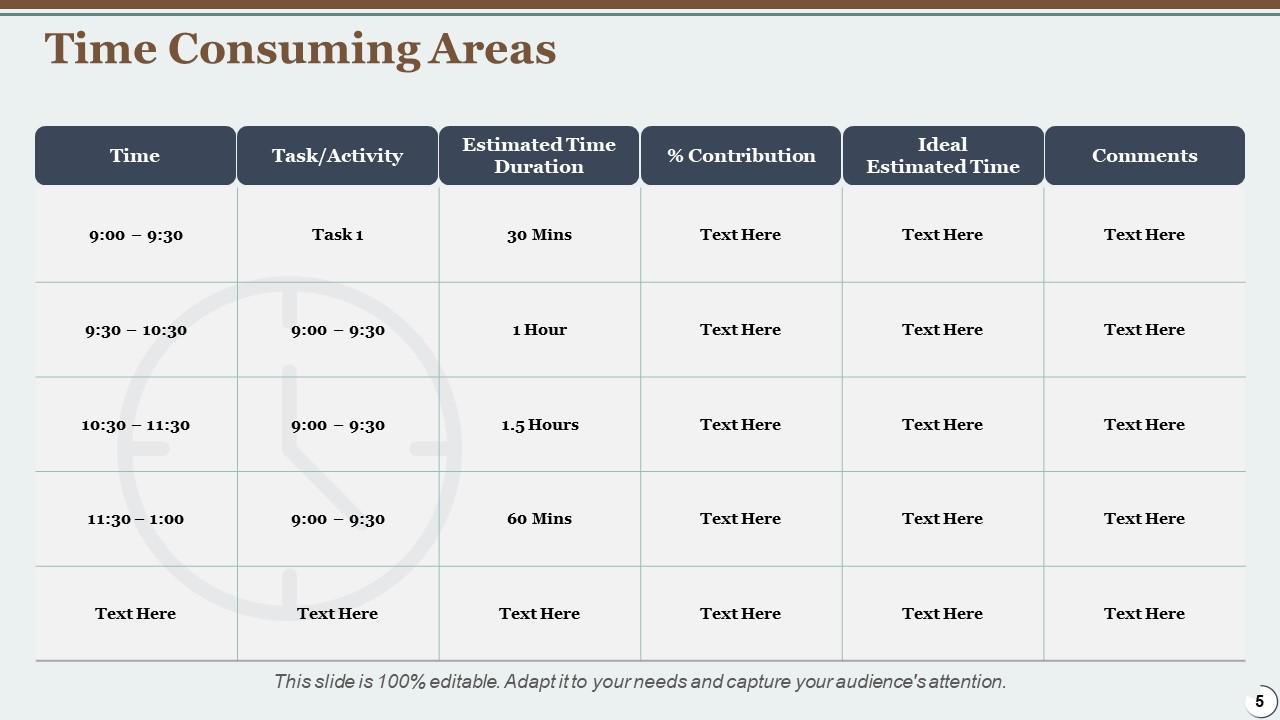
This PowerPoint Template provides a breakdown of the areas that take up the most time. It categorizes tasks based on factors like time required, task type, estimated duration, percentage contribution, and ideal estimated time. This information helps you prioritize tasks and implement strategies to improve organizational efficiency. By enabling informed decisions, the template optimizes productivity and focuses on high-impact activities.
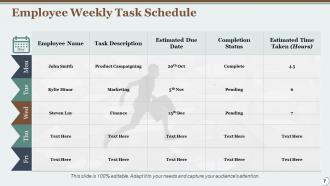
Template 2: Employee Weekly Task Schedule
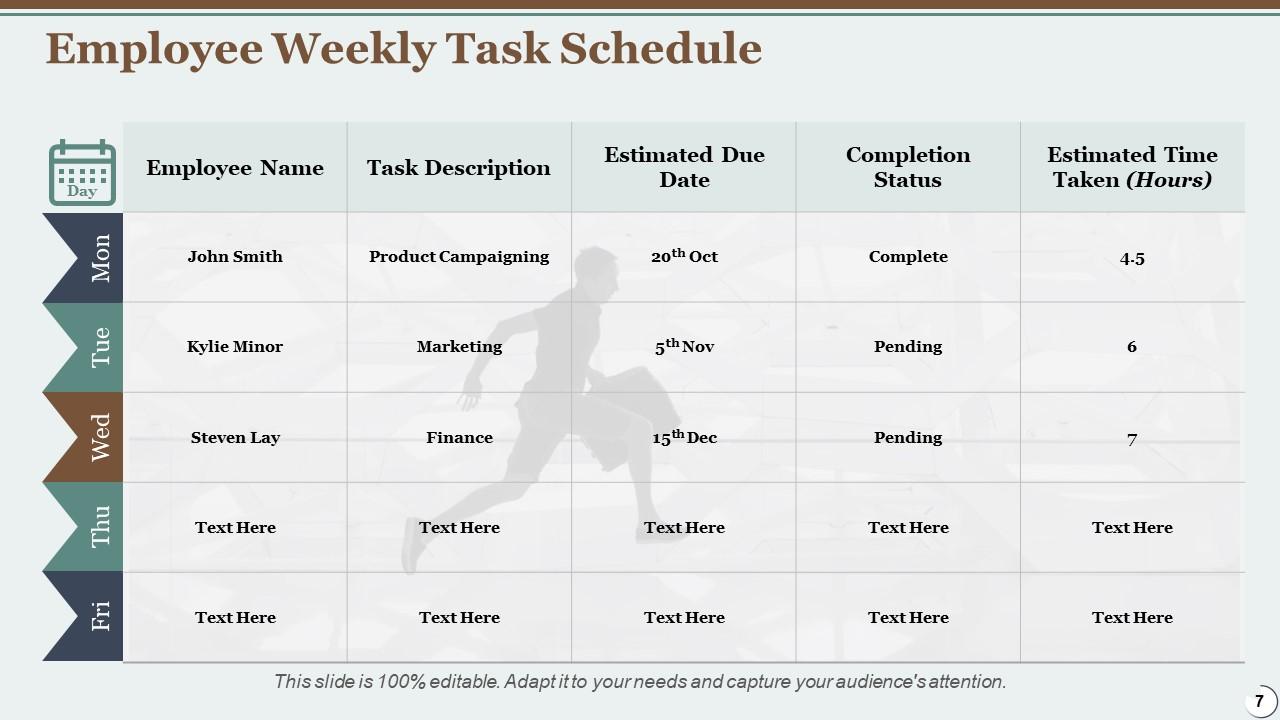
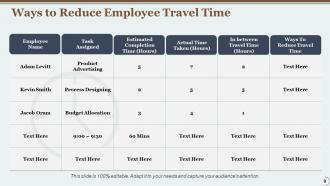
Having a weekly task schedule can really help employees manage their work effectively. By seeing all their tasks laid out for the week, they can focus on what needs to be done first based on deadlines, importance, and urgency. This helps ensure that critical work gets completed on time. The schedule includes details like employee name, task description, due date, completion status, and time taken. Having this schedule keeps employees focused, productive, and organized throughout the week, and this PPT Layout will help you implement this technique.
Template 3: Workload Prioritization Chart
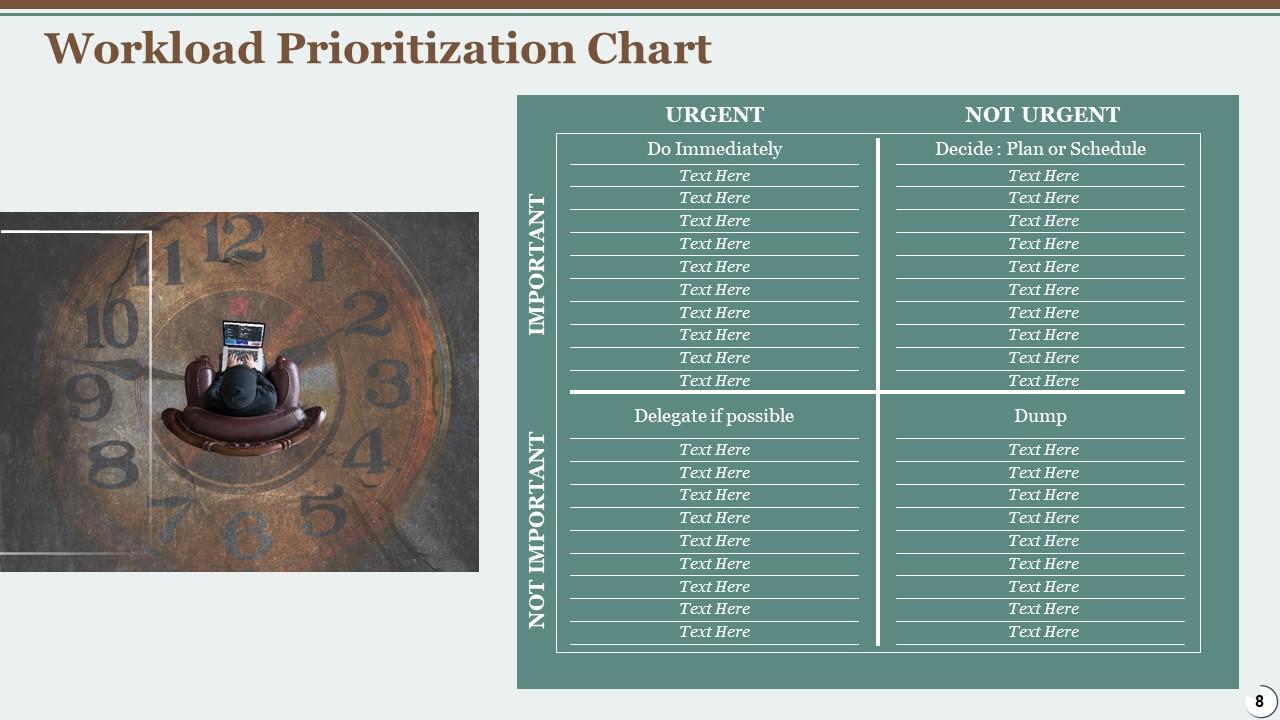
This PowerPoint Slide is essential for time management as it helps employees to focus their efforts on tasks that are both urgent and important and avoid overburdening them while doing less important tasks. Using this presentation layout, you can categorize tasks into urgent, important, not urgent and not important, individuals can efficiently and effectively allocate their time. A workload prioritization chart highlighted in this PPT Layout promotes decision making regarding whether tasks should be delegated or eliminated altogether.
Template 4: Time Utilization Analysis
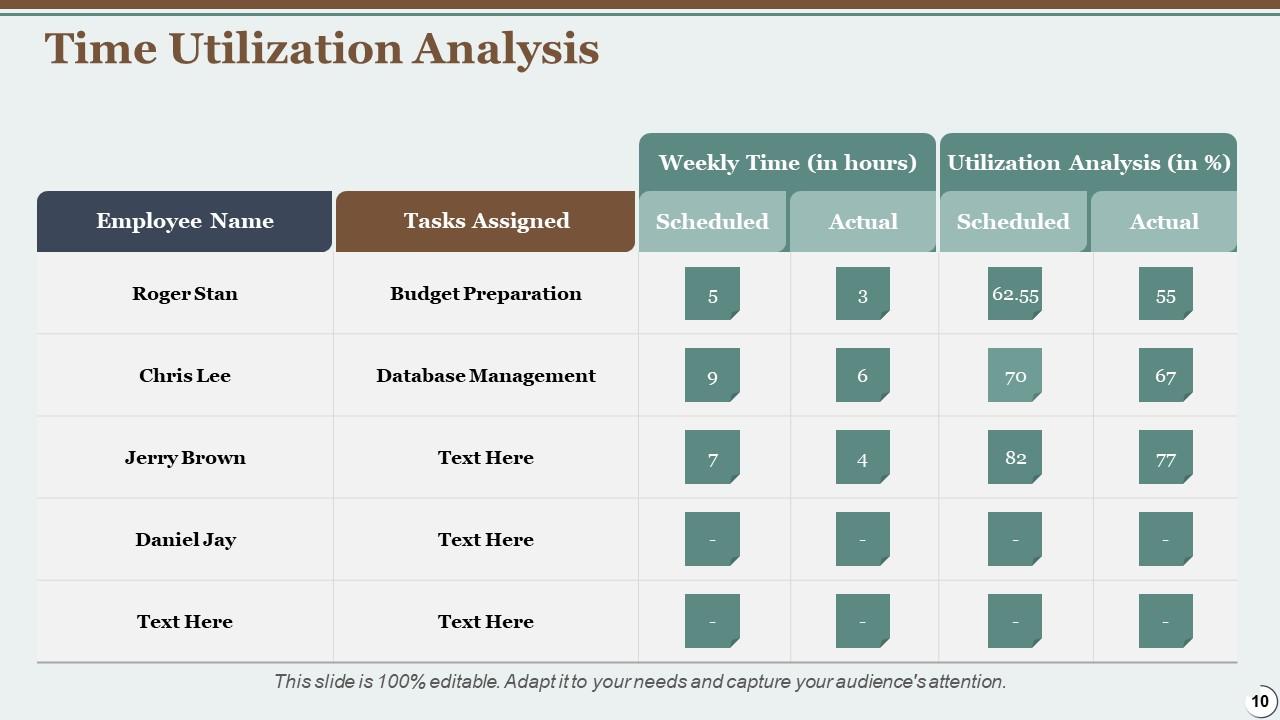
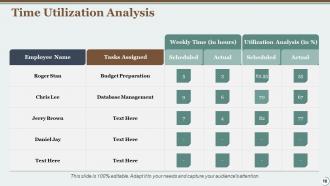
Time utilization analysis provides valuable insights that enable employees and businesses to make educated decisions about managing their time, leading to increased productivity. The table showcased in this presentation slide highlights columns like employee name, tasks assigned, weekly time, and utilization analysis. It also included scheduled time and actual time taken to complete a task.
Template 5: Workplace Breaks Criteria Table
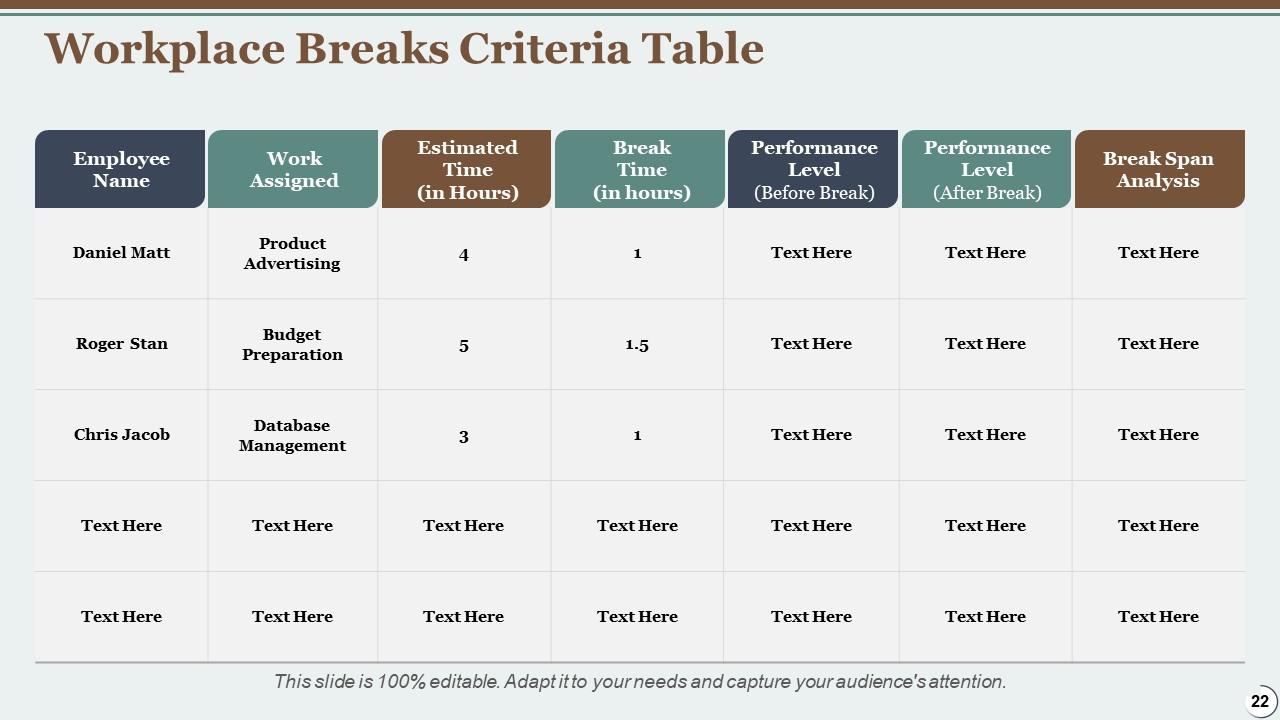
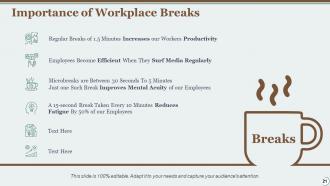
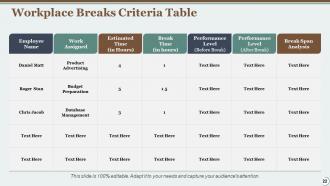
This PowerPoint Template is important for effective time management as it provides a structured approach to calculate employee productivity and monitor well-being. It includes employee names, assigned tasks, estimated times, break durations, and performance levels before and after breaks. This enables HR managers to identify patterns, optimize workloads, and ensure employees take the required breaks for optimal performance. Breaks during work hours are valuable for balancing productivity as they freshen the mind and boost morale in the workplace.
Template 6: Employee Timesheet
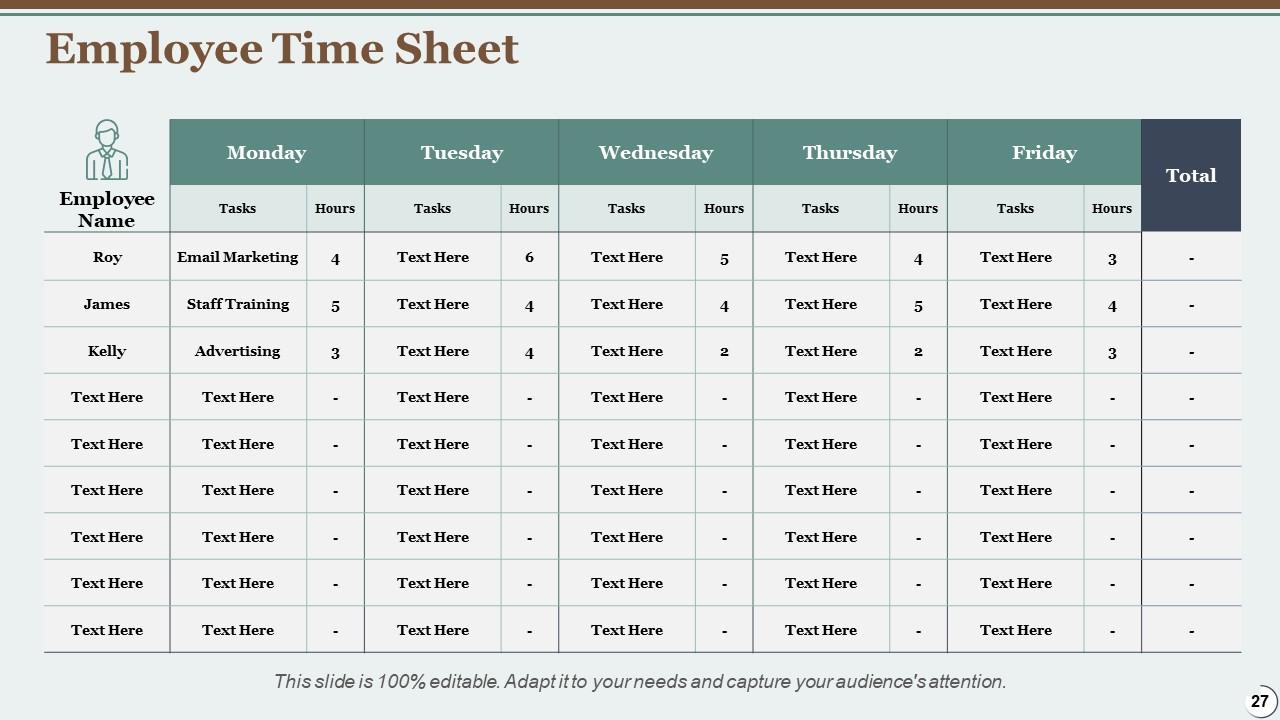
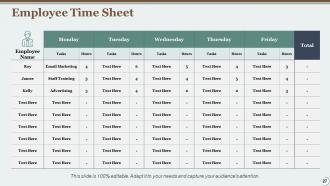
Timesheets give information on resource allocation, productivity levels, and project progress. They help with budgeting, billing clients correctly, and finding process improvement or optimization opportunities. This PPT Preset emphasizes the employees' names as well as the time it takes to execute specific jobs. You can also mention several duties, including email marketing, staff training, and advertising. This assists managers with staff planning, job prioritization, and performance evaluation.
Template 7: Goals and Task Prioritization
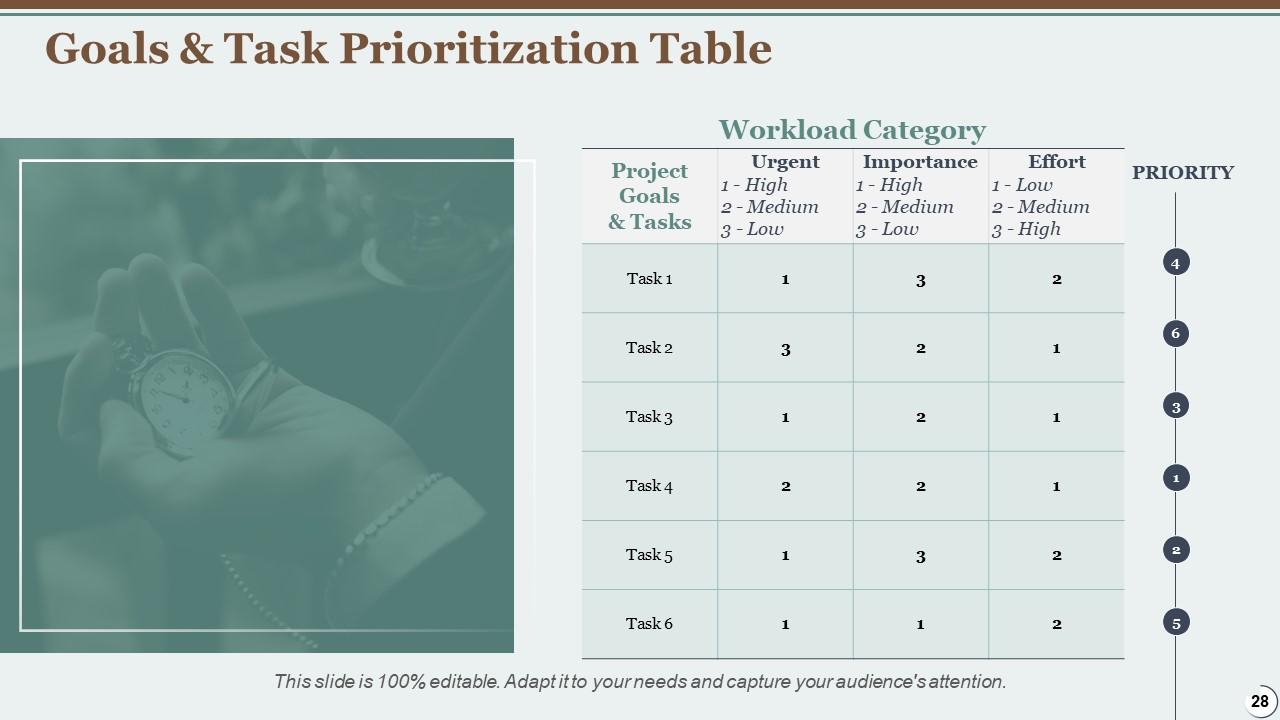
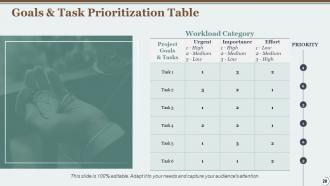
This PPT Layout highlights the project goals and workload category. Teams can accomplish specific objectives by explicitly identifying goals, which ensures concentration and direction. Prioritizing activities based on urgency, relevance, and work required enables teams to deploy resources more efficiently, optimize time management, and meet deadlines successfully.
Template 8: Employee Time Management Evaluation Chart
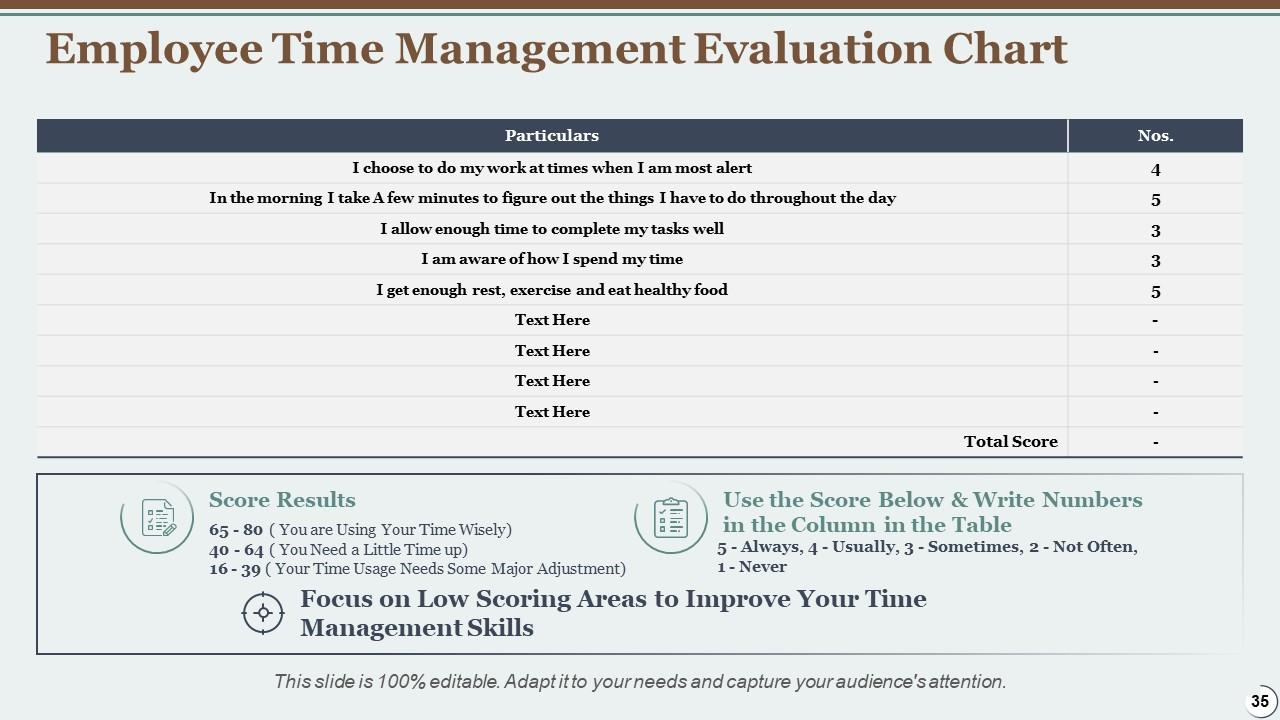
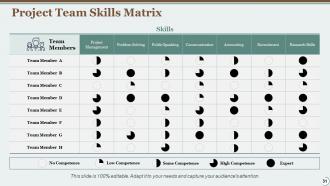
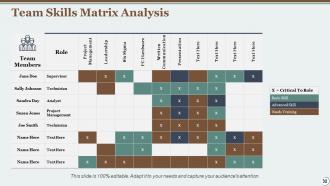
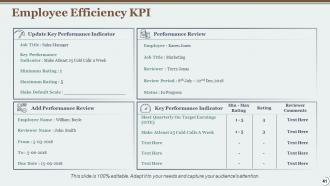
The Employee Time Management Evaluation Chart offers a systematic approach to evaluating how workers manage their time, pinpointing areas that require development and strengths. This chart showcases particulars and score results. It helps managers and HR managers to evaluate the employees' strengths and areas of improvement. This makes it easier to carry out focused developmental and training initiatives that increase output and effectiveness.
Template 9: Labour Effectiveness Dashboard
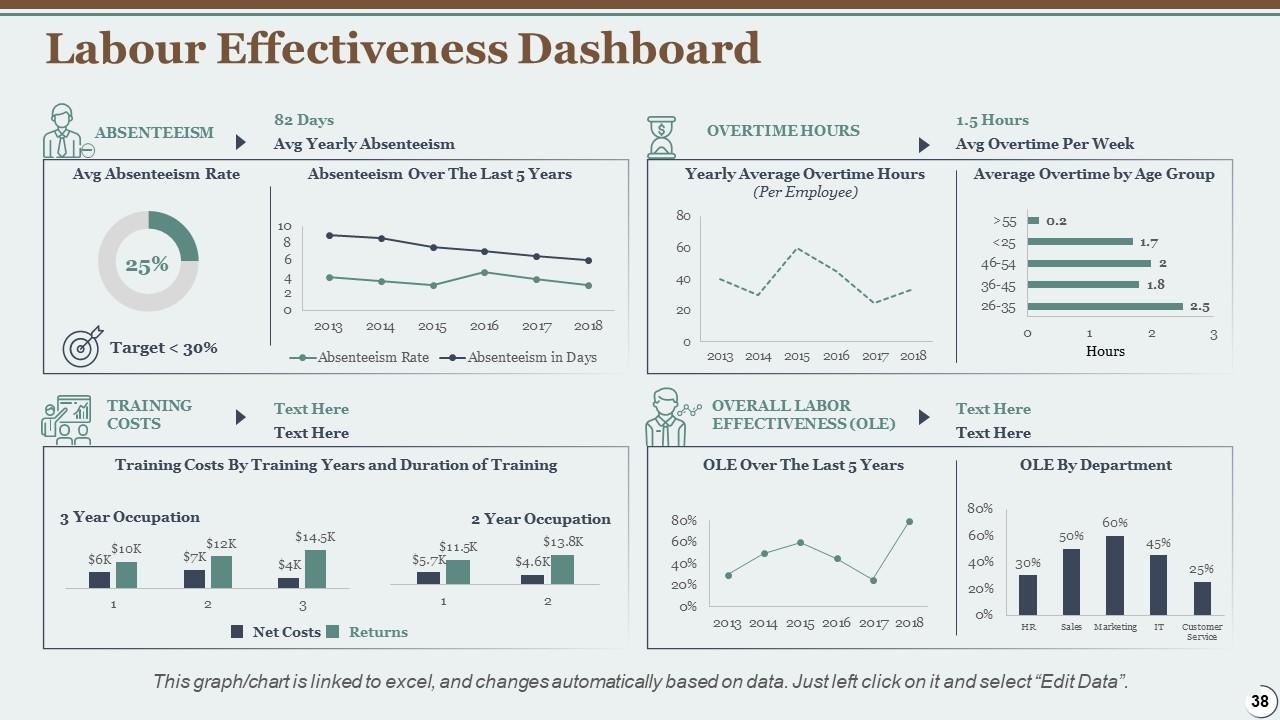
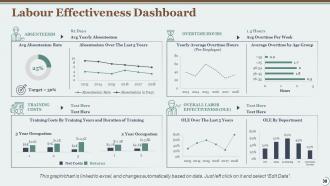
The value of a labor effectiveness dashboard is found in its capacity to offer a thorough summary of workforce performance indicators that are essential for maximizing output and effectiveness. Pie charts and graphs are used in this dashboard to provide graphical representations of variables like training expenses, overtime hours worked, and absenteeism. This provides insights into work utilization and resource allocation. Managers can employ it to spot trends, patterns, and areas that need development, which helps them make well-informed decisions that will increase worker productivity. It gives businesses the ability to maximize production, save expenses, and simplify operations.
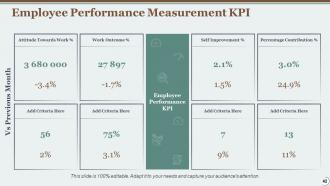
Template 10: Employee Performance Measurement KPI
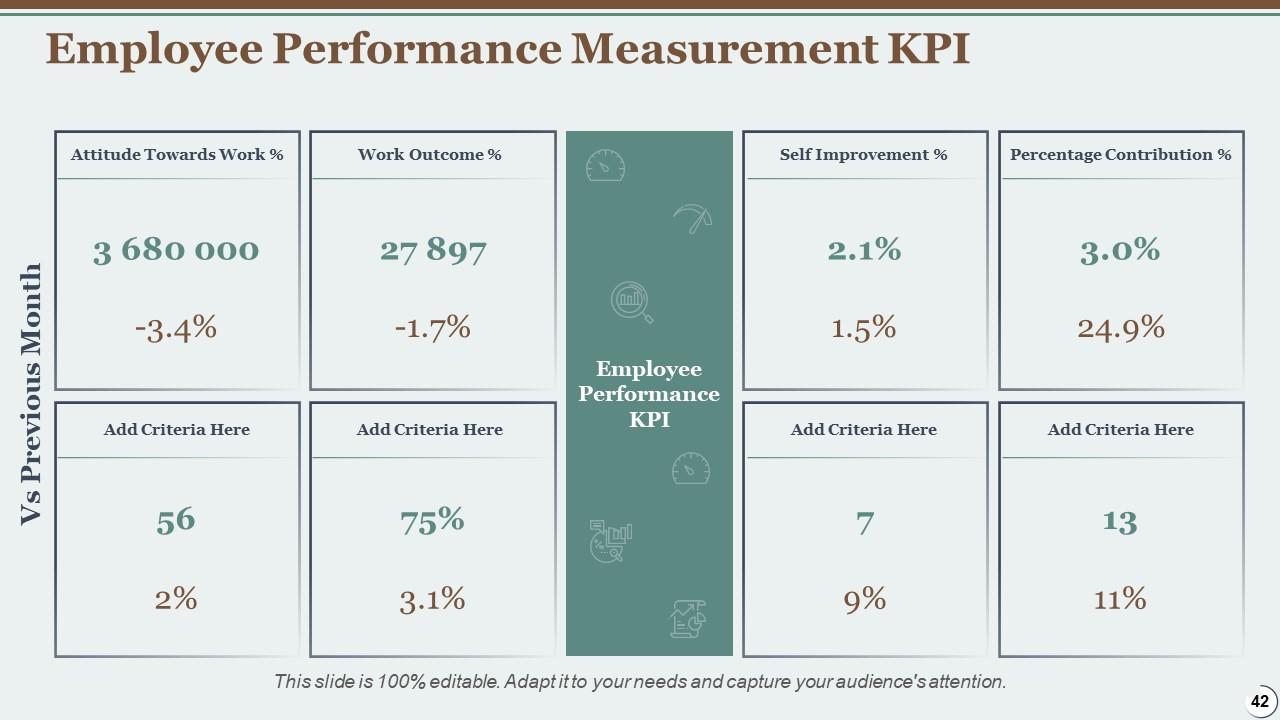
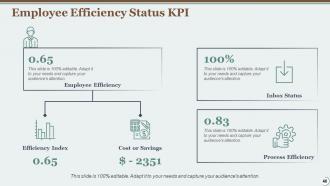
After implementing time management practices in your organization, tracking employee performance in its light is an important responsibility upon the management. With this presentation slide you can track and report data on metrics like employee attitude toward work%, work outcome%, self improvement%, etc compared to previous month. Thus, you can generate a comprehensive employee performance report considering these parameters.
Compose effective employee performance reports with our ready-to use-presentation templates
Take Control of Your Schedule
Time management is crucial for success in personal and professional endeavors. Only after implementing proven time management strategies and procedures, can we boost productivity, reduce pressure, and achieve our objectives with greater ease. Using this content-rich toolkit of time management PowerPoint Presentation, defining clear priorities, reducing distractions, and using time-saving tools and technology are other topics that should be brought to your team's attention.
Time Management Powerpoint Presentation Slides with all 60 slides:
Use our Time Management Powerpoint Presentation Slides to effectively help you save your valuable time. They are readymade to fit into any presentation structure.








FAQs for Time Management
Honestly, start by tracking your time for a week - you'll probably hate what you discover lol. After that, focus on three things: figure out your priorities, block off chunks of time for specific work (way better than random to-do lists), and get comfortable saying no to stuff that doesn't matter. Most people work best in the mornings when their energy's high. I'm weird and prefer late nights, but whatever works for you. Oh, and boundaries around meetings are crucial - they'll eat your whole day if you let them.
Honestly, templates are lifesavers. You're not sitting there staring at blank slides anymore - just drop your content into the timeline, deliverables, milestone sections. Formatting used to eat up half my day, which was ridiculous. They actually make you think through everything upfront too, so you'll catch scheduling issues or resource problems before they bite you. Your stakeholders get the same clean format each time. Find one that fits how your projects usually run and tweak it once. Then you're set.
Okay so I've been using the Eisenhower Matrix lately - basically you sort stuff by urgent vs important. Game changer honestly. Also try time-boxing your biggest tasks first thing in the morning. There's this 1-3-5 rule too: pick one big thing, three medium tasks, five small ones for your day. Works pretty well most days (though sometimes I totally ignore my own system lol). For everything else, I just ask myself "what actually happens if this doesn't get done today?" Usually the answer is... not much. Write it all down first, then be ruthless about what actually matters vs what just feels urgent.
Dude, visual aids are a game changer for time management. Like, instead of staring at a boring spreadsheet, you can actually *see* where your hours disappear. Pie charts showing planned vs. actual time? Mind-blowing stuff. Your brain just processes visual info way faster than text - probably some evolutionary thing or whatever. I made a simple timeline for my last project and immediately spotted where I was wasting time on stupid stuff. Graphs make it super obvious when you're overcommitting or missing gaps in your schedule. Honestly wish I'd started doing this years ago.
Honestly, tech is like having a personal assistant that doesn't judge you for procrastinating. Start with just one app - I'd go with a basic calendar or task manager. Don't download every productivity app in existence (been there, regretted that). The good stuff happens when you automate the mindless tasks like scheduling and reminders. Website blockers are clutch for staying focused. My time-tracking app has become weirdly addictive - probably says something about my personality lol. Project management tools handle all the boring organizational stuff so your brain can actually do the real work instead of remembering random details.
Honestly, SMART goals saved my butt with time management. You know how you used to set goals like "get better at presentations"? Yeah, that was my problem too - way too vague. Now I write stuff like "practice one 10-minute presentation weekly for the next month." Makes all the difference because suddenly you know exactly what to block out in your calendar. The measurable and time-bound parts are game changers. Instead of just hoping things work out, you're actually estimating realistic timeframes. Take whatever big goal you're struggling with and try breaking it down SMART-style - you'll instantly see what time commitment you're really looking at.
Honestly, I'd start with something simple like Toggl or just a basic notebook. Apps like RescueTime are cool because they track everything automatically, but sometimes it feels weird knowing it's watching your every move, you know? Manual logging works too - just write down what you did every hour or so. Oh, and the Pomodoro thing is pretty solid since you're naturally checking in every 25 minutes anyway. Pick one method and stick with it for a week. Then look back at your data to see where all your time actually went. You'll probably be surprised by what you find!
Honestly, delegation is like having superpowers for your workload. You get to hand off stuff to people who are probably way better at it than you anyway. Start with smaller, less critical tasks first - builds trust without the stress if something goes sideways. The trick is being super clear about what you want and when you need it. Otherwise you'll end up micromanaging the whole thing, which defeats the point entirely. Once you nail it though, you're free to tackle the big-picture stuff that actually matters. Your team gets to shine at what they're good at, and you don't burn out trying to do everything yourself.
Oh man, I'm literally the worst at this but here's what I've learned: Stop saying yes to everything first. Seriously, overcommitting is like relationship poison but for your calendar. Write down 3 main things each morning before diving into emails - sounds basic but it actually works. Task switching kills me every time. Instead of bouncing around, try batching similar stuff together. Like, do all your calls back-to-back instead of scattered throughout the day. And honestly? Stop checking Slack every two seconds. People survived before instant notifications, we'll be fine waiting an hour to respond to non-urgent garbage.
Start with just 2-3 focused 25-minute blocks for your biggest tasks. Morning works best for me since I'm basically useless after 2pm lol. Put these in your calendar like actual meetings, then use the 5-minute breaks for coffee runs or stretching. Phone goes on silent - this part's crucial. Close those random tabs you don't need. After four cycles, take a longer break (15-30 minutes). Don't go crazy at first though. Begin with one or two sessions daily, then add more once it feels natural. The whole thing falls apart if you try doing too much right away.
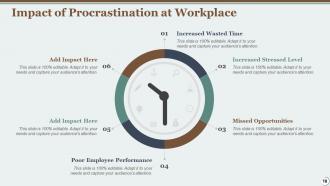
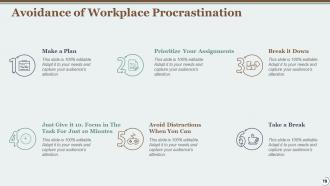
Ugh, procrastination is the worst for time management - you end up with this massive pile of stuff to do and everything becomes urgent. I swear I've spent entire mornings organizing my bookshelf instead of starting actual work. What helps me is chopping big projects into tiny pieces and doing them early when I'm not brain-dead yet. Also set mini-deadlines for yourself, not just the final one. Honestly, the hardest part is just starting. Even doing like 10 minutes breaks the spell somehow and you'll usually keep going.
Okay so first thing - write down all the stuff you absolutely can't move, work and personal. Then treat your personal time like actual appointments. I'm serious, put "gym" or "dinner with mom" on your calendar like it's a client call. You'll need wiggle room though because let's be honest, we're all terrible at estimating how long things take. Leave gaps between stuff so when work gets crazy you're not completely screwed. Time-blocking saved my sanity but it took me like two weeks to figure out what actually worked for my schedule.
Time-blocking seriously changed everything for me. You basically assign chunks of your day to specific tasks instead of just winging it. Sounds boring, I know, but it actually cuts way down on that mental exhaustion from constantly deciding what to do next. Plus you're not jumping between totally different types of work all day. I was skeptical at first too - thought it'd feel too scheduled. But honestly? It's less stressful because you can actually see when stuff will get done. Try just blocking your mornings for focused work first and see how it goes.
Dude, mindfulness is honestly a game-changer for time management. You start catching yourself when you're doom-scrolling Instagram instead of doing actual work. It helps you focus on one thing at a time rather than juggling five tasks badly. But here's the real magic – you'll pause before automatically saying yes to random requests. Like, you actually think "does this matter to me?" Pretty revolutionary, I know. Oh, and try doing a quick breathing thing before you look at your calendar each morning. Sounds weird but it works.
Looking back at your week shows you the gap between what you think you're doing vs reality. I thought I was amazing at time estimates until I actually started tracking - wow, was I wrong! You'll catch stuff like tasks that always run long or your peak energy hours. Friday check-ins work great - just 10 minutes to spot what went well and what flopped. Then you can ditch the time-wasters and focus more on what's actually working. It's honestly kind of addictive once you start seeing the patterns.
-
Appreciate the research and its presentable format.
-
Appreciate the research and its presentable format.
-
Awesome
-
Nice presentation
-
Nice presentation