

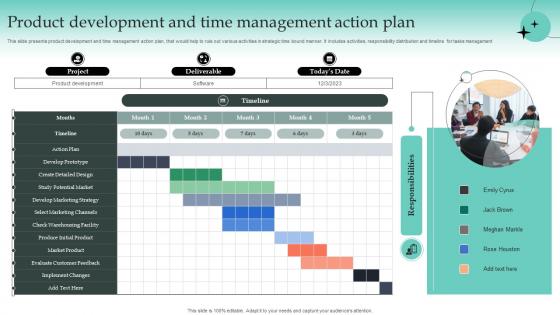
Product Development And Time Management Action Plan




Try Before you Buy Download Free Sample Product
 Impress Your
 Audience
 100%
100% Editable
 Save Hours
 of Time


This slide presents product development and time management action plan, that would help to rule out various activities in strategic time bound manner. It includes activities, responsibility distribution and timeline for tasks management.
People who downloaded this PowerPoint presentation also viewed the following :
Product Development And Time Management Action Plan with all 6 slides:
Use our Product Development And Time Management Action Plan to effectively help you save your valuable time. They are readymade to fit into any presentation structure.





FAQs for Product Development And Time
Honestly, it comes down to three big things: communication, your setup, and having a decent manager. Talk to your team way more than you think you need to - being annoying is better than everyone wondering if you've disappeared. Get your workspace dialed in too: good lighting, comfy chair, somewhere you won't get interrupted every five minutes. Your boss needs to actually trust you instead of breathing down your neck constantly (which is the worst when you're remote). Oh, and set some boundaries so work doesn't take over your entire life. I'd start by figuring out which area is most broken for you right now.
Honestly, good templates are game-changers for meetings. Everyone knows what they're supposed to cover, so you're not wasting time wondering how to structure things. Short updates instead of those painful 20-minute rambles that go nowhere. When your whole team uses the same format, comparing ideas becomes so much easier - you can actually make decisions faster. Templates force people to be concise too, which is huge. I'd start with maybe 2 templates for whatever meetings you do most. Trust me, you'll see the difference pretty quickly. Way less chaos, more actual productive discussion.
Honestly, good time management is like having a superpower for productivity. When you figure out what actually matters and ditch the busywork, you suddenly have way more time for the stuff that counts. I used to think being swamped meant I was crushing it - totally wrong lol. The magic happens when you batch similar tasks and guard your focus time like it's precious (because it is). Deadlines stop being panic-inducing nightmares. You'll actually finish projects instead of just spinning your wheels. Start with time-blocking your calendar for your biggest priorities this week and see what happens.
Dude, visuals are seriously game-changing for training stuff. People remember like 65% more when you throw in charts or graphics instead of just droning on with text. Our brains are wired to process images way faster anyway. Honestly, I've sat through so many boring presentations that were just endless bullet points - total snooze fest. Break things up with at least one visual per main point you're making. Even simple diagrams work. It gives people different ways to absorb the same info, and they'll actually retain what you taught them instead of forgetting everything by lunch.
Yeah, feedback is huge for productivity. Without it, people are basically wandering around hoping they're doing things right. I've seen teams waste weeks on stuff that could've been fixed with a quick "hey, try this instead." Regular check-ins work way better than those awful quarterly reviews - honestly, who remembers what happened three months ago? Weekly touchpoints let you catch problems early. People actually work harder when they know you're paying attention to what they're doing. Just make sure you're specific about what's working and what isn't. Saves everyone a ton of headaches later.
Start with something small that's driving you crazy right now - maybe data entry or chasing down project updates. Tools like Zapier can connect your apps so stuff moves automatically instead of you copying and pasting all day. For project tracking, Asana or Monday are solid - way better than those soul-crushing weekly meetings where nothing actually gets decided. Oh, and get everyone on shared docs in the cloud. Trust me, the whole "email me your changes" thing is such a time waster. Once people see how much smoother things run, they'll actually want to automate more stuff.
Dude, ergonomics is actually kind of a game changer - can bump your productivity up like 15-20%. Your body isn't fighting against you all day when everything's positioned right. No more constant fidgeting or that awful neck crick that kills your concentration. Monitor at eye level, feet flat on the floor - start there. I swear those two things alone help immediately. Used to think it was all about expensive chairs (which, fair, good chairs are nice) but honestly the simple stuff matters more. You won't hit that brutal 2pm energy crash as hard either.
So the Eisenhower Matrix is this four-box thing that'll save your sanity. You drop tasks into: urgent + important, important but not urgent, urgent but not really important, and total garbage. Here's the thing - most of us get stuck doing "urgent but pointless" stuff all day. Like responding to every Slack message instantly or sitting through meetings that could've been emails (ugh). The sweet spot? That "important but not urgent" box where your actual meaningful work hangs out. Honestly, just try it tomorrow and watch how much fake busy work disappears.
Okay so when things get messy, don't disappear on your team - that's literally the worst thing you can do. Be straight up about what's happening but also call out the wins, even tiny ones. People need to know their work actually matters, you know? I'd do weekly check-ins where you tackle problems head-on and give shoutouts to individuals publicly. Let them have some say in how they approach their tasks too. Oh, and catch burnout before it spirals - way easier to prevent than fix later. The whole transparency thing really works when you balance the bad news with genuine progress updates.
Dude, workspace design is actually huge for getting stuff done - like 15-25% performance differences according to studies I've read. Start with lighting and noise control first, they're game changers. Temperature matters too, obvs. Plants everywhere for creativity (I'm lowkey obsessed with mine now). You want open, inspiring spaces but also quiet zones where you can actually focus. Oh, and collaborative areas are clutch for bouncing ideas around. Honestly, just fixing the lighting alone will make you feel way more human during those long work sessions.
Honestly, clear goals are like giving your team GPS instead of just saying "drive somewhere nice." People work way better when they actually know what they're aiming for and when stuff needs to get done. I've watched teams spin their wheels for weeks because nobody clarified the target. Deadlines help too - creates that good kind of pressure where people stop procrastinating. Break big projects into chunks with mini-deadlines if you can. Your team won't be constantly asking "so... what exactly are we doing here?" Trust me, the clarity makes everything smoother.
Look, your brain literally can't function at full capacity without breaks - I found this out the hard way during that nightmare project last year. You'll hit a wall where you're just spinning your wheels and making dumb mistakes. Honestly, people who brag about never taking time off are probably getting half as much done as they think. Short bursts work way better than grinding 24/7. Plus your creativity goes to shit when you're exhausted. I know it feels weird to step away when deadlines are breathing down your neck, but trust me - set some boundaries or you'll burn out completely.
So basically, mindfulness trains your brain to notice when you're getting distracted and snap back to what you're doing. I swear it actually works - you'll catch yourself before you fall down some random internet rabbit hole. The mental noise quiets down too, which is huge because that's what makes you feel crazy busy while getting nothing done. Oh, and you become way better at reading your own energy levels. Like knowing when you're actually sharp vs. just pretending to be. Try doing 5 minutes of breathing exercises before you start working. Sounds weird but it's like hitting reset on your brain.
Honestly, start with something simple like RescueTime or Toggl just to see where your time actually disappears to - it's always shocking. Then grab a basic task manager like Todoist or Notion. I'm totally guilty of downloading like 20 productivity apps and using none of them properly. Forest is pretty cool for focus though, does that whole Pomodoro thing. But seriously, don't go crazy with apps. Pick maybe 2-3 max and stick with them for at least two weeks before deciding they suck. Otherwise you'll just waste time switching between tools instead of actually getting stuff done.
Track the obvious stuff first - project completion rates, sales figures, customer satisfaction scores. Compare before and after you roll out flexible schedules. But don't sleep on the softer metrics either. Survey your team about stress levels and work-life balance every few months. Sick days and turnover rates tell a story too. Oh, and definitely get baseline measurements before changing anything - learned that one the hard way. Give it 6-12 months of consistent tracking. Quarterly check-ins work well for seeing what's actually moving the needle.
-
I discovered some really original and instructive business slides here. I found that they suited me well.
-
I was mind-blown by the services that SlideTeam provided me. Thanks a ton!