


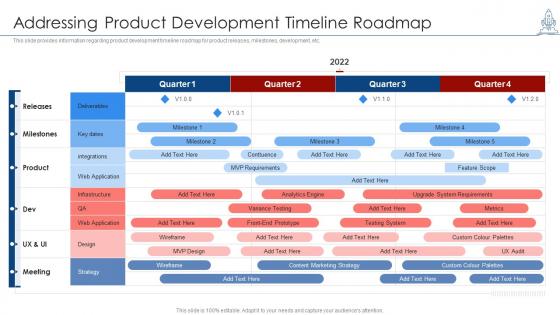
Product development timeline roadmap managing product launch




Try Before you Buy Download Free Sample Product
 Impress Your
 Audience
 100%
100% Editable
 Save Hours
 of Time


This slide provides information regarding product development timeline roadmap for product releases, milestones, development, etc.
People who downloaded this PowerPoint presentation also viewed the following :
Product development timeline roadmap managing product launch with all 6 slides:
Use our Product Development Timeline Roadmap Managing Product Launch to effectively help you save your valuable time. They are readymade to fit into any presentation structure.





FAQs for Product development timeline roadmap
So there's four main phases you'll go through: discovery, planning, development, and launch. Discovery is where you research what users actually want and test if your idea makes sense. Planning gets into the weedy stuff - requirements, timelines, feature mapping. Fair warning though, this part always drags on way longer than expected. Development is obviously the building phase with lots of testing and tweaking as you go. Launch covers your go-to-market stuff plus keeping an eye on how things perform after. Don't think of these as strict checkboxes - they overlap and you'll bounce between them. Maybe map your current project against these to spot any missing pieces?
So basically, market research shows you what to build next instead of just guessing what users want. Surveys, competitor analysis, usage data - all that stuff reveals the real pain points. I've watched entire teams scrap their roadmap when they realized users desperately needed performance fixes, not some fancy new feature the devs were pumped about. Look for the sweet spot: high demand but easy to build. Those are your quick wins. Trust me, data beats gut feelings every time, even though it's way less fun than building cool stuff you personally want.
ProductPlan and Aha! are solid for roadmaps - they handle timelines really smoothly. Though honestly, I've watched teams crush it with just Notion or Figma if you're more visual. Already using Jira? Their roadmap thing is decent enough. The real trick is finding something everyone will actually touch regularly instead of letting it gather dust. Grab the free versions of like 2-3 tools and throw your real roadmap at them. You'll know pretty quick what feels right. Oh, and don't get caught up making it perfect - better to have something slightly messy that stays updated than a beautiful ghost town.
Start with scoring features against your main business goals - revenue, retention, that kind of stuff. I make a basic effort vs impact matrix, though estimating effort is always a nightmare tbh. Customer data should drive most calls, but don't forget technical debt (boring but necessary). Dependencies matter too - some features unlock others. Being upfront about your criteria helps when stakeholders inevitably complain. Oh, and write down why you scored things the way you did. Trust me, you'll need it when someone asks "why didn't we prioritize feature X instead?" three months later.
User feedback is honestly everything for your roadmap. Collect it through surveys, support tickets, interviews - whatever works. The tricky part? Power users are loud but they're not always representative of everyone else using your product. I learned this the hard way lol. Analytics help you see what quiet users actually do versus what they say. Set up regular team reviews to go through all this stuff and don't just collect feedback - actually tell people how you used their input. That's what keeps them engaged and giving you more honest thoughts.
Honestly, the biggest thing is just getting everyone to actually talk instead of hiding in their departments. Set up weekly check-ins where each team shares what they're doing and what's blocking them - saves you from those "oh shit, you needed this when?" disasters. Everyone needs to get the big picture and where they fit in. Slack channels or shared project boards help too, though let's be real, some people will still never check them. But definitely pick someone to make final calls on decisions - nothing's worse than five people arguing in circles about the same thing for weeks.
Track both leading and lagging indicators - stuff like sprint completion rates, story points, and delivery timelines. Customer metrics are huge too: user engagement, feature adoption, beta feedback scores. But honestly, don't go overboard with dashboards. I've watched teams get completely buried in data paralysis. Bug rates and technical debt matter since they'll slow you down later. Team satisfaction is underrated but critical. Keep it simple - maybe 5-7 key metrics on a weekly dashboard that you actually review with the team religiously.
Quarterly minimum, but monthly's better if you can pull it off. Things move way too fast now - customer needs shift, competitors launch stuff, your last release teaches you something new. I learned this the hard way when we stuck to our annual plan and got totally blindsided by a startup that moved faster than us. Short bursts work better than long planning sessions anyway. Just don't change direction every week or your team will lose their minds. Set up a monthly check-in and actually show up to it. Trust me, beats scrambling when everything goes sideways.
Honestly, don't pack too much into your timeline - that's where most people mess up. Build in buffer time because stuff always takes longer than expected. Get input from your engineering team and actual customers early on, not after you've already mapped everything out. I learned this the hard way when we spent forever on this gorgeous roadmap that was completely unrealistic. Focus on the big picture stuff instead of listing every tiny feature. Oh, and review it monthly or it'll become useless pretty fast. Flexibility is key since priorities shift constantly.
Work in sprints and keep reassessing based on what users actually tell you. Don't lock yourself into specific features months ahead - that's a recipe for disaster. Instead, set quarterly themes or big-picture goals, then break everything into 2-4 week chunks where you can pivot if something isn't working. My team wasted three months building a feature literally nobody used, so trust me on this one. Your roadmap should feel alive, changing every sprint rather than being set in stone. The trick is having clear metrics from day one so you'll know when to stick with something or completely change course. Way better than guessing what people want.
Honestly, just match your communication style to what each group actually wants. Executives? Give them high-level visuals with strategic outcomes and timelines. Engineering needs the nitty-gritty technical stuff with all dependencies mapped out. Sales and marketing teams absolutely love those colorful timeline charts - makes everything click for them. I'd mix regular stakeholder meetings with async updates through email or tools like ProductPlan. Consistency matters more than you think, so whatever cadence you pick, don't flake on it. Pro tip: just ask each group upfront how they want updates delivered. Saves so much back-and-forth later.
Yeah, product lifecycle is huge for roadmap planning. Early stage? You're basically throwing features at the wall to see what sticks and validate the market. Growth phase means you can go nuts with new stuff. But mature products - that's where I see teams screw up the most honestly. They keep building like it's still day one instead of focusing on optimization and staying ahead of competitors. Declining products are trickier... sometimes you gotta plan the sunset instead of dumping more money into features nobody wants. Figure out where you actually are first - saves you from making dumb prioritization mistakes later.
Honestly, most roadmaps are just wishful thinking because nobody connects them to actual business goals. Figure out what your company's really trying to do first - hit revenue numbers, keep customers around longer, whatever. Then work backwards from there. I'd do quarterly check-ins with leadership since priorities shift constantly (learned this the hard way). Focus on business metrics, not just product stuff. When budget cuts come - and they will - you'll know exactly what to protect and what can wait. Oh, and treat it like a Google Doc, not stone tablets. Things change way too fast to be rigid about it.
Yeah, external stuff will absolutely wreck your roadmap if you're not watching. Market shifts can make your features pointless overnight. Competitors drop something new and suddenly you're scrambling to reprioritize everything. I've watched teams grind for months on features that became irrelevant - honestly painful to see. Build in flexibility from day one. Check external signals regularly and don't be afraid to axe features that stopped making sense. Do quarterly reviews where you actually look at these pressures and decide what stays. Sometimes killing a feature feels wrong but it's usually the smart move.
Set up a proper change process where people have to fill out impact forms first - timeline, budget, all that stuff. Most requests die right there, which is honestly great. Hold regular meetings to review changes as a group instead of random hallway conversations. Keep a prioritized backlog so when someone wants new features, you can show them what gets pushed out. The "why" documentation is clutch too - you'll forget the reasoning behind decisions way faster than you think. Oh, and make stakeholders use a formal template. Sounds bureaucratic but it actually saves your sanity.
-
Top Quality presentations that are easily editable.
-
Out of the box and creative design.