


POC Timeline For New Software Development





Try Before you Buy Download Free Sample Product
 Impress Your
 Audience
 100%
100% Editable
 Save Hours
 of Time


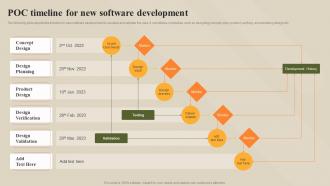
The following slide depicts the timeline for new software development to visualize and validate the idea. It constitutes of activities such as designing concept, plan, product, verifying and validating design etc.
People who downloaded this PowerPoint presentation also viewed the following :
POC Timeline For New Software Development with all 6 slides:
Use our POC Timeline For New Software Development to effectively help you save your valuable time. They are readymade to fit into any presentation structure.





FAQs for POC Timeline For
Point-of-care testing really took off with glucose strips back in the '60s. Pregnancy tests came next in the '70s - game changer for obvious reasons. Hospitals got blood gas analyzers in the '80s, then handheld cholesterol and cardiac devices showed up in the '90s. The 2000s brought rapid flu tests and early molecular stuff, but honestly COVID changed everything overnight. Suddenly everyone knew what a rapid antigen test was. Now there's AI integration and smartphone apps everywhere you look. My advice? Don't get caught up in all the bells and whistles. Pick something your team will actually use consistently - the coolest tech means nothing if it sits in a drawer.
POC development got crazy fast once digital health kicked in - we're talking years of acceleration. Now devices shoot results straight to medical records and run analytics in the cloud. Some even do AI diagnostics, which honestly blows my mind. The biggest shift? These aren't standalone tools anymore. They plug into entire health systems. Patients see results on their phones instantly, doctors monitor from anywhere, data moves everywhere seamlessly. Oh, and if you're working on any POC stuff - build in digital from the start. That ship has sailed on making it optional.
Honestly, the FDA approval stuff is brutal right now. You're trying to prove your device works accurately while making it simple enough for non-lab people to use - which is basically impossible lol. Reimbursement is a nightmare too since every region has different policies. Going global? Good luck with that - each country wants something totally different. Quality standards are all over the place depending on where you're selling. My biggest tip is to talk to regulatory people way earlier in development. Don't wait until you've already built everything like most people do.
Dude, POC testing is a game changer for remote areas. No more shipping samples to labs and waiting forever for results - you can literally diagnose and treat people on the spot. Patients in rural areas sometimes drive hours just to reach a clinic, so making them come back multiple times? That's brutal. With rapid results, you catch serious stuff faster and keep people actually engaged in their treatment. Plus you can tweak medications immediately if needed. Focus on getting POC tests for whatever conditions you see most - malaria, diabetes, whatever's common in your area. It's honestly one of the best investments.
So AI basically acts like super smart quality control for those point-of-care tests. It spots patterns in results and flags weird stuff that might trip up whoever's running the test. Most of the time you'll see it with image-based tests - like those lateral flow strips where it can catch really faint lines your eyes would totally miss. The algorithms get trained on huge datasets too, which cuts down on false positives and negatives. That's actually pretty clutch for making clinical decisions. Oh, and if you're ever looking at POC systems, definitely grill the vendors about their AI validation data.
So POC adoption is kinda pricey upfront - devices, training, all that. But here's the thing: you start saving money pretty quickly from faster diagnoses and shorter patient stays. Emergency departments love it because they can actually discharge people instead of waiting around for lab results all day. The biggest win though? You catch problems early before they turn into expensive disasters, plus you avoid a ton of unnecessary treatments. Most places I've seen hit their ROI around 2-3 years, so that's probably what you should plan for budget-wise.
So COVID basically turned POC testing into this massive priority overnight. Remember how you couldn't find rapid tests anywhere, then suddenly they were at every CVS? That whole mess exposed how useless our traditional lab system is during actual emergencies - like who has time to wait 3 days for results when people are spreading something contagious? Now everyone's throwing money at point-of-care devices. Not just for COVID stuff either, but diabetes, heart conditions, you name it. Honestly the funding opportunities right now are insane compared to what they were before 2020. Timeline expectations have totally shifted too.
So the big ones are glucose meters, pregnancy tests, COVID rapid tests, and strep tests. Blood pressure cuffs and cholesterol screeners are pretty much everywhere now too. COVID really changed everything - suddenly everyone wanted rapid tests for everything! You've got cardiac markers for heart attacks, flu/RSV combo tests, plus those urine strips for UTIs. Quick cholesterol checks are getting popular at pharmacies. The whole point is testing stuff that can't wait for lab results, you know? Focus on those main categories since they're like 80% of the market anyway.
Yeah so supply chain problems totally screw up POC test availability. Raw materials get delayed, manufacturing hits bottlenecks, distribution gets messy - it all adds up. Most POC devices need specialized parts from suppliers all over the world, which makes things worse. When demand spikes (hello COVID), manufacturing can't keep up and lead times get crazy long. Different countries have their own regulatory hoops too. Honestly, I'd work with multiple suppliers if you can. Keep some extra inventory around and bug your vendors regularly about potential delays - they usually know what's coming down the pipeline before you do.
CLSI has really good foundational stuff for POC testing - start there for the regulatory basics. AACC's webinars are decent too, though some can be a bit dry. Your state health department might have free resources worth checking out. When you buy equipment, companies like Abbott and Roche will train you on their specific devices anyway. Oh, and if you're looking for certification programs, AACC has those too - my coworker did one recently and said it was helpful. I'd honestly just start with CLSI since they cover everything broadly, then get device-specific training later.
So POC testing security basically comes down to a few layers you gotta think about. Modern devices usually have encrypted transmission and HIPAA-compliant cloud storage, which is good. But here's the thing - older devices can be sketchy with vulnerabilities, so audit those regularly. Your POC systems need to play nice with your EMR through secure integration. Role-based access controls are a must, plus proper audit trails for compliance stuff. Oh, and honestly? Always check that new POC devices actually meet your cybersecurity standards before rolling them out. Sounds obvious but you'd be surprised how often that gets skipped.
Apple's partnering with Cleveland Clinic on remote monitoring stuff, and Google's doing AI diagnostics with Mayo Clinic right at the bedside. Pretty cool actually. Amazon's taking a different approach - they're going after smaller regional hospitals instead of the big names. Smart move if you ask me. The main focus seems to be getting test results to show up instantly in EMRs and making the data sharing seamless. Oh, and when you're looking at POC vendors, definitely ask about their healthcare partnerships first. It's like a cheat code for figuring out who actually knows what they're doing with integration.
Dude, POC testing is a total game changer for personalized medicine. You get biomarker data, genetic info, drug metabolism results right at the bedside instead of waiting forever for lab results. Real-time adjustments to dosing and meds based on what's actually happening with your patient right now? Yeah, that's huge. The pharmacogenomic tests are getting way more practical too - definitely worth checking out. I mean, you're not working with some old snapshot of their condition anymore. You can switch up treatment protocols on the spot based on their actual biological response.
Trust is honestly the biggest hurdle you're gonna face. Communities get suspicious about rapid testing - they think lab tests are more accurate, plus there's all that historical baggage with medical institutions. Language barriers make everything worse too. Some people actually want the formal hospital vibe because it feels more "real" to them, which is kinda ironic. Your move? Find community leaders and healthcare workers who already have solid relationships there. They can do the heavy lifting on education and getting people comfortable with it. Way more effective than trying to convince people yourself.
Focus on sensitivity and specificity first - you want both above 95%. Run your POC tests alongside the regular lab work during the pilot (yeah, it's annoying but necessary). Track how much faster results come back and watch for user errors - keep those under 5%. Clinical concordance with your gold standard is huge too. Honestly, the documentation part is kind of a pain but future you will thank present you when regulators start asking questions. Oh, and don't forget turnaround time improvements - that's what'll actually make clinicians love it. Set these benchmarks before you start or you'll be scrambling later.
-
If you have visited their site and failed to find the products, try reaching the customer service because it will be the case that you didn't use the search bar well.
-
Innovative and Colorful designs.